Ch. 4 - Functional Anatomy of Prokaryotic and Eukaryotic Cells
Tortora - Microbiology: An Introduction 14th Edition
Tortora14th EditionMicrobiology: An IntroductionISBN: 9780138200398당신이 사용하는 게 아니라요?교과서 변경
4장, 문제 6

Compare and contrast the following:
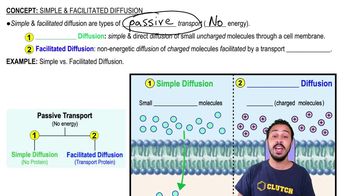
a. Simple diffusion and facilitated diffusion
b. Active transport and facilitated diffusion
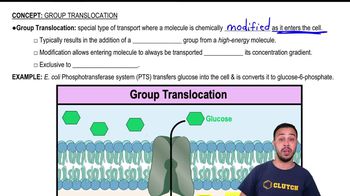
c. Active transport and group translocation

검증된 단계별 안내
1
Step 1: Define simple diffusion and facilitated diffusion. Simple diffusion is the passive movement of molecules from an area of higher concentration to an area of lower concentration directly through the phospholipid bilayer without the assistance of membrane proteins. Facilitated diffusion also moves molecules down their concentration gradient but requires specific carrier or channel proteins to help molecules that cannot easily cross the membrane on their own.
Step 2: Compare simple diffusion and facilitated diffusion by focusing on their mechanisms and specificity. Simple diffusion is non-specific and occurs for small, nonpolar molecules, while facilitated diffusion is specific to certain molecules and involves protein channels or carriers. Both processes do not require energy and move substances down their concentration gradients.
Step 3: Define active transport and facilitated diffusion. Active transport is the movement of molecules against their concentration gradient, from lower to higher concentration, using energy usually derived from ATP. Facilitated diffusion, as mentioned, moves molecules down their concentration gradient without energy input, using membrane proteins.
Step 4: Contrast active transport and facilitated diffusion by emphasizing energy use and direction of movement. Active transport requires energy and can move substances against their gradient, while facilitated diffusion does not require energy and only moves substances down their gradient. Both use membrane proteins but differ in energy dependence and directionality.
Step 5: Define group translocation and compare it with active transport. Group translocation is a type of active transport where the transported molecule is chemically modified during its passage across the membrane, often by phosphorylation, which helps retain the molecule inside the cell and prevents it from diffusing back out. Active transport generally moves molecules without chemically altering them. Both require energy and move substances against their concentration gradients.

비슷한 문제에 대한 검증된 영상 답변:

이 영상 해법은 위 문제에 도움이 된다고 튜터들이 추천한 것입니다.
영상 길이:
2m
도움이 되었나요?

주요 개념

질문에 올바르게 답하기 위해 반드시 이해해야 하는 핵심 개념들은 다음과 같습니다.

Simple Diffusion

Simple diffusion is the passive movement of molecules from an area of higher concentration to lower concentration directly through the lipid bilayer, without the need for energy or transport proteins. It typically involves small, nonpolar molecules like oxygen or carbon dioxide.
추천 영상:
가이드 코스
05:10
Simple and Facilitated Diffusion

Facilitated Diffusion

Facilitated diffusion is a passive transport process where molecules move down their concentration gradient through specific transmembrane proteins, such as channels or carriers. It does not require energy but allows larger or polar molecules to cross the membrane.
추천 영상:
가이드 코스
05:10
Simple and Facilitated Diffusion

Active Transport and Group Translocation

Active transport uses energy, often from ATP, to move molecules against their concentration gradient via transport proteins. Group translocation is a specialized active transport in bacteria where the transported molecule is chemically modified during entry, trapping it inside the cell and aiding metabolism.
추천 영상:
가이드 코스
03:37
Group Translocation
관련 실천
교과서 질문

Which of the following is false about fimbriae?

a. They are composed of protein.

b. They may be used for attachment.

c. They are found on gram-negative cells.

d. They are composed of pilin.

e. They may be used for motility.

1540
views

교과서 질문

Answer the following questions using the diagrams provided, which represent cross sections of bacterial cell walls.

a. Which diagram represents a gram-positive bacterium? How can you tell?

b. Explain how the Gram stain works to distinguish these two types of cell walls.

c. Why does penicillin have no effect on most gram-negative cells?

d. How do essential molecules enter cells through each wall?

e. Which cell wall is toxic to humans?

1339
views
교과서 질문

Which of the following statements best describes what happens to a cell exposed to polymyxins that destroy phospholipids?

a. In an isotonic solution, nothing will happen.

b. In a hypotonic solution, the cell will lyse.

c. Water will move into the cell.

d. Intracellular contents will leak from the cell.

e. Any of the above might happen.

1392
views
교과서 질문

Use the following choices to answer the following question.

a. No change will result; the solution is isotonic.

b. Water will move into the cell.

c. Water will move out of the cell.

d. The cell will undergo osmotic lysis.

e. Sucrose will move into the cell from an area of higher concentration to one of lower concentration.


Which statement best describes what happens when a gram-positive bacterium is placed in an aqueous solution of lysozyme and 10% sucrose?

870
views
교과서 질문

Why is an endospore called a resting structure? Of what advantage is an endospore to a bacterial cell?

1828
views
교과서 질문

Which of the following pairs is mismatched?

a. Glycocalyx—adherence

b. Pili—reproduction

c. Cell wall—toxin

d. Cell wall—protection

e. Plasma membrane—transport

1924
views