Thermal death point is not considered an accurate measure of the effectiveness of heat sterilization. List three factors that can alter thermal death point.
Ch. 7 - The Control of Microbial Growth

4장, 문제 2
Which of the following is most effective for sterilizing mattresses and plastic Petri dishes?
a. Chlorine
b. Ethylene oxide
c. Glutaraldehyde
d. Autoclaving
e. Nonionizing radiation
검증된 단계별 안내1
Step 1: Understand the nature of the materials to be sterilized. Mattresses and plastic Petri dishes are heat-sensitive and can be damaged by high temperatures or moisture.
Step 2: Evaluate each sterilization method's suitability for heat-sensitive materials: chlorine is a chemical disinfectant but not a sterilant and can damage materials; autoclaving uses high heat and pressure, which can deform plastics and mattresses; nonionizing radiation (like UV) has limited penetration and is mostly surface-level.
Step 3: Consider ethylene oxide, a gaseous sterilant that can penetrate porous materials and sterilize heat-sensitive items without damaging them, making it suitable for mattresses and plastic Petri dishes.
Step 4: Glutaraldehyde is a liquid chemical sterilant effective for instruments but less practical for large or porous items like mattresses and may leave residues on plastics.
Step 5: Conclude that ethylene oxide is the most effective sterilization method among the options for heat-sensitive and porous materials such as mattresses and plastic Petri dishes.

비슷한 문제에 대한 검증된 영상 답변:
이 영상 해법은 위 문제에 도움이 된다고 튜터들이 추천한 것입니다.
영상 길이:
1m주요 개념
질문에 올바르게 답하기 위해 반드시 이해해야 하는 핵심 개념들은 다음과 같습니다.
Sterilization Methods and Their Applications
Sterilization refers to the complete elimination of all microorganisms, including spores. Different methods like autoclaving, chemical sterilants, and radiation vary in effectiveness depending on the material being sterilized. Understanding which method suits heat-sensitive or heat-resistant items is crucial for effective sterilization.
추천 영상:
Streak-Plate Method
Autoclaving and Its Mechanism
Autoclaving uses pressurized steam at high temperatures (usually 121°C) to kill all microbes and spores. It is highly effective for heat-resistant materials like metal and glass but can damage heat-sensitive items such as plastics or mattresses. Its efficiency and limitations must be considered when selecting sterilization methods.
추천 영상:
Introduction to Avoiding Host Defense Mechanisms
Chemical Sterilants: Ethylene Oxide and Glutaraldehyde
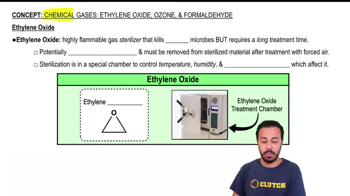
Ethylene oxide is a gaseous sterilant effective for heat- and moisture-sensitive materials, penetrating porous items like mattresses and plastics without damage. Glutaraldehyde is a liquid disinfectant used for sterilizing medical equipment but requires long exposure times and may not be suitable for all materials. Their chemical properties influence their practical use.
추천 영상:
Chemical Gases: Ethylene Oxide
관련 실천
교과서 질문
1540
views
교과서 질문
Which of the following does not kill endospores?
a. Autoclaving
b. Incineration
c. Hot-air sterilization
d. Pasteurization
e. All of the above kill endospores
1086
views
교과서 질문
Which of these disinfectants does not act by disrupting the plasma membrane?
a. Phenolics
b. Phenol
c. Quats
d. Halogens
e. Biguanides
1287
views
교과서 질문
The thermal death time for a suspension of Bacillus subtilis endospores is in dry heat and less than in an autoclave. Which type of heat is more effective? Why?
1208
views
교과서 질문
Which of the following cannot be used to sterilize a heat-labile solution stored in a plastic container?
a. Gamma radiation
b. Ethylene oxide
c. Supercritical fluids
d. Autoclaving
e. Short-wavelength radiation
1134
views
교과서 질문
If pasteurization does not achieve sterilization, why is pasteurization used to treat food?
1146
views