Ch. 9 - Biotechnology & DNA Technology
Tortora - Microbiology: An Introduction 14th Edition
Tortora14th EditionMicrobiology: An IntroductionISBN: 9780138200398당신이 사용하는 게 아니라요?교과서 변경
5장, 문제 6

You have a small gene that you want replicated by PCR. You add fluorescent dye-labeled nucleotides to the PCR thermal cycler. After three replication cycles, what percentage of the DNA single strands will fluoresce?
a. 0%
b. 12.5%
c. 50%
d. 87.5%
e. 100%

검증된 단계별 안내
1
Understand that PCR (Polymerase Chain Reaction) doubles the amount of DNA each cycle by synthesizing new strands complementary to the original template strands.
Recognize that fluorescent dye-labeled nucleotides are incorporated only into newly synthesized DNA strands during replication, not into the original template strands.
Calculate the total number of DNA strands after three cycles using the formula for exponential growth: \(\text{Number of strands} = 2^{n+1}\), where \(n\) is the number of cycles. Here, \(n=3\), so total strands = \$2^{4}$.
Determine how many of these strands are newly synthesized (and thus fluorescent). After each cycle, the number of new strands doubles, so after three cycles, the number of new strands is \(2^{3} = 8\).
Calculate the percentage of fluorescent strands by dividing the number of new strands by the total number of strands and multiplying by 100: \(\left( \frac{8}{16} \right) \times 100\).

비슷한 문제에 대한 검증된 영상 답변:

이 영상 해법은 위 문제에 도움이 된다고 튜터들이 추천한 것입니다.
영상 길이:
2m

주요 개념

질문에 올바르게 답하기 위해 반드시 이해해야 하는 핵심 개념들은 다음과 같습니다.

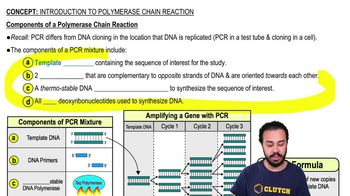
Polymerase Chain Reaction (PCR) Amplification Cycles

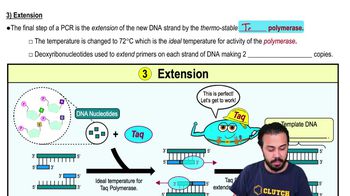
PCR is a method to exponentially amplify DNA by repeated cycles of denaturation, annealing, and extension. Each cycle doubles the number of DNA strands, so after n cycles, there are 2^n DNA strands. Understanding how DNA quantity increases with cycles is essential to predict the amount of labeled DNA.
추천 영상:
05:57
Components of a Polymerase Chain Reaction

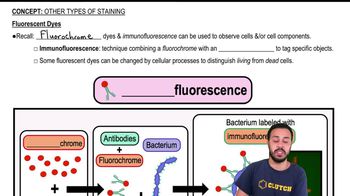
Incorporation of Fluorescent Dye-Labeled Nucleotides

Fluorescent dye-labeled nucleotides are incorporated only into newly synthesized DNA strands during the extension phase. Original template strands remain unlabeled, while newly made strands contain the fluorescent label, allowing differentiation between original and replicated DNA.
추천 영상:
02:59
Fluorescent Dyes

Calculation of Labeled DNA Proportion After Multiple PCR Cycles

After several PCR cycles, the proportion of labeled strands depends on how many strands are newly synthesized versus original. Since each cycle doubles the strands, the fraction of labeled strands can be calculated by comparing the number of labeled new strands to the total strands present.
추천 영상:
02:58
3) Extension