 뒤로
뒤로Elasticity: The Responsiveness of Demand and Supply
스터디 가이드 - 스마트 노트
 자료에 맞춘 맞춤형 노트, 핵심 정의, 예시, 맥락을 확장해 제공합니다.
Elasticity: The Responsiveness of Demand and Supply
What is Elasticity?
Elasticity measures the relative response of a quantity (either supplied or demanded) to a change in another variable, most commonly price. It is a central concept in microeconomics for understanding how consumers and producers react to changes in market conditions.
Definition: Elasticity is the percentage change in quantity divided by the percentage change in the influencing factor (e.g., price).
Example: If the price of gasoline falls by 5%, elasticity tells us the percentage increase in gasoline consumed.
Elastic vs. Inelastic Responses
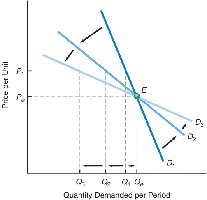
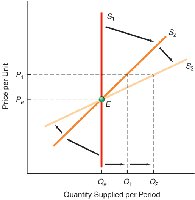
Elasticity describes how much quantity demanded or supplied changes in response to price changes.
Elastic Demand/Supply: Large change in quantity for a given price change (consumers/producers are responsive).
Inelastic Demand/Supply: Small change in quantity for a given price change (consumers/producers are not very responsive).
Consumer Example: If the price of a good rises and consumers buy much less, demand is elastic. If they buy nearly the same amount, demand is inelastic.
Producer Example: If the price rises and firms greatly increase output, supply is elastic. If output rises only slightly, supply is inelastic.
Price Elasticity of Demand
Definition and Measurement
The price elasticity of demand (PED) measures how much the quantity demanded of a good responds to a change in its price.
Formula:
Interpretation: If PED > 1, demand is elastic; if PED < 1, demand is inelastic; if PED = 1, demand is unit elastic.
Example Calculation
Suppose the price of cheddar cheese increases from $2 to $4 per pound, and quantity demanded falls from 5 billion to 4 billion pounds. The own-price elasticity of demand can be calculated as follows:
Step 1: Calculate percentage changes using the midpoint method:
Step 2: Plug into the formula:
Interpretation: Demand is inelastic in this range (|PED| < 1).
Elasticity Along the Demand Curve
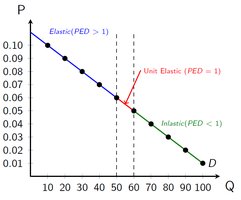
The elasticity of a straight-line demand curve changes at different points. At high prices and low quantities, demand is more elastic; at low prices and high quantities, demand is more inelastic.
Relatively Elastic: PED > 1 (upper left of the demand curve)
Unit Elastic: PED = 1 (midpoint)
Relatively Inelastic: PED < 1 (lower right of the demand curve)
Perfectly Elastic and Inelastic Demand
Special cases of elasticity:
Perfectly Elastic Demand: Quantity demanded changes infinitely with any price change (horizontal demand curve).
Perfectly Inelastic Demand: Quantity demanded does not change with price (vertical demand curve).
The same concepts apply to supply curves.
Determinants of Price Elasticity of Demand
Several factors influence how elastic demand is for a good:
Availability of Substitutes: More substitutes make demand more elastic.
Time Horizon: Demand is more elastic in the long run as consumers can adjust their behavior.
Luxury vs. Necessity: Luxuries have more elastic demand; necessities are more inelastic.
Definition of Market: Narrowly defined markets have more elastic demand due to more substitutes.
Share of Budget: Goods that take up a larger share of the consumer's budget have more elastic demand.
Price Elasticity of Supply
Definition and Measurement
The price elasticity of supply (PES) measures how much the quantity supplied responds to a change in price.
Formula:
Interpretation: PES > 1 is elastic supply; PES < 1 is inelastic supply.
Determinants of Price Elasticity of Supply
Time Horizon: Supply is more elastic in the long run as firms can adjust production capacity.
Ease of Adjustment: The easier it is for firms to change output, the more elastic supply is.
Flexibility of Producers: If producers can easily acquire resources or reduce production, supply is more elastic.
Elasticity and Total Revenue
Relationship Between Elasticity and Total Revenue
Total revenue is calculated as price times quantity (). The effect of a price change on total revenue depends on the elasticity of demand:
Elastic Demand (PED > 1): Price increase decreases total revenue; price decrease increases total revenue.
Inelastic Demand (PED < 1): Price increase increases total revenue; price decrease decreases total revenue.
Unit Elastic Demand (PED = 1): Total revenue remains unchanged when price changes.
Other Demand Elasticities
Income Elasticity of Demand
The income elasticity of demand measures how quantity demanded changes as consumer income changes.
Formula:
Interpretation:
Positive: Normal good (demand increases as income rises)
Negative: Inferior good (demand decreases as income rises)
Between 0 and 1: Necessity
Greater than 1: Luxury
Changes in Income and Good Types
Income Increases: Buy fewer inferior goods, more normal goods, a bit more necessities, and way more luxuries.
Income Decreases: Buy more inferior goods, fewer normal goods, a bit less necessities, and way less luxuries.
Cross-Price Elasticity of Demand
The cross-price elasticity of demand measures how the quantity demanded of one good responds to a change in the price of another good.
Formula:
Interpretation:
Positive: Substitutes (increase in price of Y increases demand for X)
Negative: Complements (increase in price of Y decreases demand for X)
Order Matters: The direction of calculation (YX vs. XY) affects the sign and interpretation.
Summary Table: Types of Elasticity
Elasticity Type | Formula | Interpretation |
|---|---|---|
Price Elasticity of Demand (PED) | Responsiveness of quantity demanded to price changes | |
Price Elasticity of Supply (PES) | Responsiveness of quantity supplied to price changes | |
Income Elasticity of Demand | Responsiveness of demand to income changes | |
Cross-Price Elasticity of Demand | Responsiveness of demand for one good to price changes of another |
