 뒤로
뒤로Game Theory, Cartels, and Information Economics: Study Notes for Microeconomics
스터디 가이드 - 스마트 노트
 자료에 맞춘 맞춤형 노트, 핵심 정의, 예시, 맥락을 확장해 제공합니다.
Game Theory in Microeconomics
Basic Elements of a Game
Game theory analyzes strategic interactions where the outcome for each participant depends on the actions of all. The basic elements of a game include:
Players: The decision-makers in the game (e.g., firms, individuals).
Strategies: The possible actions each player can take.
Payoffs: The outcomes or rewards each player receives for each combination of strategies.
A dominant strategy yields a higher payoff for a player, no matter what the other players do. A dominated strategy is any other strategy available to a player who has a dominant strategy.
Payoff Matrix and Nash Equilibrium
A payoff matrix (normal or strategic form) is a table that describes the payoffs for each possible combination of strategies. A Nash equilibrium is a set of strategies where no player can benefit by unilaterally changing their strategy, given the strategies of the others. Not all games have a dominant strategy, but every finite game has at least one Nash equilibrium.
Prisoner's Dilemma
The prisoner's dilemma is a classic example where each player has a dominant strategy, but both would be better off if they cooperated and played a dominated strategy. This illustrates why cooperation is difficult to maintain, even when it is mutually beneficial.
Example: Two firms (American and United Airlines) can choose to increase advertising or not. Both have a dominant strategy to increase advertising, but both are worse off than if they had cooperated and not increased spending.
Cartels and Collusion
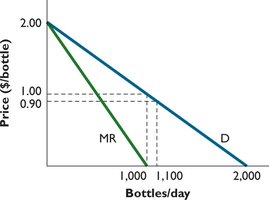
A cartel is a coalition of firms that agree to restrict output to increase economic profit. Cartel agreements are typically unstable because each member has an incentive to cheat by lowering prices to capture more market share.
Example: Two bottled water suppliers agree to split the market and set prices at the monopoly level. If one lowers the price, they capture the entire market, leading to a breakdown of the cartel agreement.
Repeated Games and Strategies
In a repeated prisoner's dilemma, the same players face the same game multiple times. Strategies like the grim-trigger (eternal punishment for defection) can sustain cooperation over time.
Sequential (Dynamic) Games and Timing
When timing matters, games are represented in extensive form (decision trees). The first mover can have an advantage, and backward induction is used to solve these games.
Credible Threats and Promises
A credible threat or promise is one that is in the best interest of the party making it to carry out. Credibility is essential for influencing the behavior of other players.
Economics of Information
Value of Information and the Middleman
Information is valuable in markets where buyers must choose among complex products. Middlemen (e.g., sales representatives) add value by reducing search costs and providing information.

Expected Value and Risk Preferences
The expected value of a gamble is the sum of all possible outcomes, each weighted by its probability:
A risk-neutral person accepts any fair or better-than-fair gamble.
A risk-averse person refuses fair gambles, preferring certainty.
Search and Commitment Problems
Search is costly and limited. People end their search when the marginal cost exceeds the marginal benefit. Commitment problems arise when better options appear after a commitment is made, leading to contract design and penalties for breaking agreements.
Asymmetric Information
Asymmetric information occurs when one party in a transaction has more or better information than the other. This can lead to market inefficiencies.

The Lemons Model
The lemons model (Akerlof, 1970) explains how asymmetric information can reduce the average quality of goods for sale. Sellers of high-quality goods withdraw from the market, leaving only low-quality goods ("lemons").
Example: Used car market, where buyers cannot distinguish between good cars and lemons, leading to lower prices and fewer good cars offered for sale.
Adverse Selection
Adverse selection occurs when products or services are selected by the highest-risk individuals, raising costs for providers. This is common in insurance markets, where those most likely to make claims are also most likely to buy insurance.
Moral Hazard
Moral hazard arises when one party takes more risks because they do not bear the full consequences of those risks, often due to insurance or guarantees. Deductibles and co-payments are used to mitigate moral hazard.
Signaling and Credibility
To overcome asymmetric information, parties may use signals that are costly or difficult to fake (e.g., warranties, advertising, educational credentials). These signals help communicate quality credibly.
Statistical Discrimination
Statistical discrimination uses observable group characteristics to infer unobservable individual characteristics, which can lead to group-based pricing or hiring practices.
Summary Table: Key Concepts in Game Theory and Information Economics
Concept | Definition | Example/Application |
|---|---|---|
Dominant Strategy | Best action regardless of what others do | Advertising in airline duopoly |
Nash Equilibrium | No player can benefit by changing strategy unilaterally | Both firms increase advertising |
Prisoner's Dilemma | Dominant strategies lead to worse outcomes for all | Cartel breakdown |
Adverse Selection | High-risk individuals are more likely to buy insurance | Health insurance markets |
Moral Hazard | Insured parties take more risks | Bank bailouts |
Lemons Model | Asymmetric information lowers average quality | Used car market |
Signaling | Costly actions to reveal private information | Warranties, education |
Additional info: These notes expand on the original material by providing definitions, formulas, and examples for each key concept, ensuring the content is self-contained and suitable for exam preparation.
