 뒤로
뒤로Macroeconomic Foundations: GDP, Inflation, Savings, and Money
스터디 가이드 - 스마트 노트
 자료에 맞춘 맞춤형 노트, 핵심 정의, 예시, 맥락을 확장해 제공합니다.
Principles of Measuring Economic Output
Gross Domestic Product (GDP)
Gross Domestic Product (GDP) is the primary measure of a nation's economic output. It represents the market value of all final goods and services produced within a country's borders during a specific period, typically a year or a quarter.
Market Value: GDP aggregates the value of goods and services using market prices, giving higher weight to more expensive items, reflecting their perceived benefit to consumers.
Final Goods and Services: Only goods and services consumed by the end user are included to avoid double counting. Intermediate goods, used in the production of final goods, are excluded.
Domestic Production: GDP measures output within a country's borders, regardless of the nationality of the producer.
Time Frame: Only goods and services produced within the measured period are included. Sales of used goods are not counted, except for the value added by services such as commissions.
Example: If a bakery produces bread using flour purchased from a mill, only the value added at each stage is counted in GDP.

Methods of Measuring GDP
There are three main approaches to measuring GDP, each providing a different perspective on economic activity:
Expenditure Approach: Sums total spending on final goods and services by households, firms, government, and foreigners (net exports).
Income Approach: Sums all incomes earned by factors of production, including wages, rents, interest, and profits.
Production (Value Added) Approach: Sums the value added at each stage of production across all firms.
GDP Equation (Expenditure Approach):
= GDP
= Consumption Expenditure
= Investment
= Government Purchases
= Net Exports (Exports - Imports)

Components of GDP
Consumption: Household spending on goods and services, including durable goods (e.g., cars), nondurable goods (e.g., food), and services (e.g., education).
Investment: Business spending on capital goods, residential construction, and changes in inventories. Financial investments (stocks, bonds) are not included unless they represent new capital formation.
Government Purchases: Spending by all levels of government on goods and services, excluding transfer payments (e.g., Social Security).
Net Exports: The value of exports minus imports. Exports add to GDP, while imports are subtracted as they represent spending on foreign-produced goods.
Adjusting GDP for Price Changes
Nominal vs. Real GDP
To compare economic output over time, it is necessary to distinguish between changes in output and changes in prices.
Nominal GDP: Measures output using current prices, reflecting both changes in quantity and price.
Real GDP: Measures output using constant base-year prices, isolating changes in the quantity of goods and services produced.
Formula for Real GDP:
Example: If the price of pizza and calzones increases, but the quantity produced also rises, real GDP will show the change in output, not just the effect of higher prices.

Limitations of GDP as a Welfare Measure
GDP does not account for non-market activities (e.g., household production, volunteer work).
It omits the value of leisure, environmental quality, and resource depletion.
GDP does not measure income distribution or inequality.
GDP per capita is correlated with material well-being, health, and education, but is not a comprehensive measure of welfare.

Measuring the Price Level and Inflation
Consumer Price Index (CPI)
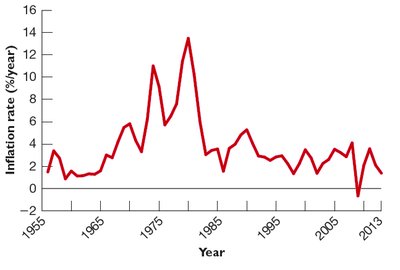
The Consumer Price Index (CPI) measures the average change in prices paid by consumers for a fixed basket of goods and services over time. It is used to assess changes in the cost of living and to adjust nominal values for inflation.
Calculation: CPI is the ratio of the cost of the basket in the current year to the cost in the base year, multiplied by 100.
Inflation Rate: The annual percentage change in the CPI.
Real vs. Nominal Quantities
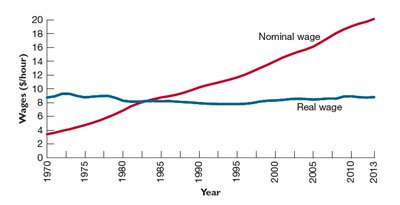
Nominal Quantity: Measured in current dollars.
Real Quantity: Adjusted for changes in the price level, reflecting purchasing power.
Example: Comparing wages or incomes across years requires adjusting for inflation to determine real purchasing power.
Indexing and Policy Implications
Indexing: Adjusting nominal values (e.g., Social Security payments, tax brackets) to maintain real value in the face of inflation.
CPI Biases: The CPI may overstate inflation due to substitution bias, quality changes, and the introduction of new goods.
The Costs and Consequences of Inflation
Relative Prices and Inflation
Inflation is a general increase in the price level, but relative prices (the price of one good compared to another) can change independently of inflation. Inflation can obscure the information conveyed by prices, making it harder for buyers and sellers to distinguish between changes in relative prices and overall inflation.
Shoe Leather Costs: The resources wasted when people reduce their money holdings to avoid the inflation tax.
Unexpected Redistribution: Unanticipated inflation can benefit borrowers and hurt lenders, as debts are repaid with less valuable money.
Planning Uncertainty: High and variable inflation complicates long-term planning for households and firms.
Inflation and Interest Rates
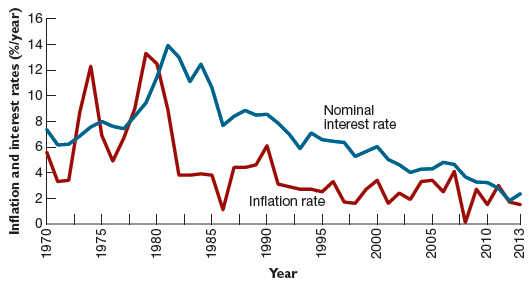
Nominal Interest Rate: The stated rate, not adjusted for inflation.
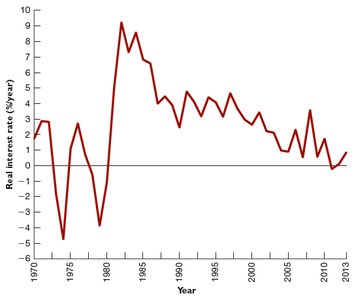
Real Interest Rate: The nominal rate minus the inflation rate.
The Fisher Effect: The tendency for nominal interest rates to rise with expected inflation.
Savings, Wealth, and Investment
Definitions and Measurement
Saving: The portion of current income not spent on current needs.
Wealth: The value of assets owned minus liabilities owed at a point in time.
Flow vs. Stock: Saving is a flow (measured over time), while wealth is a stock (measured at a point in time).
National Savings: The sum of private and public saving, representing the resources available for investment in new capital goods.
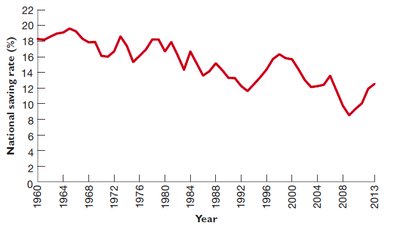
Private and Public Saving
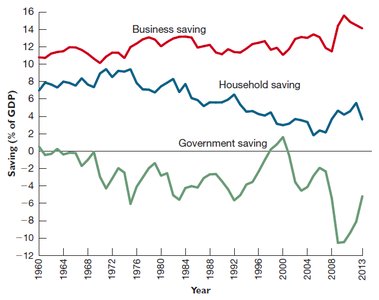
Private Saving: After-tax income minus consumption ().
Public Saving: Net tax revenue minus government spending ().
Government Budget: A surplus increases public saving; a deficit reduces it.
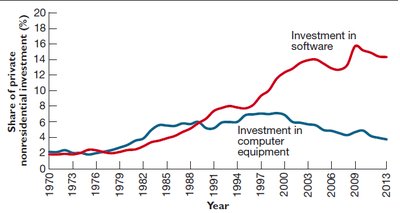
Investment and Capital Formation
Investment decisions depend on the cost of capital goods and the real interest rate.
Technical innovation, tax policy, and expected returns influence investment levels.
Money, Banking, and the Price Level
Money Supply and Its Measurement
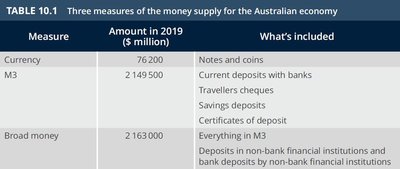
Money is defined by its liquidity—the ease with which it can be used for transactions. The money supply includes currency, current deposits, and other liquid assets.
Measure | Amount in 2019 ($ million) | What's included |
|---|---|---|
Currency | 76,200 | Notes and coins |
M3 | 2,149,500 | Current deposits with banks, travellers cheques, savings deposits, certificates of deposit |
Broad money | 2,163,000 | Everything in M3 plus deposits in non-bank financial institutions and bank deposits by non-bank financial institutions |
Central Banking and Monetary Policy
The central bank (e.g., Reserve Bank of Australia) manages the money supply and influences interest rates through open-market operations.
The cash rate is the benchmark interest rate for overnight loans between financial institutions.
Open-market operations involve buying or selling government securities to adjust the money supply and achieve the target cash rate.
The Quantity Theory of Money
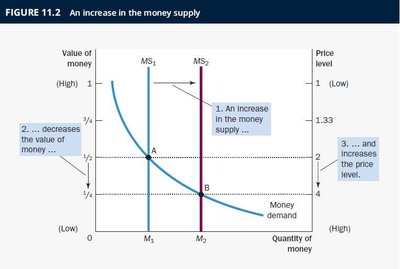
The velocity of money measures how quickly money circulates in the economy. The quantity equation relates the money supply to nominal GDP:
= Money supply
= Velocity of money
= Price level
= Real output
According to the quantity theory, increases in the money supply lead to proportional increases in the price level (inflation) if velocity and output are constant.
Balance of Payments
Current and Capital Accounts
Current Account: Records net exports (exports minus imports), net income from abroad, and net transfers (e.g., foreign aid).
Capital Account: Records foreign direct investment, portfolio investment, and other capital flows.
Balance of Payments Identity: The sum of the current account, capital account, and changes in official reserves must equal zero.
Summary
GDP measures the value of final goods and services produced within a country.
CPI and other price indices track changes in the cost of living and inflation.
Savings and investment are crucial for capital formation and long-term growth.
The money supply and central bank policy influence inflation and economic activity.
The balance of payments tracks a nation's economic transactions with the rest of the world.
