 뒤로
뒤로Market Power, Monopoly, and Monopolistic Competition: Study Notes
스터디 가이드 - 스마트 노트
 자료에 맞춘 맞춤형 노트, 핵심 정의, 예시, 맥락을 확장해 제공합니다.
Market Power
Economies of Scale and Returns to Scale
Market power refers to the ability of a firm to influence the price of its product. Economies of scale occur when increasing production lowers average costs, often leading to market dominance or natural monopoly.
Constant Returns to Scale: Doubling all inputs doubles output.
Increasing Returns to Scale: Output increases by a greater percentage than the increase in inputs; average costs decrease as output increases.
Natural Monopoly: A monopoly that arises due to economies of scale, where one firm can supply the entire market at a lower cost than multiple firms.
Network Economies
Network economies occur when the value of a product increases as more people use it. Examples include telephones, operating systems, and social networks.
Examples: VHS, Blu-ray, Windows OS, eBay, Facebook.
Large Start-Up Costs and Cost Structures
Some industries have high fixed (start-up) costs and low variable costs, leading to declining average total cost (ATC) as output increases.
Fixed Cost (F): Costs that do not vary with output (e.g., development costs).
Variable Cost (VC): Costs that vary with output (e.g., labor).
Total Cost (TC):
Average Total Cost (ATC):
Average Fixed Cost (AFC):
As output (Q) increases, ATC falls due to the spreading of fixed costs.
Example: Intel's Market Power
Intel dominates the processor market due to high development costs (fixed) and low marginal costs, allowing it to supply most of the market efficiently.
Monopoly
Demand Curves for Competitive and Monopoly Firms
Competitive firms face a perfectly elastic demand curve, while monopolists face a downward-sloping demand curve, giving them price-setting power.
Monopoly Revenue and Marginal Revenue
Total Revenue (TR):
Average Revenue (AR):
Marginal Revenue (MR):
For a monopolist, MR is always less than price because lowering price to sell more units reduces revenue from previous units.
Profit Maximization for a Monopoly
The monopolist maximizes profit where marginal revenue equals marginal cost (MR = MC). The corresponding price is found on the demand curve at this quantity.
Profit:
Profit (expanded):
The Welfare Cost of Monopoly
Monopolies charge a price above marginal cost, leading to a misallocation of resources and deadweight loss. The monopolist produces less than the socially efficient quantity.
Deadweight Loss: The loss of total surplus due to monopoly pricing.


Price Discrimination
Definition and Examples
Price discrimination is the practice of selling the same good at different prices to different customers, even though production costs are the same. Examples include student and pensioner discounts at cinemas.

Requirements: Market power and the ability to prevent arbitrage (resale).
Perfect Price Discrimination: Charging each customer their maximum willingness to pay, eliminating consumer surplus and deadweight loss.
Price discrimination can increase monopolist profits and reduce deadweight loss.
Market Power and Competition Policy
Government Responses to Market Power
Governments may intervene in cases of natural monopoly, market dominance, or potential collusion in oligopolies.
Natural Monopoly: State ownership with marginal cost pricing and subsidies, or private ownership with price cap regulation.
Market Domination: Banning mergers or breaking up dominant firms to maintain competition.
Collusive Behaviour: Preventing mergers that lessen competition and punishing anti-competitive practices.






Monopolistic Competition
Characteristics
Monopolistic competition is a market structure with many sellers offering differentiated products and free entry and exit.
Product Differentiation: Each firm offers a slightly different product, facing a downward-sloping demand curve.
Free Entry/Exit: Firms can enter or exit the market, driving economic profit to zero in the long run.

Short-Run and Long-Run Equilibrium
In the short run, firms can earn profits or losses. In the long run, entry and exit ensure zero economic profit.
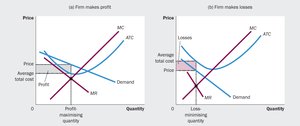
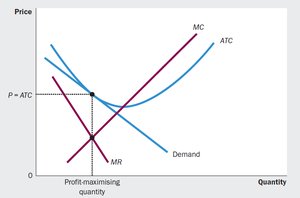
Short Run: Profits attract new entrants, shifting demand left for incumbents.
Long Run: Price equals average total cost, but exceeds marginal cost, leading to deadweight loss.
Monopolistic vs. Perfect Competition
Monopolistic Competition: Price > Marginal Cost, zero economic profit in the long run, product differentiation.
Perfect Competition: Price = Marginal Cost, zero economic profit in the long run, homogeneous products.
Welfare Implications
Monopolistic competition leads to some deadweight loss due to mark-up pricing, but product variety benefits consumers. Regulation is typically not pursued due to administrative complexity.
