 뒤로
뒤로Microeconomics Labor Markets Quiz Study Guide
스터디 가이드 - 스마트 노트
 자료에 맞춘 맞춤형 노트, 핵심 정의, 예시, 맥락을 확장해 제공합니다.
Q1. Why is the demand for labor described as a derived demand?
Background
Topic: Labor Demand
This question tests your understanding of why firms demand labor, focusing on the concept of derived demand in microeconomics.
Key Terms:
Derived Demand: Demand for a factor of production (like labor) that arises from the demand for the goods and services produced by that factor.
Labor Market: The market in which employers hire workers and workers seek jobs.
Step-by-Step Guidance
Recall that firms hire labor to produce goods and services, not for its own sake.
Think about what motivates a firm to hire more workers: Is it because of the demand for the products those workers help produce?
Consider the relationship between the demand for a product and the demand for labor used to make that product.
Try solving on your own before revealing the answer!
Final Answer: B
The demand for labor is derived from the demand for products that use labor in the production process. Firms hire workers because consumers want the goods and services those workers produce.
Q2. What is the marginal revenue product of labor for a competitive seller?
Background
Topic: Marginal Revenue Product (MRP) of Labor
This question tests your understanding of how firms calculate the value of hiring an additional worker in a competitive market.
Key Terms and Formula:
Marginal Product of Labor (MPL): The additional output produced by hiring one more worker.
Marginal Revenue Product of Labor (MRPL): The additional revenue generated from hiring one more worker.
Step-by-Step Guidance
Identify the marginal product of labor (how much extra output is produced by one more worker).
Recall that in a competitive market, the output price (P) is constant.
Multiply the marginal product of labor by the output price to find the marginal revenue product.
Try solving on your own before revealing the answer!
Final Answer: D
The marginal revenue product of labor for a competitive seller is equal to the marginal product of labor multiplied by the output price.
Q3. For a perfectly competitive seller, what is the marginal revenue product?
Background
Topic: Marginal Revenue Product in Perfect Competition
This question tests your understanding of how hiring an additional worker affects total revenue in a perfectly competitive market.
Key Terms:
Marginal Revenue Product: The change in total revenue from hiring one more worker.
Perfect Competition: A market where firms are price takers.
Step-by-Step Guidance
Consider what happens to total revenue when a firm hires one more worker.
Think about how the output price and marginal product of labor interact in a competitive market.
Focus on the change in total revenue, not just the output price or number of workers.
Try solving on your own before revealing the answer!
Final Answer: C
For a perfectly competitive seller, the marginal revenue product is the change in total revenue that results from hiring another worker.
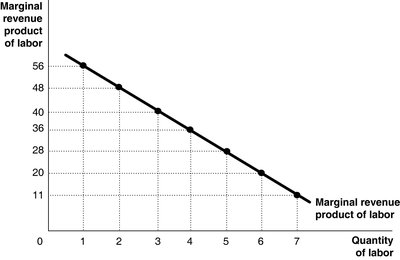
Q4. Refer to Figure 16-1. If the wage rate is $40, how many workers should Dale hire?
Background
Topic: Profit Maximization in Labor Hiring
This question tests your ability to use the marginal revenue product curve to determine the optimal number of workers to hire given a wage rate.
Key Terms and Formula:
Marginal Revenue Product of Labor (MRPL): The additional revenue from hiring one more worker.
Wage Rate: The cost of hiring one more worker.
Step-by-Step Guidance
Examine the MRPL values on the graph for each quantity of labor.
Compare each MRPL value to the wage rate ($40).
Identify the highest quantity of labor where MRPL is still greater than or equal to the wage rate.
Stop before the MRPL drops below the wage rate.
Try solving on your own before revealing the answer!
Final Answer: B (3 units)
Dale should hire 3 workers, because at this point the marginal revenue product is still at least $40, but hiring a fourth worker would drop the MRPL below the wage rate.
Q5. Refer to Figure 16-1. What happens to the curve if the market price of doilies rises from $2 to $3?
Background
Topic: Shifts in Marginal Revenue Product Curve
This question tests your understanding of how changes in output price affect the marginal revenue product of labor curve.
Key Terms:
Marginal Revenue Product of Labor (MRPL): Depends on both the marginal product of labor and the output price.
Curve Shift: A change in the entire curve, not just a movement along it.
Step-by-Step Guidance
Recall the formula: .
Consider what happens to MRPL when the output price increases.
Think about whether this change affects all quantities of labor or just one point.
Try solving on your own before revealing the answer!
Final Answer: A
The curve shifts to the right, because an increase in the output price raises the marginal revenue product for every quantity of labor.
Q6. If a competitive firm pays $12 per hour and sells its product at $3 per unit, and the last worker hired increases output by three units per hour, what should the firm do to maximize profits?
Background
Topic: Profit Maximization and Marginal Analysis
This question tests your ability to compare the marginal revenue product of labor to the wage rate to determine hiring decisions.
Key Terms and Formula:
Marginal Revenue Product of Labor (MRPL):
Wage Rate: The cost of hiring one more worker.
Step-by-Step Guidance
Calculate the marginal revenue product for the last worker: .
Compare the MRPL to the wage rate ($12).
Decide whether the firm should hire more, fewer, or the same number of workers based on this comparison.
Try solving on your own before revealing the answer!
Final Answer: B
The firm should lay off some workers, because the marginal revenue product of the last worker is less than the wage rate.
Q7. What happens when the wage rate decreases?
Background
Topic: Labor Demand Curve
This question tests your understanding of how changes in wage rate affect the quantity of labor demanded.
Key Terms:
Labor Demand Curve: Shows the relationship between wage rate and quantity of labor demanded.
Quantity Demanded vs. Shift: A movement along the curve vs. a shift of the curve.
Step-by-Step Guidance
Recall that a decrease in wage rate makes hiring workers less expensive.
Think about whether this causes a movement along the labor demand curve or shifts the curve itself.
Consider what happens to the quantity of labor demanded as wage rate falls.
Try solving on your own before revealing the answer!
Final Answer: D
A decrease in the wage rate causes an increase in the quantity of labor demanded (movement along the curve).
Q8. What could cause an increase in a perfectly competitive firm's demand for labor?
Background
Topic: Shifts in Labor Demand
This question tests your understanding of factors that shift the labor demand curve for a competitive firm.
Key Terms:
Labor Demand Curve: Shows how much labor firms want to hire at different wage rates.
Market Demand for Product: Affects the firm's need for labor.
Step-by-Step Guidance
Recall that labor demand is derived from the demand for the firm's product.
Think about what happens if more people want to buy the firm's product.
Consider whether changes in wage rate or labor supply affect labor demand directly.
Try solving on your own before revealing the answer!
Final Answer: A
An increase in the market demand for the firm's product will increase the firm's demand for labor.
Q9. Which of the following will NOT shift the labor supply curve?
Background
Topic: Labor Supply Curve Shifts
This question tests your understanding of what factors shift the labor supply curve versus what causes movement along the curve.
Key Terms:
Labor Supply Curve: Shows the relationship between wage rate and quantity of labor supplied.
Shift vs. Movement: A shift is caused by changes in factors other than wage rate.
Step-by-Step Guidance
Recall that changes in wage rate cause movement along the supply curve, not a shift.
Consider how changes in retirement age, labor force participation, or immigration policy affect labor supply.
Identify which option is a change in wage rate.
Try solving on your own before revealing the answer!
Final Answer: D
An increase in the wage rate does not shift the labor supply curve; it causes movement along the curve.
Q10. If Alan Shaw reduces his work hours when his salary increases, what does this imply about the income and substitution effects?
Background
Topic: Income and Substitution Effects
This question tests your understanding of how changes in salary affect labor supply decisions through income and substitution effects.
Key Terms:
Income Effect: Higher income allows more leisure, possibly reducing work hours.
Substitution Effect: Higher wage makes leisure more expensive, possibly increasing work hours.
Step-by-Step Guidance
Recall what happens when salary increases: both effects are at play.
If Alan works less, which effect is stronger?
Consider whether leisure is a normal or inferior good for Alan.
Try solving on your own before revealing the answer!
Final Answer: C
The income effect dominates the substitution effect; Alan chooses more leisure as his salary increases.
Q11. What happens to equilibrium wage and quantity of pilots if the government enforces a lower mandatory retirement age?
Background
Topic: Labor Market Equilibrium
This question tests your understanding of how changes in labor supply affect equilibrium wage and quantity in a specific labor market.
Key Terms:
Equilibrium Wage: The wage at which labor supply equals labor demand.
Mandatory Retirement Age: Affects the supply of labor.
Step-by-Step Guidance
Consider how lowering the retirement age affects the number of pilots available.
Think about the impact on labor supply and what happens to equilibrium wage and quantity.
Recall basic supply and demand principles for labor markets.
Try solving on your own before revealing the answer!
Final Answer: B
The equilibrium wage rises and the equilibrium quantity of pilots falls, because fewer pilots are available due to earlier retirement.
Q12. What are compensating differentials?
Background
Topic: Wage Differentials
This question tests your understanding of why some jobs pay higher wages to compensate for unpleasant or risky aspects.
Key Terms:
Compensating Differential: Extra wage paid to compensate for undesirable job characteristics.
Non-monetary Benefits: Benefits other than wages.
Step-by-Step Guidance
Recall why some jobs pay more than others, even for similar skill levels.
Think about jobs with unpleasant, risky, or undesirable conditions.
Consider whether compensating differentials are about experience or job characteristics.
Try solving on your own before revealing the answer!
Final Answer: B
Compensating differentials are higher wages that compensate workers for unpleasant aspects of a job.
