 뒤로
뒤로Microeconomics Study Guide: Supply and Demand Interactions
스터디 가이드 - 스마트 노트
 자료에 맞춘 맞춤형 노트, 핵심 정의, 예시, 맥락을 확장해 제공합니다.
Q1. As more consumers purchase the game, what impact does it have on the game’s price and quantity?
Background
Topic: Demand Shifts and Market Equilibrium
This question tests your understanding of how an increase in consumer demand affects equilibrium price and quantity, assuming supply remains unchanged.

Key Terms and Formulas
Demand Curve: Shows the relationship between price and quantity demanded.
Equilibrium: The point where supply and demand curves intersect.
Shift in Demand: An increase in demand shifts the curve to the right.
Step-by-Step Guidance
Identify the change: More consumers are buying the game, which means demand increases.
Visualize the demand curve shifting to the right on a supply and demand graph.
Recall that the supply curve does not change in this scenario.
Think about what happens to equilibrium price and quantity when demand increases but supply stays the same.
Set up the next step: Use the supply and demand diagram to determine the new equilibrium point.
Try solving on your own before revealing the answer!
Final Answer:
Both the price and quantity of the game increase.
When demand increases and supply remains unchanged, the equilibrium moves to a higher price and higher quantity.
Q2. What impact does the new contract have on the price of a Ford automobile?
Background
Topic: Supply Shifts Due to Changes in Production Costs
This question tests your understanding of how an increase in production costs (such as higher wages) affects the supply curve and market price.

Key Terms and Formulas
Supply Curve: Shows the relationship between price and quantity supplied.
Production Costs: Higher costs shift the supply curve to the left.
Equilibrium Price: The price at which supply equals demand.
Step-by-Step Guidance
Recognize that a new contract increases Ford's unit cost of production (e.g., higher wages).
Understand that higher production costs cause the supply curve to shift left (decrease in supply).
Demand is unchanged in this scenario.
Consider what happens to equilibrium price and quantity when supply decreases but demand stays the same.
Set up the next step: Use the supply and demand diagram to find the new equilibrium.
Try solving on your own before revealing the answer!
Final Answer:
The price of Ford automobiles increases, and the quantity sold decreases.
A leftward shift in supply leads to higher prices and lower equilibrium quantity, assuming demand is unchanged.
Q3. What impact does this have on the price and quantity of Pepsi?
Background
Topic: Substitutes and Demand Shifts
This question tests your understanding of how a price increase in one substitute (Coke) affects the demand for another (Pepsi).

Key Terms and Formulas
Substitute Goods: Products that can replace each other in consumption.
Demand Shift: An increase in the price of Coke increases demand for Pepsi.
Equilibrium: The intersection of supply and demand curves.
Step-by-Step Guidance
Note that Coke and Pepsi are substitutes; a price increase in Coke makes Pepsi more attractive.
Demand for Pepsi increases, shifting the demand curve to the right.
Supply of Pepsi does not change in this scenario.
Think about how the new demand curve affects equilibrium price and quantity for Pepsi.
Set up the next step: Use the supply and demand diagram to determine the new equilibrium for Pepsi.
Try solving on your own before revealing the answer!
Final Answer:
The price and quantity of Pepsi both increase.
When demand for Pepsi rises due to a higher price of Coke, equilibrium price and quantity for Pepsi increase.
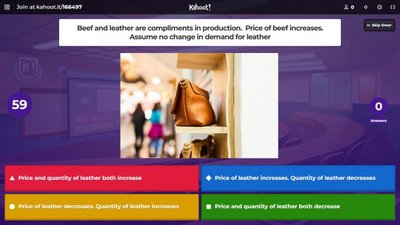
Q4. What impact does this have on the price and quantity of Leather?
Background
Topic: Complementary Goods in Production (Byproducts)
This question tests your understanding of how an increase in the price of beef (a primary product) affects the supply of leather (a byproduct).
Key Terms and Formulas
Complementary Goods in Production: Goods produced together, such as beef and leather.
Supply Shift: An increase in beef production increases the supply of leather.
Equilibrium: The intersection of supply and demand curves.
Step-by-Step Guidance
Recognize that higher beef prices lead ranchers to produce more beef.
Since leather is a byproduct, its supply increases as more beef is produced.
Demand for leather remains unchanged in this scenario.
Consider how an increase in supply affects equilibrium price and quantity for leather.
Set up the next step: Use the supply and demand diagram to determine the new equilibrium for leather.
Try solving on your own before revealing the answer!
Final Answer:
The price of leather decreases, and the quantity of leather increases.
An increase in supply (with demand unchanged) leads to a lower equilibrium price and higher quantity.
