 뒤로
뒤로Microeconomics Test 2 – Step-by-Step Study Guidance
스터디 가이드 - 스마트 노트
 자료에 맞춘 맞춤형 노트, 핵심 정의, 예시, 맥락을 확장해 제공합니다.
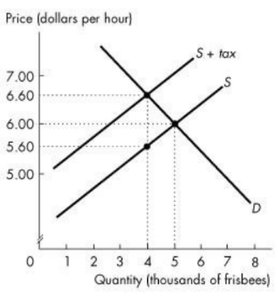
Q17. Refer to the figure below showing the market for frisbees before and after a tax is imposed. On each frisbee, the buyers' share of the tax is ___?
Background
Topic: Tax Incidence and Market Equilibrium
This question tests your understanding of how a tax imposed on a good affects the equilibrium price and quantity, and how the burden of the tax is shared between buyers and sellers (tax incidence).
Key Terms and Formulas
Tax Incidence: The division of the burden of a tax between buyers and sellers, depending on the relative elasticities of supply and demand.
Buyer's Share of Tax: The amount by which the price paid by buyers increases after the tax is imposed.
Seller's Share of Tax: The amount by which the price received by sellers decreases after the tax is imposed.
Equilibrium Price and Quantity: The price and quantity where the supply and demand curves intersect before the tax.
Step-by-Step Guidance
Identify the equilibrium price and quantity before the tax is imposed. This is where the original supply curve (S) and the demand curve (D) intersect.
Locate the new equilibrium after the tax is imposed. This is where the new supply curve (S + tax) intersects the demand curve (D).
Determine the price that buyers pay after the tax (move up from the new equilibrium to the demand curve).
Determine the price that sellers receive after the tax (move down from the new equilibrium to the original supply curve).
Calculate the difference between the price buyers pay after the tax and the equilibrium price before the tax. This difference is the buyers' share of the tax.
Try solving on your own before revealing the answer!
Final Answer: $0.60
Buyers' share of the tax is the increase in price they pay, which is $6.60 (after tax) minus $6.00 (before tax), resulting in $0.60 per frisbee.
This shows that buyers bear $0.60 of the tax per frisbee, while the rest is borne by sellers.
