 뒤로
뒤로Pricing Strategies in Microeconomics: Multiple Products, Price Discrimination, Peak-Load, and Cost-Plus Pricing
스터디 가이드 - 스마트 노트
 자료에 맞춘 맞춤형 노트, 핵심 정의, 예시, 맥락을 확장해 제공합니다.
Pricing of Goods
Introduction to Pricing Decisions
Pricing is one of the most critical decisions for managers, directly affecting both short-run profits and long-term success. Firms with market power face more complex pricing decisions than those in perfectly competitive markets, as they must consider demand characteristics and may benefit from advanced pricing strategies such as price discrimination.
Market Power: Firms with the ability to influence prices must analyze demand and consider differentiated pricing strategies.
Long-Term Impact: Pricing decisions today can affect future profitability and market position.
Pricing of Multiple Products
Production Interrelationships
When firms produce several products, managers must consider how these products are related, either through demand or production processes. Products may be produced in variable or fixed proportions, affecting pricing and output decisions.
By-Products: Some products are produced together, such as paper and packaging materials.
Fixed Ratio Production: If products are produced in a fixed ratio (e.g., 1:1), the marginal revenue of the combined output equals the sum of the marginal revenues of each product, set equal to marginal cost:
Example: A paper company produces paper and packaging materials in a 1:1 ratio. The cost and demand functions are:
Total Cost:
Marginal Cost:
Paper: ,
Packaging: ,


Since , total revenue and profit-maximizing output can be found by substituting and setting .
Price Discrimination
Definition and Types
Price discrimination is the practice of charging different prices to different consumers for similar goods. There are three main types:
First-Degree Price Discrimination: Charging each customer their reservation price.
Second-Degree Price Discrimination: Charging different prices for different quantities or blocks of the same good.
Third-Degree Price Discrimination: Charging different prices to distinct consumer groups based on demand elasticity.
First-Degree Price Discrimination
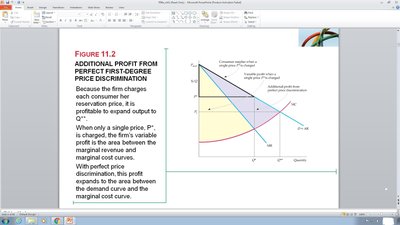
This strategy involves charging each customer the maximum they are willing to pay for each unit. The incremental revenue from each unit is the price paid, given by the demand curve. The additional profit is the area between the demand and marginal cost curves.
Profit Maximization: Expand production as long as .
Limitation: Rarely possible due to impracticality and lack of information about each customer's reservation price.
Second-Degree Price Discrimination
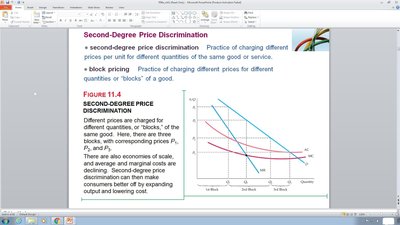
Firms charge different prices for different quantities of the same good, often seen in utilities or bulk purchases. This is also known as block pricing.
Example: A single light bulb costs $5, but a box of four costs $14 ($3.50 each).
Block Pricing: Electric companies charge different rates for different usage blocks.
Third-Degree Price Discrimination
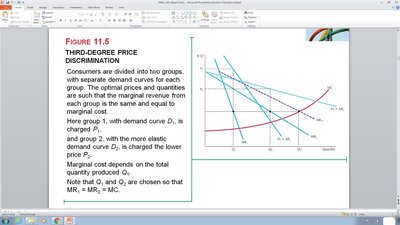
Consumers are divided into groups with separate demand curves. Examples include student or senior discounts, and advance-purchase airline tickets. The firm maximizes profit by equating marginal revenue and marginal cost for each group:
Relative prices depend on demand elasticities:
Peak-Load Pricing
Definition and Application
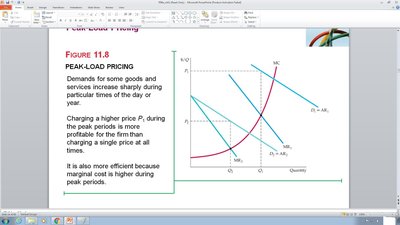
Peak-load pricing involves charging higher prices during periods of high demand when capacity constraints make marginal cost higher. This is common in electricity markets or amusement parks during peak times.
Efficiency: Higher prices during peak periods reflect higher marginal costs and allocate resources efficiently.
Example: Electricity prices are higher in winter or during the day when demand peaks.
Cost-Plus (Markup) Pricing
Definition and Steps
Cost-plus pricing sets prices by adding a markup to the average cost of production, aiming to achieve a target rate of return. This method is common in practice due to its simplicity.
Step 1: Calculate average cost (AC): , where and .
Step 2: Add markup to cover target profit: , where is total desired profit.
Example: An automobile manufacturer with TFC = $1 billion, and target profit of 10% on $2 billion investment, selling 100,000 units, would set price to cover costs plus target profit per unit.
Evaluation of Cost-Plus Pricing
Advantages: Simple, promotes price stability, and provides clear justification for price changes.
Criticism: Ignores demand conditions and may not maximize profit if demand is not considered.
