 뒤로
뒤로The Competitive Firm and Market Supply Curves: Microeconomics Study Notes
스터디 가이드 - 스마트 노트
 자료에 맞춘 맞춤형 노트, 핵심 정의, 예시, 맥락을 확장해 제공합니다.
The Competitive Firm
Definition and Characteristics
The competitive firm operates in a market where it takes the price as given, ignores the actions of rival firms, and does not engage in strategic behavior. The market determines the price, and individual firms, such as wheat farmers or small businesses, act as price takers.
Price Taker: The firm cannot influence the market price; it accepts the prevailing price.
No Strategic Behavior: Firms do not consider the actions of competitors when making decisions.
Demand Curve: The demand curve faced by a competitive firm is perfectly elastic at the market price.
Key Formulas:
Total Revenue: $TR = PQ$
Marginal Revenue: $MR = \Delta TR / \Delta Q$
Average Revenue: $AR = TR / Q$
For a price-taking firm, the demand curve is a horizontal line at the market price, and $P = MR = AR$.
Output Determination of a Competitive Firm
Profit Maximization
Firms aim to maximize profit, defined as the difference between total revenue and total cost:
Profit: $Profit = TR - TC$
Profit Maximizing Condition: Profits are maximized when $MR = MC$. For a competitive firm, $P = MR$, so the condition becomes $P = MC(Q)$.
Profit vs. Rent
Profit: $Profit = TR - TC = TR - (FC + TVC)$
Rent: $Rent = TR - TVC$ (avoidable opportunity cost)
Producer's Surplus: Rent is also known as Producer's Surplus, representing gains from trade on the production side.
Graphical methods to find TVC, rent, and profit:
Method 1: The area under the MC curve represents TVC.
Method 2: The rectangle area $TVC = AVC \times Q$.
Individual Supply Curve
The distinction between profit and rent is crucial for deriving the individual firm's supply curve:
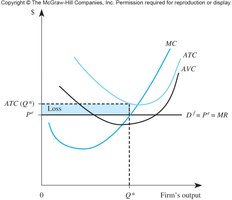
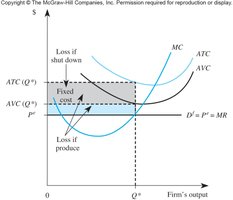
As long as $Rent \geq 0$, the firm produces in the short run ($P \geq AVC$). This is the shutdown point (minimum AVC).
When $Profit \geq 0$, the firm does not make a loss ($P \geq AC$). This is the breakeven point (minimum AC).
The firm's supply curve is the MC curve above the shutdown point.
The individual supply curve is always upward-sloping.
Equilibrium Profit
Understanding Economic Profit
Economic profit is the difference between total revenue and total cost, where total cost includes both explicit and implicit costs:
Total Cost: $TC = FC + TVC = \text{Sunk costs} + \text{Avoidable opportunity costs} = \text{Explicit costs} + \text{Implicit costs}$
Example: Jake's Yumburger stall illustrates explicit costs, accounting profit, economic costs, and economic profit. Economic profit considers opportunity costs, such as foregone salary.
Economic Profit in Equilibrium
In equilibrium, competitive firms earn zero economic profit.
Entry or exit of firms adjusts the output price, eliminating profit or loss.
If profit arises from a special factor input, its opportunity cost rises until profit is eliminated.
In equilibrium: $P = MC = minAC$ (the "trinity" condition).
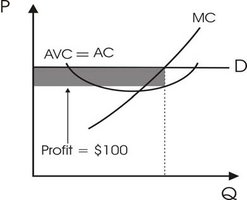
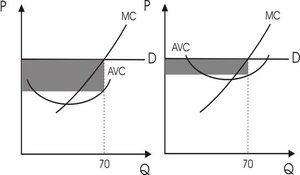
Rent in Equilibrium: Firms can earn rent (payment to the fixed factor of production) even when economic profit is zero.
Market Supply Curve
Definition and Construction
The market supply curve is the horizontal sum of individual supply curves, considering the distribution and characteristics of firms in the market.
Identical Firms: If all firms are identical (no sunk costs, same AC and MC), the market supply curve is flat at $P = minAC$, and $Q = Nq$.
Different Firms: If firms differ in fixed/sunk costs, those with lower AVC produce first as price rises, followed by others as price increases.
The market supply curve is upward-sloping, reflecting both intensive (existing firms produce more) and extensive (new firms enter) margin adjustments.
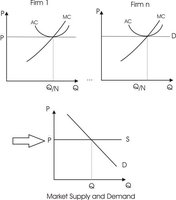
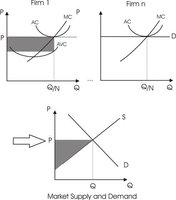
Equilibrium Outcomes
The marginal firm earns zero profit and zero rent.
Intra-marginal firms earn zero profit but positive rent.
Summary Table: Key Concepts
Concept | Formula | Condition |
|---|---|---|
Total Revenue (TR) | $TR = PQ$ | -- |
Marginal Revenue (MR) | $MR = \Delta TR / \Delta Q$ | -- |
Average Revenue (AR) | $AR = TR / Q$ | -- |
Profit Maximization | $MR = MC$ | Competitive firm: $P = MC$ |
Shutdown Point | $P = minAVC$ | Rent $\geq 0$ |
Breakeven Point | $P = minAC$ | Profit $\geq 0$ |
Economic Profit | $TR - TC$ | Zero in equilibrium |
Producer's Surplus (Rent) | $TR - TVC$ | Positive in equilibrium |
Additional info: Academic context was added to clarify the distinction between profit and rent, the construction of supply curves, and equilibrium outcomes for competitive firms.
