 뒤로
뒤로The Competitive Firm and Market Supply Curves
스터디 가이드 - 스마트 노트
 자료에 맞춘 맞춤형 노트, 핵심 정의, 예시, 맥락을 확장해 제공합니다.
The Competitive Firm and Market Supply Curves
The Competitive Firm
The competitive firm is a fundamental concept in microeconomics, describing a firm that operates in a perfectly competitive market. Such a firm is a price taker, meaning it accepts the market price as given and cannot influence it through its own actions.
Price Taking: Each firm takes the market price as given and does not engage in strategic behavior with rivals.
Market Determination: The price is determined by the overall market, not by individual firms.
Examples: Wheat farmers or small firms in highly competitive industries.
Demand Curve Faced by a Competitive Firm: The demand curve is perfectly elastic at the market price, meaning the firm can sell any quantity at that price but none at a higher price.
Total Revenue (TR):
Marginal Revenue (MR):
Average Revenue (AR):
For a competitive firm, .
Output Determination of a Competitive Firm
Firms aim to maximize profit, which is the difference between total revenue and total cost. The profit-maximizing output is found where marginal revenue equals marginal cost.
Profit:
Profit Maximizing Condition: ; for a competitive firm, .
Profit vs. Rent:
Profit:
Rent: (avoidable opportunity cost)
Rent is also called Producer Surplus, representing gains from trade on the production side.
Graphical methods to find TVC, rent, and profit:
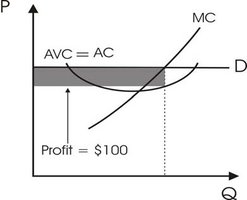
Method 1: The area under the MC curve equals TVC.
Method 2: The rectangle area .
Shutdown and Breakeven Points
Shutdown Point: The minimum of the AVC curve; the firm produces as long as .
Breakeven Point: The minimum of the AC curve; the firm earns zero profit when .
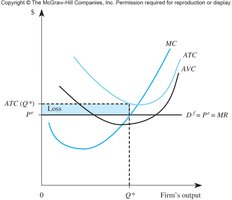
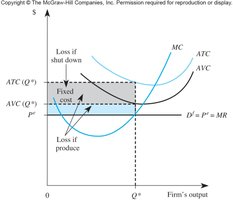
The firm supply curve is the MC curve above the shutdown point (minimum AVC), and is always upward-sloping.
Equilibrium Profit
Economic profit considers both explicit and implicit costs. In the long-run equilibrium of a competitive market, firms earn zero economic profit due to free entry and exit.
Economic Profit:
Total Cost:
Example: Calculating explicit costs, accounting profit, economic costs, and economic profit for a hypothetical business scenario.
In equilibrium:
Entry and exit of firms drive economic profit to zero.
If profit is due to a special input, its opportunity cost rises until profit is eliminated.
At equilibrium: (the 'trinity').
Firms can still earn rent (producer surplus) in equilibrium, which is payment to the fixed factor of production.
Individual and Market Supply Curves
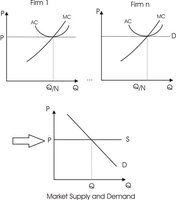
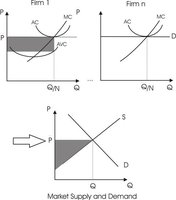
The individual supply curve of a competitive firm is its marginal cost curve above the shutdown point. The market supply curve is the horizontal sum of all individual supply curves.
Identical Firms: If all firms are identical, the market supply curve is flat at and .
Different Firms: If firms have different fixed costs, those with lower AVC produce first as price rises, and others enter as price increases.
The market supply curve is upward-sloping in general.
Summary Table: Key Profit and Rent Conditions
Condition | Mathematical Expression | Firm's Decision |
|---|---|---|
Shutdown Point | Firm is indifferent between producing and shutting down | |
Breakeven Point | Firm earns zero economic profit | |
Producer Surplus (Rent) | Firm continues to produce as long as rent is non-negative | |
Economic Profit | Entry/exit drives profit to zero in long-run equilibrium |
Additional info:
Producer surplus is the area above the supply curve and below the market price, representing the extra benefit producers receive above their variable costs.
In the long run, only the most efficient firms survive, and all firms earn zero economic profit but may still earn rent if they own a unique or fixed resource.
