Skip to main content
Nutrition
나의 코스
배우기
시험 준비
AI 튜터
학습 가이드
플래시카드
앱을 사용해 보세요
나의 코스
배우기
시험 준비
AI 튜터
학습 가이드
플래시카드
앱을 사용해 보세요
뒤로
Accessory Organs definitions
카드를 뒤집기 위해 탭할 수 있습니다.
Liver
카드를 뒤집기 위해 탭할 수 있습니다.
👆
Liver
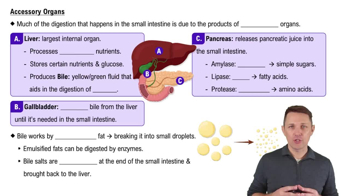
Largest internal organ responsible for processing absorbed nutrients, storing glucose, and producing bile for fat digestion.
진행 상황 추적
컨트롤 버튼이 '내비게이션' 모드로 변경되었습니다.
1/15
관련 플래시카드
관련 실천
추천 영상
Accessory Organs quiz
Accessory Organs
15 용어
Accessory Organs exam
Accessory Organs
26 용어
Accessory Organs
3. The Human Body & Digestion
10 문제점
주제
Nutrient Absorption and Transport
3. The Human Body & Digestion
10 문제점
주제
3. The Human Body & Digestion
7 주제
15 문제점
장
02:18
Accessory Organs Example 1
281
views
3
rank
04:54
Accessory Organs
341
views
6
rank
이 집합의 용어 (15)
하이드의 정의
Liver
Largest internal organ responsible for processing absorbed nutrients, storing glucose, and producing bile for fat digestion.
Gallbladder
Small organ beneath the liver that stores bile until it is needed in the small intestine for fat emulsification.
Pancreas
Feather-shaped organ releasing pancreatic juice containing enzymes and bicarbonate into the small intestine.
Bile
Yellow-green fluid produced by the liver that emulsifies fats, enabling digestive enzymes to access and break them down.
Bile Salts
Active components of bile that emulsify fats and are reabsorbed in the small intestine for recycling by the liver.
Pancreatic Juice
Secretion containing bicarbonate and digestive enzymes, neutralizing stomach acid and aiding macronutrient breakdown.
Bicarbonate
Substance in pancreatic juice that neutralizes acidic chyme, raising pH for safe and effective digestion in the small intestine.
Pancreatic Amylase
Enzyme in pancreatic juice that breaks down starches and carbohydrates into simple sugars for absorption.
Pancreatic Lipase
Enzyme in pancreatic juice that digests fats into fatty acids, facilitating their absorption in the small intestine.
Pancreatic Protease
Enzyme in pancreatic juice that breaks down proteins into amino acids for absorption in the small intestine.
Duodenum
First section of the small intestine where chyme mixes with secretions from accessory organs for digestion.
Emulsification
Process by which large fat droplets are broken into smaller ones, increasing surface area for enzyme action.
Chyme
Partially digested, acidic food mixture entering the small intestine from the stomach for further digestion.
Absorption
Process in the small intestine where nutrients and bile salts are taken up into the bloodstream for use or recycling.
Macronutrients
Nutritional components such as carbohydrates, fats, and proteins that require enzymatic breakdown for absorption.
 뒤로뒤로
뒤로뒤로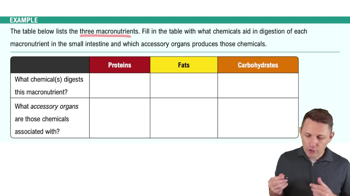
 02:18
02:18