Skip to main content
Nutrition
나의 코스
배우기
시험 준비
AI 튜터
학습 가이드
플래시카드
앱을 사용해 보세요
나의 코스
배우기
시험 준비
AI 튜터
학습 가이드
플래시카드
앱을 사용해 보세요
뒤로
Accessory Organs exam
카드를 뒤집기 위해 탭할 수 있습니다.
What is the main function of the liver in digestion?
카드를 뒤집기 위해 탭할 수 있습니다.
👆
What is the main function of the liver in digestion?
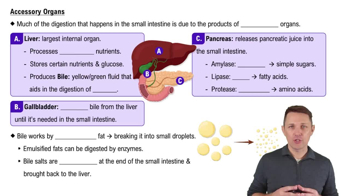
Processes absorbed nutrients and produces bile for fat digestion.
진행 상황 추적
컨트롤 버튼이 '내비게이션' 모드로 변경되었습니다.
1/26
관련 플래시카드
관련 실천
추천 영상
Accessory Organs definitions
Accessory Organs
15 용어
Accessory Organs quiz
Accessory Organs
15 용어
Accessory Organs
3. The Human Body & Digestion
10 문제점
주제
Nutrient Absorption and Transport
3. The Human Body & Digestion
10 문제점
주제
3. The Human Body & Digestion
7 주제
15 문제점
장
02:18
Accessory Organs Example 1
280
views
3
rank
04:54
Accessory Organs
340
views
6
rank
이 집합의 용어 (26)
하이드의 정의
What is the main function of the liver in digestion?
Processes absorbed nutrients and produces bile for fat digestion.
Gallbladder
A small organ that stores bile produced by the liver until it is needed in the small intestine.
Pancreatic amylase
An enzyme from the pancreas that digests starches (carbohydrates) into simple sugars.
What does bile do to fats in the small intestine?
Emulsifies fats, breaking them into smaller droplets for enzyme digestion.
Bile salts
Active components of bile that emulsify fats and are reabsorbed at the end of the small intestine.
Where is bile produced and where is it stored?
Bile is produced in the liver and stored in the gallbladder.
Pancreatic lipase
An enzyme from the pancreas that digests fats into fatty acids.
What is the role of bicarbonate in pancreatic juice?
Neutralizes stomach acid and raises the pH of chyme entering the small intestine.
Emulsification
The process of breaking up large fat globules into smaller droplets, increasing surface area for enzymes.
What happens to bile salts after they aid in fat digestion?
They are reabsorbed at the end of the small intestine and returned to the liver.
Pancreatic protease
An enzyme from the pancreas that digests proteins into amino acids.
Which organ is the largest internal organ in the body?
The liver.
What is the function of the gallbladder?
Stores and releases bile into the small intestine when needed.
Duodenum
The first section of the small intestine where chyme mixes with bile and pancreatic juices.
What is the main function of the pancreas in digestion?
Releases pancreatic juice containing enzymes and bicarbonate into the small intestine.
Why is emulsification important for fat digestion?
It increases the surface area of fats, making them more accessible to digestive enzymes.
What are the three main enzymes in pancreatic juice?
Amylase, lipase, and protease.
Accessory organs
Organs that aid digestion by producing and delivering fluids but do not directly contact food.
What does the liver do with absorbed nutrients?
Processes and stores nutrients, including glucose.
What is the function of pancreatic juice?
Neutralizes stomach acid and contains enzymes to digest carbohydrates, fats, and proteins.
How does bile reach the small intestine?
It is released from the gallbladder through ducts into the duodenum.
What is the role of the small intestine in relation to accessory organs?
Receives digestive fluids from accessory organs to aid in nutrient absorption.
What triggers the release of bile from the gallbladder?
The presence of fat in the small intestine.
Chyme
The semi-liquid mixture of partially digested food and gastric juices entering the small intestine.
What is the main purpose of the accessory organs in digestion?
To secrete fluids and enzymes that aid in the breakdown and absorption of nutrients.
How are bile salts recycled in the body?
They are reabsorbed in the small intestine and returned to the liver for reuse.
 뒤로뒤로
뒤로뒤로
 02:18
02:18