Skip to main content
Nutrition
나의 코스
배우기
시험 준비
AI 튜터
학습 가이드
플래시카드
앱을 사용해 보세요
나의 코스
배우기
시험 준비
AI 튜터
학습 가이드
플래시카드
앱을 사용해 보세요
뒤로
Water exam
카드를 뒤집기 위해 탭할 수 있습니다.
What percentage of the human body is water?
카드를 뒤집기 위해 탭할 수 있습니다.
👆
What percentage of the human body is water?
50-70% of body mass, depending on body composition, sex, and age.
진행 상황 추적
컨트롤 버튼이 '내비게이션' 모드로 변경되었습니다.
1/30
관련 플래시카드
관련 실천
추천 영상
Water definitions
Water
15 용어
Water quiz
Water
15 용어
Water quiz #1
Water
10 용어
Water
8. Water and Minerals
10 문제점
주제
Introduction to Minerals
8. Water and Minerals
10 문제점
주제
8. Water and Minerals
10 주제
15 문제점
장
05:47
Water Requirements
171
views
3
rank
04:15
Osmosis
211
views
4
rank
03:15
Water Example 2
165
views
2
rank
이 집합의 용어 (30)
하이드의 정의
What percentage of the human body is water?
50-70% of body mass, depending on body composition, sex, and age.
Intracellular fluid
Fluid found inside the cells; makes up about two-thirds of body water.
What is the main function of the hypothalamus in fluid balance?
It regulates hydration by triggering thirst and releasing ADH to retain water.
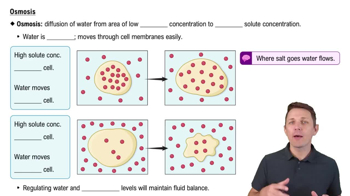
Osmosis
The diffusion of water from an area of low solute concentration to high solute concentration.
What is the recommended daily water intake for adult males?
3.7 liters per day.
Universal solvent
A substance, like water, that dissolves most solutes, enabling cellular functions.
What is the main difference between sensible and insensible water loss?
Sensible loss can be felt (urine, sweat), insensible loss cannot (breath, skin evaporation).
Extracellular fluid
Fluid outside the cells, including interstitial fluid, blood, and lymph; about one-third of body water.
How does the body respond to increased blood sodium or decreased blood volume?
The hypothalamus triggers thirst and releases ADH to retain water.
Antidiuretic hormone (ADH)
A hormone released by the pituitary gland that signals the kidneys to retain water.
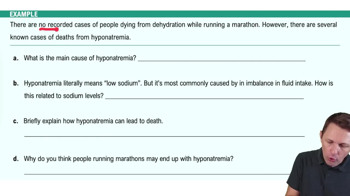
What is hyponatremia?
A dangerous condition caused by low sodium in extracellular fluid, often due to overhydration.
What are the main symptoms of dehydration?
Dark urine, strong thirst, loss of appetite, discomfort, headaches; severe cases can be fatal.
Interstitial fluid
The fluid that surrounds and bathes the body's cells.
What is the best indicator of hydration status?
Urine color; light yellow indicates good hydration.
Diuretic
A substance that increases urine production, leading to increased water loss.
What is the recommended daily water intake for adult females?
2.7 liters per day.
How much of daily water intake typically comes from beverages?
About 80%.
What is the effect of caffeine in coffee and tea on hydration?
Minimal diuretic effect; coffee and tea still count toward hydration.
What is the main function of water in temperature regulation?
Water's high heat capacity helps resist temperature changes and cools the body via sweat.
Electrolytes
Salts dissolved in body fluids that help regulate osmosis and fluid balance.
What happens to cells during dehydration?
Water leaves the cells by osmosis, causing them to shrink.
What is the role of water in tissue protection?
It cushions and lubricates tissues, such as in joints and around the brain and spinal cord.
How does overhydration affect cells?
Water enters cells by osmosis, causing them to swell; can lead to hyponatremia.
What is the myth about 'eight glasses of water a day'?
It's not a precise requirement; actual needs vary by sex, age, activity, and environment.
What populations are at higher risk for dehydration?
Infants and the elderly.
What is the main route of water loss from the body?
Urine.
How does alcohol affect fluid balance?
Alcohol is a diuretic, increasing urine production and risk of dehydration.
What is the function of thirst?
A physiological mechanism that creates the conscious desire to drink fluids.
What is the effect of sugary drinks on hydration and health?
They count toward hydration but add excess calories and sugars, increasing obesity risk.
How does body composition affect total body water?
More muscle mass increases body water percentage; more fat decreases it.
 뒤로뒤로
뒤로뒤로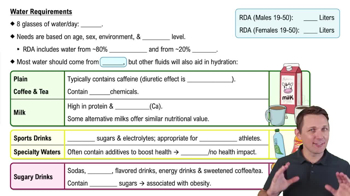
 05:47
05:47