Skip to main content
Organic Chemistry
나의 코스
배우기
시험 준비
AI 튜터
학습 가이드
교과서적 해결책
플래시카드
탐험해 보세요
앱을 사용해 보세요
나의 코스
배우기
시험 준비
AI 튜터
학습 가이드
교과서적 해결책
플래시카드
탐험해 보세요
앱을 사용해 보세요
뒤로
Acetylide quiz
카드를 뒤집기 위해 탭할 수 있습니다.
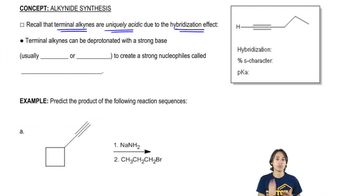
Why are terminal alkynes considered uniquely acidic compared to other hydrocarbons?
카드를 뒤집기 위해 탭할 수 있습니다.
👆
Why are terminal alkynes considered uniquely acidic compared to other hydrocarbons?
Terminal alkynes have high s-character due to sp hybridization, making their hydrogen more acidic than typical hydrocarbons.
진행 상황 추적
컨트롤 버튼이 '내비게이션' 모드로 변경되었습니다.
1/15
관련 플래시카드
관련 실천
추천 영상
Acetylide definitions
Alkynide Synthesis
15 용어
Acetylide
9. Alkenes and Alkynes
7 문제점
주제
Johnny
Hydrogenation of Alkynes
9. Alkenes and Alkynes
7 문제점
주제
Johnny
9. Alkenes and Alkynes - Part 1 of 2
5 주제
11 문제점
장
Ernest
9. Alkenes and Alkynes - Part 2 of 2
5 주제
11 문제점
장
Johnny
04:19
Understanding how to convert terminal alkynes to alkynides.
3959
views
30
rank
8
comments
02:57
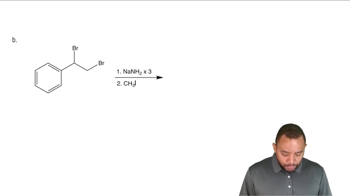
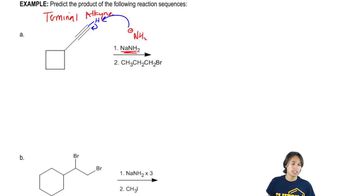
Using double dehydrohalogenation to perform alkynide synthesis.
3532
views
30
rank
17
comments
03:48
The mechanism of alkynide synthesis.
3554
views
39
rank
15
comments
이 집합의 용어 (15)
하이드의 정의
Why are terminal alkynes considered uniquely acidic compared to other hydrocarbons?
Terminal alkynes have high s-character due to sp hybridization, making their hydrogen more acidic than typical hydrocarbons.
What is the typical pKa value of a terminal alkyne?
The pKa of a terminal alkyne is about 25, which is unusually low for a hydrocarbon.
Which strong bases are commonly used to deprotonate terminal alkynes?
Sodium amide (NaNH2) and sodium hydride (NaH) are commonly used to deprotonate terminal alkynes.
What is formed when a terminal alkyne is deprotonated by a strong base?
A negatively charged species called a sodium alkynide (or alkynide ion) is formed.
What type of reaction occurs when a sodium alkynide reacts with a primary alkyl halide?
An SN2 nucleophilic substitution reaction occurs, forming a new carbon-carbon bond.
Why are sodium alkynides considered strong nucleophiles?
They have a negative charge localized on a carbon with high s-character, making them highly reactive toward electrophiles.
What is the role of sodium in sodium alkynide?
Sodium acts as a counterion, balancing the negative charge on the alkynide ion.
What is the result of reacting a sodium alkynide with a primary alkyl halide?
The alkynide replaces the halide, extending the carbon chain by forming a new C–C bond.
What is dehydrohalogenation of a vicinal dihalide?
It is the elimination of two halide groups from adjacent carbons, usually using a strong base, to form an alkyne.
How many moles of sodium amide are typically required to convert a vicinal dihalide to a terminal alkyne?
Three moles of sodium amide are typically required: two for eliminations and one for deprotonation of the terminal alkyne.
What happens to the terminal alkyne after dehydrohalogenation and treatment with excess sodium amide?
The terminal alkyne is deprotonated to form a negatively charged alkynide ion.
What is the next step after generating a terminal alkynide ion in synthesis?
The alkynide ion can react with a primary alkyl halide via SN2 to add a new alkyl group.
Why must the alkyl halide used in the SN2 reaction with sodium alkynide be primary?
Primary alkyl halides are less hindered and more reactive in SN2 reactions, preventing elimination or side reactions.
What is the final product when a terminal alkynide reacts with methyl iodide?
An internal alkyne is formed, with a methyl group added to the terminal carbon.
What is the significance of the hybridization effect in the acidity of terminal alkynes?
The sp hybridization gives the terminal carbon 50% s-character, increasing its ability to stabilize negative charge and thus its acidity.
 뒤로
뒤로

 04:19
04:19