Skip to main content
Organic Chemistry
나의 코스
배우기
시험 준비
AI 튜터
학습 가이드
교과서적 해결책
플래시카드
탐험해 보세요
앱을 사용해 보세요
나의 코스
배우기
시험 준비
AI 튜터
학습 가이드
교과서적 해결책
플래시카드
탐험해 보세요
앱을 사용해 보세요
뒤로
Catalytic Allylic Alkylation definitions
카드를 뒤집기 위해 탭할 수 있습니다.
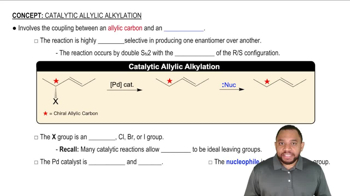
Allylic Carbon
카드를 뒤집기 위해 탭할 수 있습니다.
👆
Allylic Carbon
A carbon atom adjacent to a carbon-carbon double bond, often serving as a reactive site in coupling reactions.
진행 상황 추적
컨트롤 버튼이 '내비게이션' 모드로 변경되었습니다.
1/14
관련 플래시카드
관련 실천
추천 영상
Catalytic Allylic Alkylation quiz
Catalytic Allylic Alkylation
15 용어
Catalytic Allylic Alkylation
35. Transition Metals
5 문제점
주제
Alkene Metathesis
35. Transition Metals
5 문제점
주제
27. Transition Metals - Part 1 of 4
6 주제
14 문제점
장
Johnny
35. Transition Metals - Part 2 of 4
4 주제
12 문제점
장
35. Transition Metals - Part 3 of 4
4 주제
12 문제점
장
35. Transition Metals - Part 4 of 4
3 주제
9 문제점
장
VideoThumbView.guidedCourse
3:13
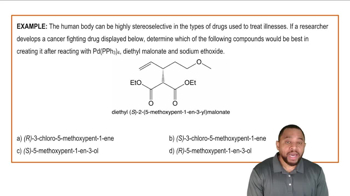
Catalytic Allylic Alkylation Example 1
562
views
VideoThumbView.guidedCourse
3:21
Catalytic Allylic Alkylation Concept 1
562
views
이 집합의 용어 (14)
하이드의 정의
Allylic Carbon
A carbon atom adjacent to a carbon-carbon double bond, often serving as a reactive site in coupling reactions.
Enolate
A resonance-stabilized anion formed by deprotonation at the alpha position of a carbonyl compound, acting as a nucleophile.
Stereoselectivity
A reaction preference for forming one stereoisomer over another, often resulting in a single enantiomer.
Enantiomer
A non-superimposable mirror image molecule, differing in spatial arrangement and optical activity.
Double SN2 Mechanism
A two-step nucleophilic substitution process involving consecutive backside attacks, leading to retention of configuration.
Retention of Configuration
A process where the spatial arrangement of atoms around a chiral center remains unchanged after a reaction.
Inversion of Configuration
A change in the spatial arrangement at a chiral center, typically resulting from a single SN2 reaction.
Palladium Catalyst
A transition metal complex that facilitates bond formation and selectivity in organic transformations.
Ligand
An atom or group attached to a central metal atom, influencing the reactivity and selectivity of a catalyst.
Leaving Group
An atom or group that departs with an electron pair during a substitution reaction, enabling nucleophilic attack.
Halogen
A group 17 element, such as chlorine, bromine, or iodine, commonly serving as a leaving group in organic reactions.
Ester
A functional group derived from an acid and an alcohol, often acting as a leaving group in catalytic processes.
Triphenylphosphine
An organophosphorus compound frequently used as a ligand in palladium-catalyzed reactions.
Nucleophile
A species with a lone pair or pi electrons, capable of donating electrons to form a new covalent bond.
 뒤로뒤로
뒤로뒤로
 3:13
3:13