Skip to main content
Organic Chemistry
나의 코스
배우기
시험 준비
AI 튜터
학습 가이드
교과서적 해결책
플래시카드
탐험해 보세요
앱을 사용해 보세요
나의 코스
배우기
시험 준비
AI 튜터
학습 가이드
교과서적 해결책
플래시카드
탐험해 보세요
앱을 사용해 보세요
뒤로
Claisen-Schmidt Condensation quiz
카드를 뒤집기 위해 탭할 수 있습니다.
What is the Claisen-Schmidt condensation?
카드를 뒤집기 위해 탭할 수 있습니다.
👆
What is the Claisen-Schmidt condensation?
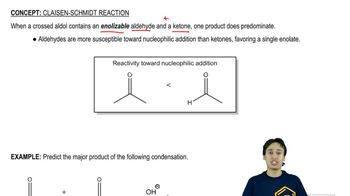
It is a specific type of crossed aldol reaction involving an enolizable aldehyde and an enolizable ketone.
진행 상황 추적
컨트롤 버튼이 '내비게이션' 모드로 변경되었습니다.
1/15
관련 플래시카드
관련 실천
추천 영상
Claisen-Schmidt Condensation definitions
Claisen-Schmidt Condensation
13 용어
Claisen-Schmidt Condensation
25. Condensation Chemistry
5 문제점
주제
Laura
Claisen Condensation
25. Condensation Chemistry
6 문제점
주제
Johnny
22. Condensation Chemistry - Part 1 of 3
3 주제
9 문제점
장
Ernest
22. Condensation Chemistry - Part 2 of 3
4 주제
12 문제점
장
Johnny
25. Condensation Chemistry - Part 3 of 3
2 주제
6 문제점
장
Johnny
02:28
Predict the Major Product
1791
views
9
rank
10
comments
02:10
Claisen-Schmidt Reaction
1925
views
8
rank
3
comments
이 집합의 용어 (15)
하이드의 정의
What is the Claisen-Schmidt condensation?
It is a specific type of crossed aldol reaction involving an enolizable aldehyde and an enolizable ketone.
How does the Claisen-Schmidt reaction differ from typical crossed aldol reactions?
Unlike typical crossed aldol reactions, it uses two enolizable carbonyl compounds and still predominantly yields a single product.
Why are crossed aldol reactions usually performed with one non-enolizable carbonyl compound?
This prevents multiple products from forming, making the reaction more selective.
What is meant by 'enolizable' in the context of carbonyl compounds?
An enolizable compound has alpha hydrogens that can be deprotonated to form an enolate ion.
Why does the Claisen-Schmidt reaction favor the formation of one product?
Aldehydes are more susceptible to nucleophilic addition than ketones, so the reaction favors one enolate over the other.
In the Claisen-Schmidt reaction, which compound typically acts as the electrophile?
The aldehyde typically acts as the electrophile because it is more reactive toward nucleophilic addition.
What role does the ketone play in the Claisen-Schmidt condensation?
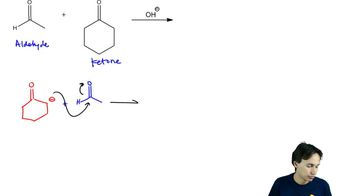
The ketone usually forms the enolate, which attacks the aldehyde.
What would theoretically happen if both the aldehyde and ketone formed enolates in the Claisen-Schmidt reaction?
Multiple products could form, leading to a mixture, but in practice, only one product predominates.
Why is the Claisen-Schmidt reaction considered an exception to the rule about crossed aldol reactions?
It allows both reactants to be enolizable and still produces mainly one product.
What is the major product of a Claisen-Schmidt condensation between an enolizable ketone and an enolizable aldehyde?
The major product is the result of the enolate from the ketone attacking the aldehyde.
How does the susceptibility of aldehydes to nucleophilic addition affect the Claisen-Schmidt reaction?
It makes the aldehyde more likely to be attacked, favoring its role as the electrophile.
What is the significance of the Punnett square analogy in the Claisen-Schmidt reaction?
It illustrates the potential for multiple products, but in reality, only one product predominates.
Can both the ketone and aldehyde form enolates in the Claisen-Schmidt reaction?
Yes, both can theoretically form enolates, but only the ketone enolate reacts predominantly.
What is encouraged when predicting the outcome of a Claisen-Schmidt condensation?
Students should predict the major product formed when both reactants are enolizable.
Why does the Claisen-Schmidt reaction not result in a mess of products despite both reactants being enolizable?
Because the aldehyde is more reactive as an electrophile, the reaction is selective and yields mainly one product.
 뒤로뒤로
뒤로뒤로


 02:28
02:28