Skip to main content
Organic Chemistry
나의 코스
배우기
시험 준비
AI 튜터
학습 가이드
교과서적 해결책
플래시카드
탐험해 보세요
앱을 사용해 보세요
나의 코스
배우기
시험 준비
AI 튜터
학습 가이드
교과서적 해결책
플래시카드
탐험해 보세요
앱을 사용해 보세요
뒤로
Nucleophilic Substitution definitions
카드를 뒤집기 위해 탭할 수 있습니다.
Nucleophile
카드를 뒤집기 위해 탭할 수 있습니다.
👆
Nucleophile
Species with high electron density, often carrying a negative charge, that donates electrons to form new bonds.
진행 상황 추적
컨트롤 버튼이 '내비게이션' 모드로 변경되었습니다.
1/15
관련 플래시카드
관련 실천
추천 영상
Nucleophilic Substitution quiz
Introduction to Substitution
10 용어
Nucleophilic Substitution quiz #1
Introduction to Substitution
16 용어
Nucleophilic Substitution
7. Substitution Reactions
5 문제점
주제
Ernest
Good Leaving Groups
7. Substitution Reactions
7 문제점
주제
Johnny
7. Substitution Reactions
5 주제
15 문제점
장
Johnny
05:55
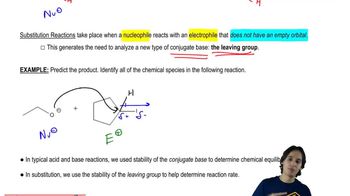
Predict the product
5360
views
148
rank
22
comments
05:01
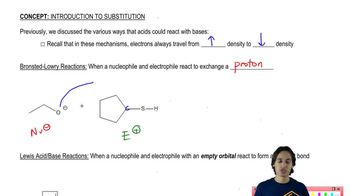
Nucleophiles and Electrophiles can react in Bronsted-Lowry Reactions.
7201
views
93
rank
23
comments
01:47
Nucleophiles and Electrophiles can react in Substitution Reactions.
5663
views
65
rank
5
comments
이 집합의 용어 (15)
하이드의 정의
Nucleophile
Species with high electron density, often carrying a negative charge, that donates electrons to form new bonds.
Electrophile
Species with low electron density, often neutral or electron-deficient, that accepts electrons during reactions.
Substitution Reaction
Process where a nucleophile replaces a group attached to an electrophile, requiring bond breaking and forming.
Bronsted-Lowry Reaction
Type of acid-base process involving proton transfer and formation of a conjugate base and new bond.
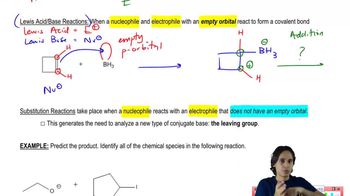
Lewis Acid
Electron-deficient species, often with an empty orbital, that readily accepts electron pairs.
Lewis Base
Electron-rich species capable of donating a pair of electrons to form a covalent bond.
Leaving Group
Atom or group that departs with an electron pair when a new bond forms during substitution.
Conjugate Base
Species formed after an acid donates a proton, often acting as a leaving group in reactions.
Formal Charge
Calculated value indicating electron distribution on an atom, used to assess stability after reactions.
Octet
Stable electron configuration where an atom possesses eight valence electrons, guiding bond formation.
Dipole
Separation of charge within a bond, creating partial positive and negative regions that influence reactivity.
Acidic Hydrogen
Hydrogen atom with partial positive character, easily transferred during acid-base or substitution reactions.
Sigma Bond
Single covalent bond formed by direct overlap of orbitals, resulting from electron pair sharing.
Empty Orbital
Unoccupied atomic or molecular region capable of accepting electron pairs during bond formation.
Equilibrium Arrow
Symbol indicating reversible reactions, especially in proton transfer processes.
 뒤로뒤로
뒤로뒤로

 05:55
05:55