Pyrimidine dimers can lead to cancer by causing mutations in DNA, which disrupt normal cellular processes and can result in uncontrolled cell growth.
What type of mutation results from one nucleotide being substituted for another?
A point mutation results from one nucleotide being substituted for another.
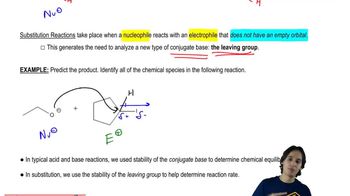
What is a nucleophile in the context of substitution reactions?
A nucleophile is an electron donor that attacks an electrophile in substitution reactions.
What role does a leaving group play in substitution reactions?
A leaving group is the atom or group that departs after a nucleophile forms a new bond with the electrophile.
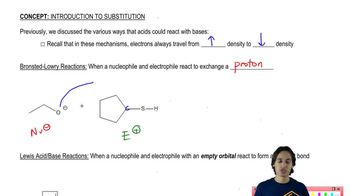
How do electrons move in acid-base reactions?
Electrons move from regions of high density (nucleophiles) to regions of low density (electrophiles) in acid-base reactions.
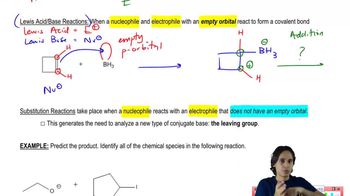
What is the difference between Bronsted-Lowry and Lewis acid-base reactions?
Bronsted-Lowry reactions involve proton exchange, while Lewis acid-base reactions involve electron donation to an empty orbital without hydrogen exchange.
Why is boron considered a good electrophile?
Boron is a good electrophile because it has an incomplete octet and an empty p orbital that can accept electrons.
What happens when a nucleophile attacks an electrophile without an empty orbital?
A bond must be broken to accommodate the new bond formed by the nucleophile's attack, resulting in a leaving group.
What is the significance of dipoles in determining the electrophile in a reaction?
Dipoles help identify the most positive atom in a molecule, which is typically the electrophile in a reaction.
What is the precursor to a very important reaction in the addition chapter?
The precursor is the formation of a new covalent bond between a nucleophile and an electrophile without hydrogen exchange, as seen in Lewis acid-base reactions.
 뒤로
뒤로

 05:55
05:55