Skip to main content
Organic Chemistry
나의 코스
배우기
시험 준비
AI 튜터
학습 가이드
교과서적 해결책
플래시카드
탐험해 보세요
앱을 사용해 보세요
나의 코스
배우기
시험 준비
AI 튜터
학습 가이드
교과서적 해결책
플래시카드
탐험해 보세요
앱을 사용해 보세요
뒤로
SN1 Reaction definitions
카드를 뒤집기 위해 탭할 수 있습니다.
SN1 Mechanism
카드를 뒤집기 위해 탭할 수 있습니다.
👆
SN1 Mechanism
A two-step substitution process involving a neutral nucleophile and formation of a carbocation intermediate.
진행 상황 추적
컨트롤 버튼이 '내비게이션' 모드로 변경되었습니다.
1/15
관련 플래시카드
관련 실천
추천 영상
SN1 Reaction quiz #1
SN1 Mechanism
12 용어
SN1 Reaction
7. Substitution Reactions
7 문제점
주제
Ernest
Substitution Comparison
7. Substitution Reactions
7 문제점
주제
Ernest
7. Substitution Reactions
5 주제
15 문제점
장
Johnny
10:49
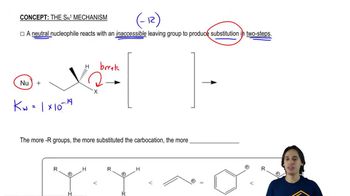
Drawing the SN1 Mechanism
7500
views
98
rank
49
comments
01:13
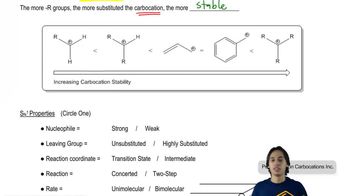
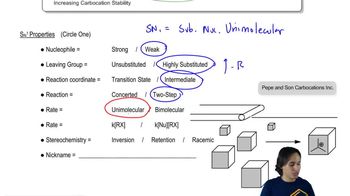
Why highly substituted leaving groups favor SN1.
5532
views
61
rank
8
comments
08:16
Understanding the properties of SN1.
5754
views
71
rank
14
comments
이 집합의 용어 (15)
하이드의 정의
SN1 Mechanism
A two-step substitution process involving a neutral nucleophile and formation of a carbocation intermediate.
Carbocation
A positively charged carbon species with three bonds, sp2 hybridization, and trigonal planar geometry.
Intermediate
A distinct, isolatable species formed between steps of a reaction, unlike a fleeting transition state.
Leaving Group
An atom or group, often a halogen, that departs from the substrate, enabling carbocation formation.
Nucleophile
A neutral molecule with electron pairs that attacks electrophilic centers, often a solvent in this context.
Unimolecular Kinetics
A rate law dependent solely on substrate concentration, reflecting the slow, carbocation-forming step.
Racemization
The creation of a 1:1 mixture of enantiomers due to planar intermediate allowing attack from either side.
Solvolysis
A reaction where the solvent acts as the nucleophile, commonly observed in this substitution process.
Tertiary Alkyl Halide
A substrate with three alkyl groups attached to the carbon bearing the leaving group, favoring carbocation stability.
Rate-Determining Step
The slowest stage in a reaction sequence, here being the dissociation to form a carbocation.
Trigonal Planar Geometry
A flat, three-bonded arrangement around a central atom, characteristic of carbocation intermediates.
Substitution Product
The final molecule formed when a nucleophile replaces a leaving group on the substrate.
Transition State
A high-energy, non-isolatable configuration; in this mechanism, replaced by a true intermediate.
Alkyl Group
A hydrocarbon fragment attached to the reactive center, increasing carbocation stability with greater substitution.
First-Order Reaction
A process where the reaction rate depends linearly on the concentration of only one reactant.
 뒤로뒤로
뒤로뒤로

 10:49
10:49