뒤로
뒤로Acid-Base Equilibria: Strong and Weak Acids, pH, and Titrations
스터디 가이드 - 스마트 노트
 자료에 맞춘 맞춤형 노트, 핵심 정의, 예시, 맥락을 확장해 제공합니다.
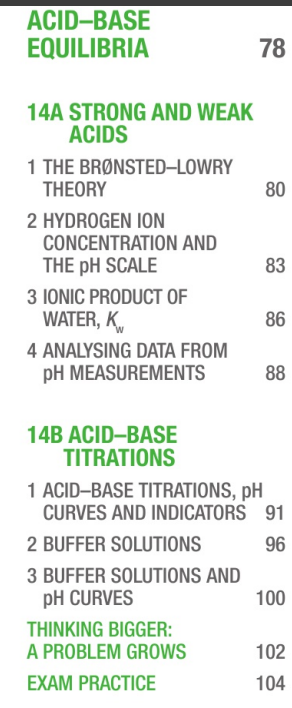
Acid-Base Equilibria
14A Strong and Weak Acids
The Brønsted–Lowry Theory
The Brønsted–Lowry theory defines acids as proton (H+) donors and bases as proton acceptors. This concept expands the definition of acids and bases beyond those that contain hydroxide or hydrogen ions, allowing for a broader range of acid-base reactions.
Acid: A substance that donates a proton to another substance.
Base: A substance that accepts a proton.
Example: In the reaction between hydrochloric acid and water: HCl acts as the acid, and water acts as the base.
Hydrogen Ion Concentration and the pH Scale
The pH scale is a logarithmic measure of hydrogen ion concentration in a solution. It is used to quantify the acidity or basicity of a solution.
pH Formula:
Acidic solutions: pH < 7
Neutral solutions: pH = 7
Basic solutions: pH > 7
Example: A solution with M has a pH of 3.
Ionic Product of Water, Kw
The ionic product of water () is the equilibrium constant for the self-ionization of water. It is important for understanding the relationship between hydrogen and hydroxide ion concentrations in aqueous solutions.
Equation:
At 25°C,
Example: In pure water, M
Analysing Data from pH Measurements
pH measurements are used to determine the concentration of hydrogen ions in a solution, which can be used to calculate other properties such as acidity, basicity, and equilibrium constants.
Key Point: Accurate pH measurements allow for the determination of acid and base strengths, calculation of equilibrium constants, and analysis of buffer systems.
Example: Using pH data to calculate the concentration of an unknown acid in solution.
14B Acid-Base Titrations
Acid-Base Titrations, pH Curves and Indicators
Acid-base titrations are analytical techniques used to determine the concentration of an acid or base by reacting it with a solution of known concentration. pH curves and indicators are used to monitor the progress of the titration and identify the equivalence point.
Titration Curve: A plot of pH versus volume of titrant added.
Indicator: A substance that changes color at a specific pH, signaling the endpoint of the titration.
Example: Titrating acetic acid with sodium hydroxide and using phenolphthalein as an indicator.
Buffer Solutions
Buffer solutions are mixtures of a weak acid and its conjugate base (or a weak base and its conjugate acid) that resist changes in pH when small amounts of acid or base are added.
Buffer Equation:
Example: A mixture of acetic acid and sodium acetate acts as a buffer.
Buffer Solutions and pH Curves
Buffer solutions are often analyzed using pH curves to observe their resistance to pH changes. These curves demonstrate the effectiveness of a buffer in maintaining a stable pH.
Key Point: Buffers maintain pH within a narrow range, even when acids or bases are added.
Example: Addition of HCl to a buffer solution causes only a slight decrease in pH compared to pure water.
Thinking Bigger: A Problem Grows
This section likely presents a complex, real-world problem involving acid-base equilibria, titrations, or buffer systems, requiring the application of multiple concepts discussed above.
Key Point: Integrating knowledge of acid-base theory, pH, titrations, and buffers to solve advanced problems.
Exam Practice
Practice questions and problems are provided to reinforce understanding and prepare for exams on acid-base equilibria, titrations, and buffer solutions.
Key Point: Applying theoretical knowledge to practical and exam-style questions.