 뒤로
뒤로Acid-Base Reactions: Brønsted-Lowry and Lewis Theories, Strength, and Equilibria
스터디 가이드 - 스마트 노트
 자료에 맞춘 맞춤형 노트, 핵심 정의, 예시, 맥락을 확장해 제공합니다.
Acid-Base Reactions
Brønsted-Lowry Theory of Acids and Bases
The Brønsted-Lowry theory defines acids as proton (H+) donors and bases as proton acceptors. This concept is fundamental in organic chemistry for understanding proton transfer reactions.
Brønsted acid: Proton donor
Brønsted base: Proton acceptor
Example:
Example:
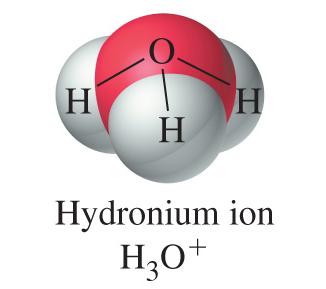
Hydronium ion (H3O+) is the actual form of the proton in aqueous solution, formed when acids donate protons to water.
Proton Transfer and Reaction Mechanisms
Proton transfer reactions are illustrated using electron-pushing (curved arrow) notation to show the movement of electron pairs during bond breaking and formation.
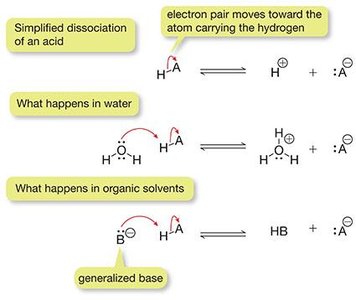
In water, acids transfer protons to water molecules, forming hydronium ions. In organic solvents, a generalized base abstracts the proton.
Conjugate Acid-Base Pairs
Definition and Identification
Every acid-base reaction involves two conjugate pairs. The acid forms its conjugate base after donating a proton, and the base forms its conjugate acid after accepting a proton.
Conjugate acid: The species formed when a base gains a proton.
Conjugate base: The species formed when an acid loses a proton.
Example: (base) (conjugate acid); (acid) $\rightarrow$ (conjugate base)
Acid and Base Strength
Strong vs. Weak Acids and Bases
The strength of an acid or base is determined by its degree of ionization in water. Strong acids and bases ionize completely, while weak acids and bases only partially ionize.
Strong acid: Ionizes completely in water (e.g., HNO3, HCl)
Weak acid: Partially ionizes (e.g., CH3COOH)
Strong base: Ionizes completely (e.g., NaOH)
Weak base: Partially ionizes (e.g., NH3)
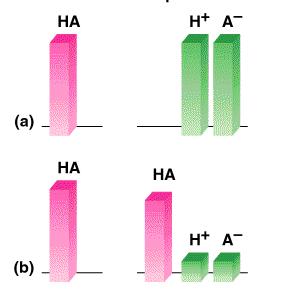
In strong acids, nearly all HA dissociates to H+ and A-. In weak acids, most HA remains undissociated.
Acid Ionization Constant (Ka) and pKa
The acid ionization constant () quantifies the extent of acid dissociation in water. The pKa is the negative logarithm of $K_a$ and is commonly used to compare acid strengths.
Strong acids: , small or negative
Weak acids: , positive
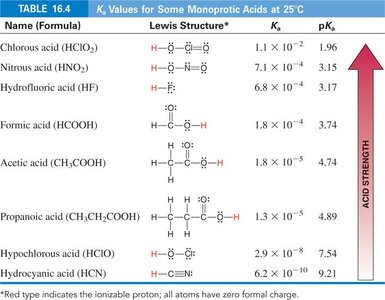
This table compares and values for several monoprotic acids, illustrating the range of acid strengths.
Free Energy and Acid Strength
The favorability of acid dissociation is related to the change in free energy (). Strong acids have negative $\Delta G^\circ$, while weak acids have positive $\Delta G^\circ$.
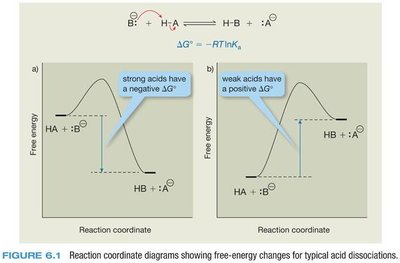
Strong acids dissociate with a negative free energy change, favoring products. Weak acids have a positive free energy change, favoring reactants.
pH, pKa, and the Henderson-Hasselbalch Equation
pH and pKa Relationship
pH measures the concentration of H+ ions in solution, while pKa reflects acid strength. Both are logarithmic scales, so small changes have large effects on equilibrium.
A difference of 1 pH unit = 10-fold change in [H+]
A difference of 2 pH units = 100-fold change
Henderson-Hasselbalch Equation
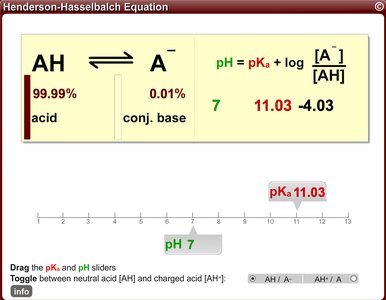
The Henderson-Hasselbalch equation relates pH, pKa, and the ratio of conjugate base to acid. It is essential for buffer calculations and predicting ionization states.
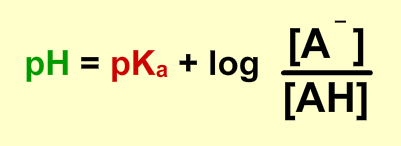
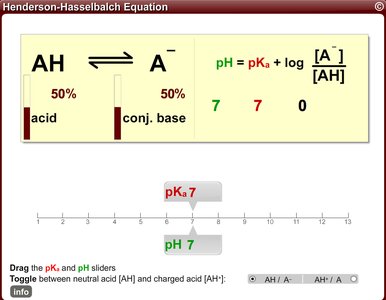
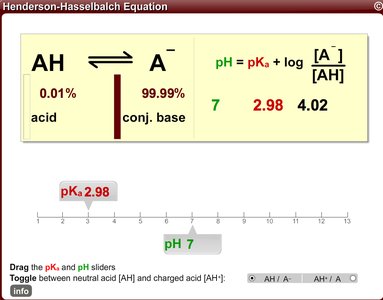
When [A-] = [HA], pH = pKa. If pH > pKa, the conjugate base predominates; if pH < pKa, the acid predominates.
Predicting Acid-Base Equilibria
Direction of Acid-Base Reactions
The favored direction of an acid-base reaction is from the stronger acid (lower pKa) to the weaker acid (higher pKa). The equilibrium favors the side with the weaker acid and base.
Compare pKa values: Reaction proceeds from lower to higher pKa
If pKa values are unavailable, compare conjugate base stability using five criteria
Factors Affecting Acid Strength
1. Atom Size
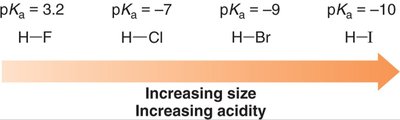
As the size of the atom bearing the negative charge increases (down a group), the conjugate base becomes more stable, and the acid becomes stronger.
Example: (pKa = 3.2) < (pKa = -7) < (pKa = -9) < (pKa = -10)
2. Electronegativity
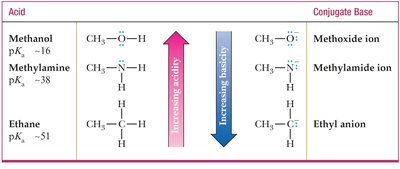
As electronegativity increases (across a period), the conjugate base is better able to stabilize the negative charge, increasing acid strength.
3. Resonance
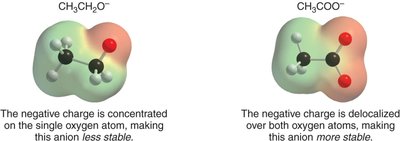
Resonance delocalizes the negative charge in the conjugate base, stabilizing it and increasing acid strength.
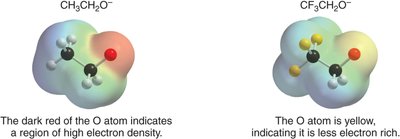
4. Inductive Effects
Electronegative atoms near the acidic proton withdraw electron density, stabilizing the conjugate base. The effect decreases with distance and increases with the number of electronegative atoms.
5. Hybridization
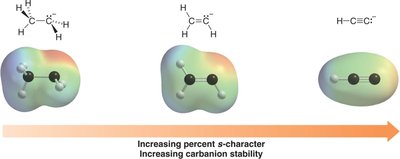
Greater s-character in the atom bearing the negative charge increases acidity. For carbon acids: sp > sp2 > sp3.
sp (50% s): pKa ≈ 25
sp2 (33% s): pKa ≈ 44
sp3 (25% s): pKa ≈ 50
Lewis Acid-Base Theory
Definitions
The Lewis theory broadens the definition of acids and bases:
Lewis acid: Electron pair acceptor (electrophile)
Lewis base: Electron pair donor (nucleophile)

Many organic reactions are best understood using the Lewis concept, especially those involving electron pair movement rather than proton transfer.
Summary Table: Factors Affecting Acid Strength
Factor | Effect on Acid Strength | Example |
|---|---|---|
Atom Size | Increases down a group | HI > HBr > HCl > HF |
Electronegativity | Increases across a period | CH4 < NH3 < H2O < HF |
Resonance | Delocalizes charge, stabilizes base | Acetic acid vs. ethanol |
Inductive Effect | Stabilizes base via electron withdrawal | CF3COOH > CH3COOH |
Hybridization | More s-character, stronger acid | HC≡CH > H2C=CH2 > CH3CH3 |
Learning Outcomes
Identify acids, bases, conjugate acids, and conjugate bases in reactions
Compare acid and base strength using pKa values and qualitative criteria
Predict the direction of acid-base equilibria
Determine the ionization state of a compound at a given pH using the Henderson-Hasselbalch equation
Apply Brønsted-Lowry and Lewis definitions to classify reagents and mechanisms
