 뒤로
뒤로Aldol and Related Condensations: Enolate Chemistry and Synthetic Applications
스터디 가이드 - 스마트 노트
 자료에 맞춘 맞춤형 노트, 핵심 정의, 예시, 맥락을 확장해 제공합니다.
Chapter IV: Aldol Condensations and Enolate Chemistry
Introduction to Alpha Substitution and Carbonyl Condensations
Alpha (α) substitution and carbonyl condensation reactions are fundamental in organic synthesis, particularly for constructing complex molecules. These reactions involve the chemistry of the carbon atom adjacent to a carbonyl group (the α-carbon), which is rendered more acidic due to resonance stabilization of the resulting enolate ion. Enolate ions and enols are nucleophilic and can participate in substitution and condensation reactions, forming new carbon-carbon bonds.
Alpha Substitution: Replacement of an α-hydrogen with another group via enolate or enol intermediates.
Carbonyl Condensation: The enolate ion attacks another carbonyl compound, leading to C–C bond formation.

Enols and Enolate Ions
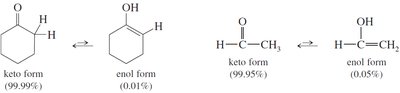
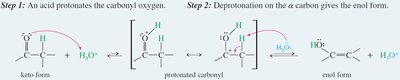
Ketones and aldehydes can form enolate ions in the presence of strong bases. The equilibrium between the keto and enol forms is known as keto–enol tautomerism. Tautomers are structural isomers that interconvert by the migration of a proton and a shift of a double bond.
Keto–Enol Tautomerism: The keto form is usually favored due to greater stability, but the enol form is important in many reactions.
Acid/Base Catalysis: Both acid and base can catalyze tautomerization by facilitating proton transfer.
Formation and Reactivity of Enolate Ions
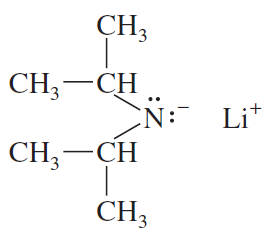
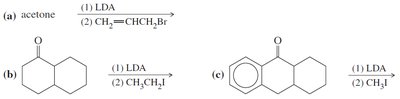
Enolate ions are generated by deprotonation of the α-carbon using a strong base. The most effective base for complete enolate formation is lithium diisopropylamide (LDA), which is non-nucleophilic and strong enough to fully convert carbonyl compounds to their enolates.
Enolate Structure: Enolates are resonance-stabilized anions with nucleophilic character at both the α-carbon and the oxygen atom.
Base Selection: LDA is preferred when complete enolate formation is required before reaction with an electrophile.

Alkylation of Enolate Ions
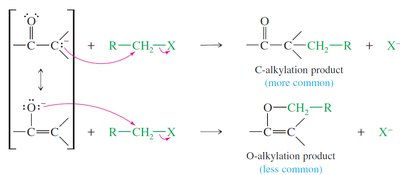
Enolate ions can undergo alkylation, where an alkyl halide reacts with the enolate to form a new C–C bond, typically at the α-carbon. This reaction is a key method for chain extension in organic synthesis.
C-Alkylation: The most common pathway, leading to a new carbon-carbon bond at the α-position.
O-Alkylation: Less common, involves alkylation at the oxygen atom.
Alpha Halogenation of Ketones and Acids
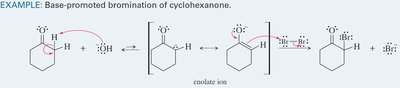
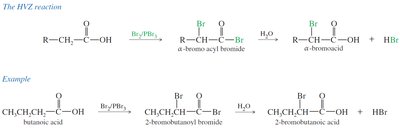
Ketones and carboxylic acids can undergo α-halogenation, where a halogen replaces an α-hydrogen. In ketones, this is typically base- or acid-catalyzed. For carboxylic acids, the Hell–Volhard–Zelinsky (HVZ) reaction is used.
Base-Promoted Halogenation: Involves enolate formation followed by halogenation.
HVZ Reaction: Specifically brominates the α-position of carboxylic acids.
The Aldol Condensation
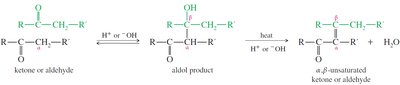
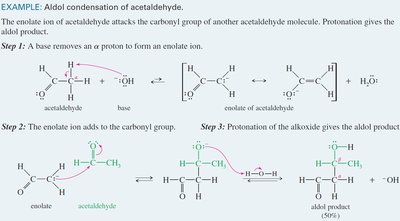
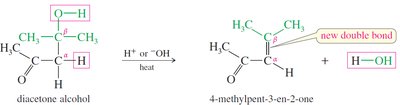
The aldol condensation is a fundamental reaction in organic synthesis, involving the nucleophilic addition of an enolate ion to another carbonyl compound. The initial product is a β-hydroxy carbonyl compound (an 'aldol'), which can dehydrate to form an α,β-unsaturated carbonyl compound.
Base-Catalyzed Aldol Condensation: Enolate ion attacks a carbonyl group, followed by protonation.
Acid-Catalyzed Aldol Condensation: Enol acts as a nucleophile toward a protonated carbonyl group.
Dehydration: Heating the aldol product leads to loss of water and formation of a conjugated double bond.
Crossed Aldol Condensations
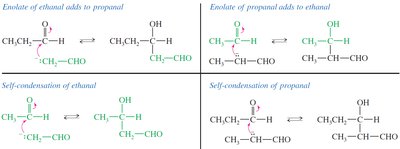
When two different carbonyl compounds are used, the reaction is called a crossed (or mixed) aldol condensation. Careful selection of reactants is necessary to avoid complex mixtures. If only one reactant can form an enolate, the reaction is more selective.
Product Diversity: Multiple products are possible unless one reactant lacks α-hydrogens.
Strategic Use: Crossed aldol condensations are useful for constructing complex molecules when selectivity can be controlled.
Intramolecular Aldol (Aldol Cyclizations)
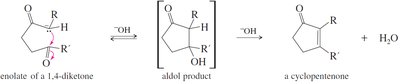
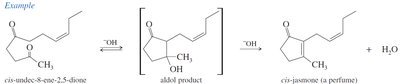
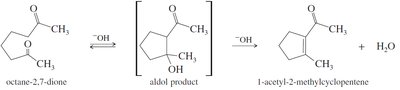
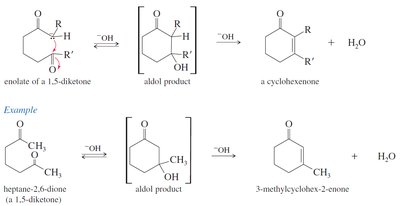
When a molecule contains two carbonyl groups, an intramolecular aldol reaction can occur, leading to ring formation. Five- and six-membered rings are most commonly formed due to favorable ring strain considerations.
Ring Size: Cyclizations to five- and six-membered rings are favored.
Applications: Useful for synthesizing cyclic ketones and enones.
Claisen Ester Condensation
The Claisen condensation is the ester analogue of the aldol reaction. It involves the condensation of two esters (or one ester and one ketone) to form a β-keto ester. The reaction proceeds via enolate formation and nucleophilic acyl substitution.
Mechanism: Enolate ion attacks the carbonyl carbon of another ester, forming a tetrahedral intermediate and eliminating an alkoxide.
Product: β-Keto ester, which is a valuable synthetic intermediate.
Dieckmann Condensation
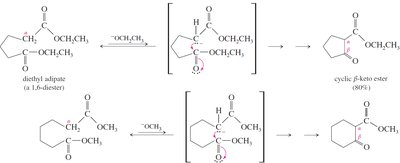
The Dieckmann condensation is an intramolecular Claisen condensation, leading to the formation of cyclic β-keto esters. Five- and six-membered rings are most easily formed due to favorable ring closure energetics.
Mechanism: Similar to the Claisen condensation but occurs within a single molecule.
Applications: Useful for synthesizing cyclic compounds in organic synthesis.
Summary Table: Key Reactions of Enolate Chemistry
Reaction | Reactants | Product | Key Features |
|---|---|---|---|
Alpha Substitution | Carbonyl + Electrophile | α-Substituted carbonyl | Via enolate/enol intermediate |
Alkylation | Enolate + Alkyl halide | α-Alkylated carbonyl | New C–C bond at α-carbon |
Alpha Halogenation | Ketone/acid + Halogen | α-Halogenated product | Base or acid catalyzed |
Aldol Condensation | Enolate + Carbonyl | β-Hydroxy carbonyl | May dehydrate to α,β-unsaturated carbonyl |
Claisen Condensation | 2 Esters | β-Keto ester | Enolate addition to ester |
Dieckmann Condensation | Diester | Cyclic β-keto ester | Intramolecular Claisen |
Additional info: The mechanisms and synthetic strategies discussed here are foundational for advanced organic synthesis, including the construction of complex natural products and pharmaceuticals.
