 뒤로
뒤로Amines and Their Derivatives: Structure, Reactivity, and Synthesis
스터디 가이드 - 스마트 노트
 자료에 맞춘 맞춤형 노트, 핵심 정의, 예시, 맥락을 확장해 제공합니다.
Amines and Derivatives
Introduction to Amines
Amines are organic compounds derived from ammonia (NH3) in which one or more hydrogen atoms are replaced by alkyl or aryl groups. They play crucial roles in biological systems, including neurotransmission, bioregulation, and defense mechanisms. Many amines are pharmacologically active and are used as drugs and medicines.
Definition: Amines are nitrogen-containing organic compounds with the general formula RNH2, R2NH, or R3N.
Biological Importance: Examples include histamine (vasodilation), piperazine (anthelmintic), niacin (vitamin), and pyridoxine (vitamin B6).
Applications: Used in pharmaceuticals, agriculture, and as intermediates in organic synthesis.
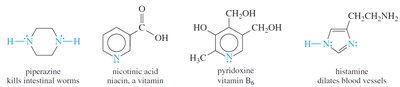
Nomenclature and Classification of Amines
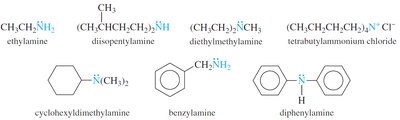
Amines are classified based on the number of organic groups attached to the nitrogen atom:
Primary (1°) amines: One alkyl or aryl group attached to nitrogen (RNH2).
Secondary (2°) amines: Two groups attached (R2NH).
Tertiary (3°) amines: Three groups attached (R3N).
Quaternary ammonium salts: Four groups attached, nitrogen bears a positive charge (R4N+).
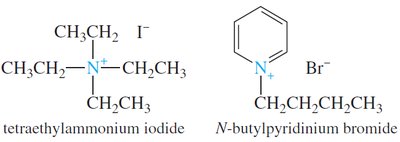
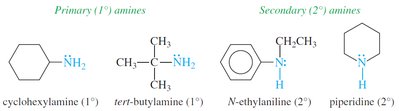
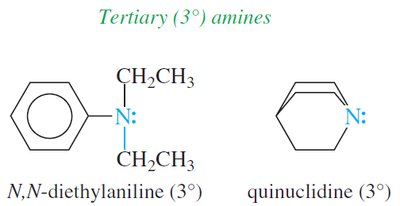
Common Naming: Names are based on the alkyl groups attached to nitrogen, followed by "-amine". Prefixes di-, tri-, tetra- indicate multiple identical groups.
IUPAC Naming: The longest carbon chain determines the root name. The suffix "-amine" replaces "-e" in the alkane name. The position of the amino group is indicated by a number. Substituents on nitrogen are denoted by "N-".

Examples and Practice
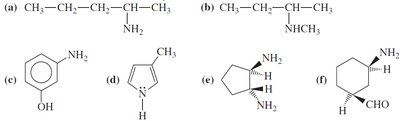
Structure Drawing: Practice drawing structures for tert-butylamine, α-aminopropionaldehyde, N-ethyl-N-methylhexan-3-amine, m-chloroaniline.
Naming Practice: Assign correct names to given amine structures.
Basicity and Reactivity of Amines
Basicity of Amines
Amines act as nucleophiles (Lewis bases) due to the lone pair of electrons on nitrogen. They can also function as Brønsted–Lowry bases by accepting protons.
Key Point: The basicity of amines is influenced by the nature of substituents and their ability to donate or withdraw electrons.
Example: Alkyl amines are generally more basic than aryl amines due to electron-donating effects.
Reactions of Amines
Aromatic Substitution of Amines
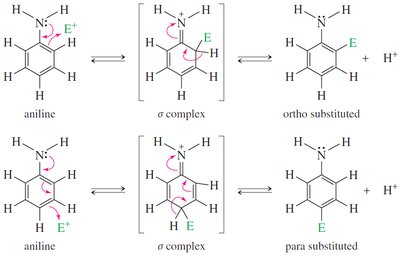
In arylamines, the nitrogen's lone pair stabilizes intermediates during electrophilic aromatic substitution, making amino groups strong activating, ortho/para-directing groups.
Key Point: Amino groups facilitate substitution at ortho and para positions.
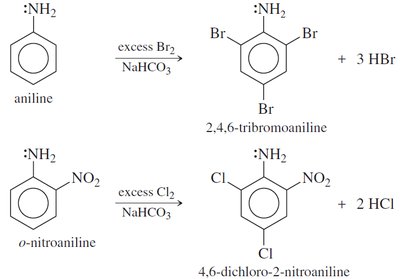
Example: Halogenation of aniline derivatives occurs readily without a catalyst; excess reagent leads to full substitution at ortho and para positions.
Alkylation of Amines by Alkyl Halides
Amines react with primary alkyl halides via SN2 mechanism to form alkylated ammonium halides. Tertiary halides are too hindered for SN2, and secondary halides often yield elimination products.
Equation:
Key Point: Alkylation is most efficient with primary halides.

Acylation of Amines by Acid Halides
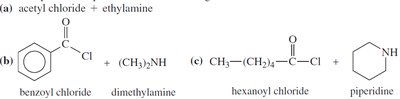
Primary and secondary amines react with acid halides to form amides via nucleophilic acyl substitution.
Equation:
Key Point: Acylation is used to synthesize amides from amines.

Amines as Leaving Groups: The Hofmann Elimination
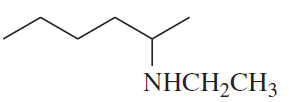
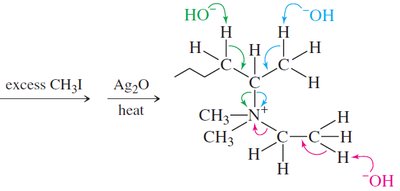
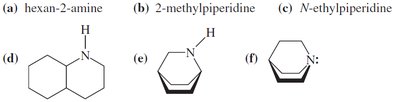
Amines can be converted to alkenes via elimination reactions after being transformed into good leaving groups (e.g., quaternary ammonium salts). The Hofmann elimination is a concerted E2 reaction, typically yielding the least-substituted alkene (contrary to Zaitsev's rule).
Equation:
Key Point: Hofmann elimination favors less-substituted alkene products.

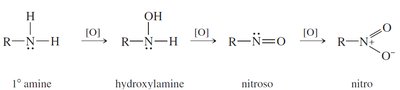
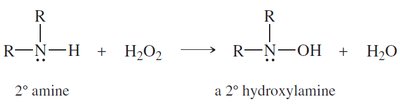
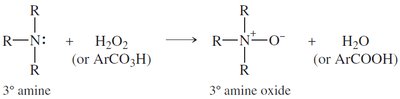
Oxidation of Amines; The Cope Elimination
Primary amines: Oxidized easily, often yielding complex mixtures.
Secondary amines: Oxidized to hydroxylamines.
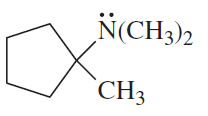
Tertiary amines: Oxidized to amine oxides, which can undergo Cope elimination to yield the least-substituted alkene.
Reactions of Amines with Nitrous Acid
Amines react with nitrous acid (HONO) to form diazonium salts, which are useful intermediates in organic synthesis.
Mechanism: Nitrous acid protonates and loses water to form the nitrosonium ion, which reacts with primary amines to yield diazonium cations.
Key Point: Alkanediazonium salts are unstable and decompose to nitrogen and carbocations.

Reactions of Arenediazonium Salts
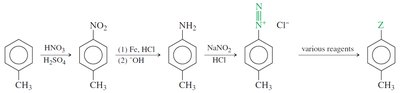
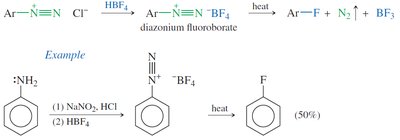
Arenediazonium salts are formed by diazotizing primary aromatic amines. These salts can be used to introduce a variety of functional groups onto aromatic rings, such as hydroxide, halides, cyanide, and hydrogen.
Sandmeyer Reaction: Replacement of diazonium group by chloride, bromide, or cyanide.
Hydrolysis: Replacement by hydroxide.
Reduction: Replacement by hydrogen (deamination).
Fluorination/Iodination: Replacement by fluoride or iodide.
Synthesis of Amines: Reductive Amination
Reductive amination is a two-step process: formation of an imine or oxime from a ketone or aldehyde, followed by reduction to the amine.
Equation:
Key Point: Reductive amination is a versatile method for synthesizing primary, secondary, and tertiary amines.



Additional info:
These notes cover the structure, nomenclature, basicity, reactivity, and synthetic methods for amines, corresponding to Chapter 21 in standard Organic Chemistry textbooks.
Key reactions include aromatic substitution, alkylation, acylation, elimination (Hofmann and Cope), oxidation, diazotization, and reductive amination.
Tables and mechanisms are illustrated with relevant images to reinforce concepts.
