 뒤로
뒤로Amino Acids and Peptides: Structure, Properties, and Reactions
스터디 가이드 - 스마트 노트
 자료에 맞춘 맞춤형 노트, 핵심 정의, 예시, 맥락을 확장해 제공합니다.
Proteins Are Polymers of Amino Acids
Basic Structure of Amino Acids
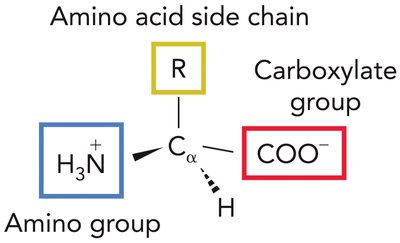
All amino acids share a common structure consisting of a central tetrahedral α-carbon (Cα) bonded to four different groups: a carboxyl group, an amino group, a hydrogen atom, and a unique side chain (R group). The diversity of R groups gives rise to the 20 standard amino acids found in proteins.
Peptides are short chains of amino acids (usually less than 40 residues), also called oligopeptides.
Proteins are long polypeptide chains composed of amino acid residues linked by peptide bonds.
Stereochemistry of Amino Acids
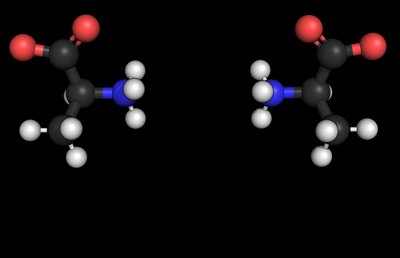
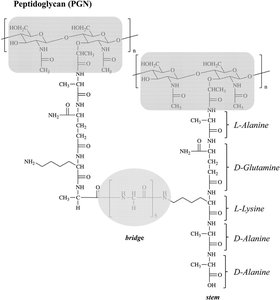
The α-carbon is chiral in all amino acids except glycine, which has two hydrogen atoms. This chirality allows for two enantiomers: L and D forms. In biological systems, almost all amino acids are L-amino acids, which share the same absolute configuration. D-amino acids are rare but can be found in bacterial cell walls (e.g., peptidoglycan).
Enantiomers are non-superimposable mirror images.
The D/L system specifies the absolute configuration of the amino acid.
Classification of Amino Acids
Grouping by Side Chain Properties
The 20 standard amino acids are classified based on the chemical properties of their side chains (R groups):
Nonpolar (hydrophobic)
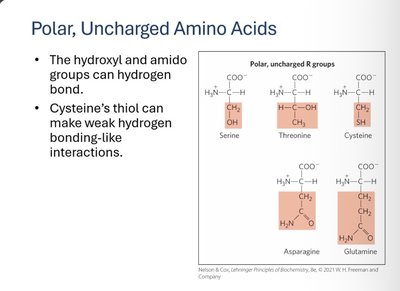
Polar, uncharged
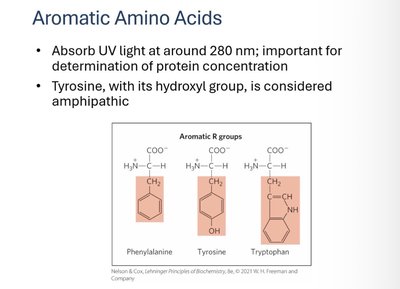
Aromatic
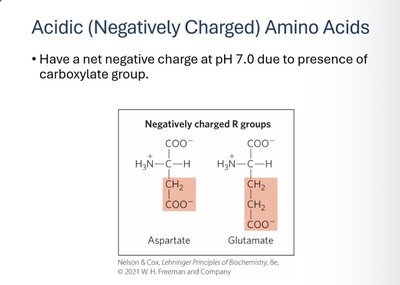
Acidic (negatively charged)
Basic (positively charged)
Covalent Modifications of Amino Acids
Phosphorylation and Dephosphorylation
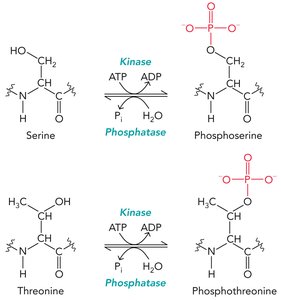
Enzymes called kinases add phosphate groups to proteins (commonly on serine and threonine residues) using ATP as the phosphate donor. Phosphatases remove these phosphate groups. These modifications regulate protein function and signaling pathways.
Acid-Base Properties of Amino Acids
Zwitterions and Buffering
At physiological pH (~7), amino acids exist as zwitterions, carrying both a positive (amino group) and negative (carboxyl group) charge. The carboxyl and amino groups can act as acids or bases, allowing amino acids to buffer changes in pH.
At low pH: both groups are protonated (net positive charge).
At high pH: both groups are deprotonated (net negative charge).
At neutral pH: zwitterion form (net charge = 0).
Titration Curves and Isoelectric Point (pI)
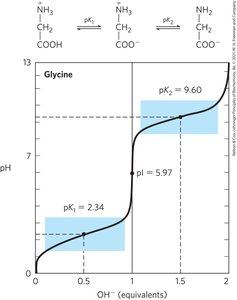
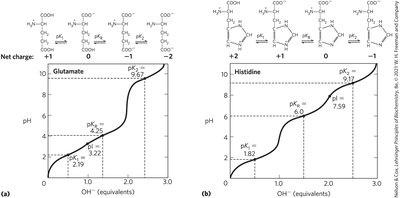
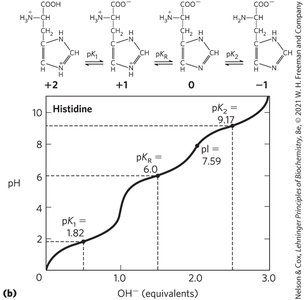
The titration curve of an amino acid shows how its charge changes with pH. The isoelectric point (pI) is the pH at which the net charge is zero. For amino acids without ionizable side chains:
At pH = pI, the amino acid is least soluble in water and does not migrate in an electric field.
For amino acids with ionizable side chains, the pI is calculated using the pKa values on either side of the neutral form.
Peptide Bond Formation and Properties
Amidation and Peptide Bond Formation
A peptide bond is formed by a condensation reaction between the carboxyl group of one amino acid and the amino group of another, releasing water. This reaction is catalyzed by the ribosome in cells. Peptide bonds are hydrolyzed by proteases.
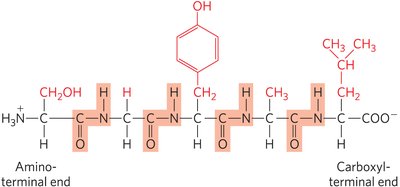
Peptides are unbranched chains of amino acids (residues) linked by peptide bonds.
Peptides have directionality: the sequence is written from the N-terminal (amino end) to the C-terminal (carboxyl end).
Peptide Nomenclature and Directionality
Peptides are named by listing the amino acid residues from the N-terminus to the C-terminus. Abbreviations include three-letter and one-letter codes.
Ionizable Groups in Peptides
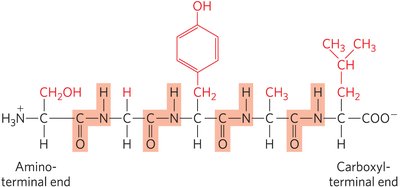
In peptides, only the N-terminal α-amino group, the C-terminal α-carboxyl group, and any ionizable side chains contribute to the overall charge and pI of the peptide. The amide group in the peptide bond is not ionizable.
Biological Functions of Peptides
Hormonal Peptides
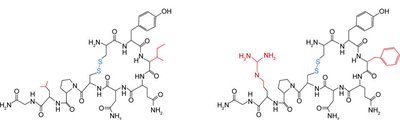
Many small peptides act as hormones or signaling molecules. For example, oxytocin and vasopressin are peptide hormones with important physiological roles and contain disulfide bonds that stabilize their structure.
Summary Table: Amino Acid Classification
Group | Examples | Key Properties |
|---|---|---|
Nonpolar | Glycine, Alanine, Valine | Hydrophobic, aliphatic side chains |
Polar, uncharged | Serine, Threonine, Cysteine | Hydrogen bonding, some can form disulfide bonds |
Aromatic | Phenylalanine, Tyrosine, Tryptophan | Absorb UV light, amphipathic (tyrosine) |
Acidic | Aspartate, Glutamate | Negatively charged at pH 7 |
Basic | Lysine, Arginine, Histidine | Positively charged at pH 7 (except histidine, which is partially protonated) |
