 뒤로
뒤로Aromatic Compounds: Structure, Stability, and Applications
스터디 가이드 - 스마트 노트
 자료에 맞춘 맞춤형 노트, 핵심 정의, 예시, 맥락을 확장해 제공합니다.
Chapter 16: Aromatic Compounds
Introduction to Aromatic Compounds
Aromatic compounds are a class of organic molecules characterized by the presence of one or more benzene rings. Historically, these compounds were named for their pleasant odors, but their chemical properties are defined by their unique ring structures and electron delocalization. Benzene (C6H6) is the prototypical aromatic compound, first isolated by Michael Faraday and later synthesized by Eilhard Mitscherlich. Aromatic hydrocarbons, also known as arenes, differ from aliphatic hydrocarbons in their reactivity and structure.
Benzene: The simplest aromatic hydrocarbon, consisting of a six-membered ring with alternating double bonds.
Arenes: Compounds containing one or more benzene rings.
Aliphatic compounds: Organic compounds not containing aromatic rings.
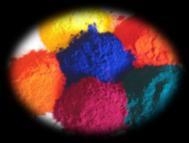
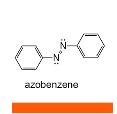
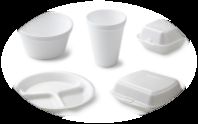
Applications: Aromatic compounds are foundational in pharmaceuticals, dyes, plastics, explosives, perfumes, fuels, and pesticides.



Structure and Reactivity of Benzene
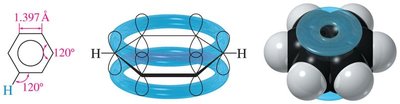
Benzene is much less reactive than typical alkenes, failing to undergo addition reactions. Instead, it undergoes substitution reactions, highlighting its unique stability. August Kekulé proposed a ring structure with alternating single and double bonds, but modern understanding reveals that benzene is a resonance hybrid with delocalized electrons.
Resonance Hybrid: Benzene's electrons are delocalized over the ring, represented by a hexagon with an inscribed circle.
Bond Lengths: All C–C bonds in benzene are equal (1.397 Å), intermediate between single and double bonds.
Planarity: Benzene is planar, with 120° bond angles, indicating sp2 hybridization.
Nomenclature of Benzene Derivatives
Benzene derivatives are named by indicating substituents as prefixes or by using common parent names. When two substituents are present, their positions are described as ortho (o-), meta (m-), or para (p-), or by numbers.
Monosubstituted Benzenes: Named by prefixing the substituent (e.g., chlorobenzene).
Common Names: Toluene, phenol, aniline, benzoic acid.
Disubstituted Benzenes: Positions 2 and 6: ortho; 3 and 5: meta; 4: para.
Multiple Substituents: Use lowest possible numbers.
Stability of Benzene and Annulenes
Benzene exhibits greater stability than predicted by its heat of hydrogenation, due to resonance energy. Annulenes are cyclic hydrocarbons with alternating single and double bonds, but not all are aromatic.
Resonance Energy: The difference between predicted and observed heat of hydrogenation.
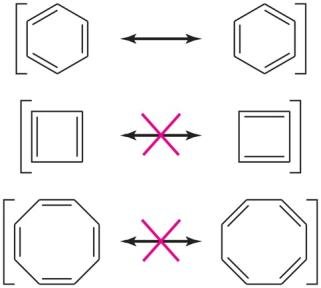
Annulenes: Benzene ([6]-annulene), cyclobutadiene ([4]-annulene), cyclooctatetraene ([8]-annulene).
Aromaticity Criterion: Not all conjugated cyclic molecules are aromatic.
Aromaticity and the Hückel (4n+2) Rule
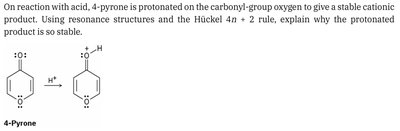
Aromatic compounds must be cyclic, planar, fully conjugated, and contain (4n+2) π electrons (where n is an integer). This rule, derived from molecular orbital theory, distinguishes aromatic from anti-aromatic and non-aromatic compounds.
Hückel Rule: Only monocyclic conjugated molecules with (4n+2) π electrons are aromatic.
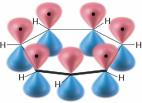
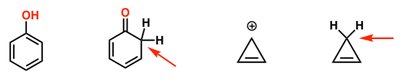
Planarity: All atoms must be sp2 hybridized for continuous π-electron delocalization.
Anti-aromaticity: Compounds with 4n π electrons are destabilized.
Examples of Aromatic, Anti-aromatic, and Non-aromatic Compounds
Compounds are classified based on their cyclicity, planarity, conjugation, and π electron count. Benzene is aromatic, cyclobutadiene is anti-aromatic, and cyclooctatetraene is non-aromatic.
Aromatic: Cyclic, planar, fully conjugated, (4n+2) π electrons.
Anti-aromatic: Cyclic, planar, fully conjugated, 4n π electrons.
Non-aromatic: Lacks planarity or conjugation.
Determining π Electrons: π electrons reside in p orbitals; sp2 hybridized atoms have one p orbital each.
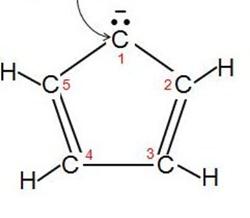
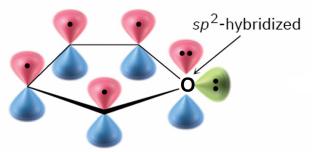
Aromaticity of Furan
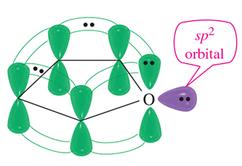
Furan is a five-membered ring with an oxygen atom. It is aromatic because it is cyclic, planar, fully conjugated, and follows Hückel's rule with 6 π electrons. The oxygen atom is sp2 hybridized, and one lone pair participates in the π system.

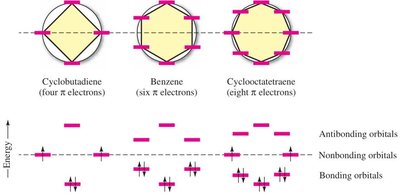
The Polygon Rule in Molecular Orbital Theory
The Polygon Rule states that the molecular orbital (MO) energy diagram of a fully conjugated cyclic system resembles the shape of its regular polygon, with one vertex at the lowest energy level. If all π electrons fill only bonding orbitals, the system is aromatic; if some occupy antibonding orbitals, it is anti-aromatic.
Aromatic Ions
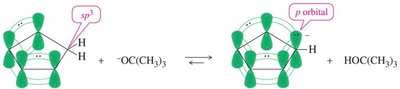
The Cyclopentadienyl Ion
Cyclopentadiene is unusually acidic because loss of a proton converts it to the aromatic cyclopentadienyl anion, which has 6 π electrons and a continuous π system.
The Cycloheptatrienyl Ion
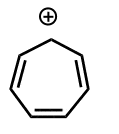
Cycloheptatriene is non-aromatic, but its cation (tropylium ion) is aromatic with 6 π electrons. The anion is anti-aromatic and highly reactive.
Polynuclear Aromatic Hydrocarbons (PAHs)
PAHs consist of two or more fused aromatic rings, such as naphthalene, anthracene, phenanthrene, pyrene, and benzo[a]pyrene. These compounds are important in environmental chemistry and materials science.
Heterocyclic Aromatic Compounds
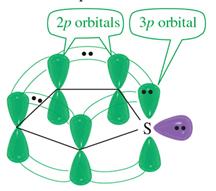
Heterocyclic compounds contain at least one atom other than carbon in the ring. Aromatic heterocycles include pyridine, pyrrole, furan, thiophene, imidazole, and pyrimidine. The aromaticity depends on the electronic structure and the role of heteroatoms.
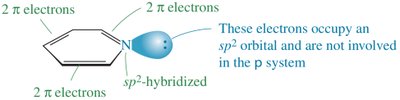
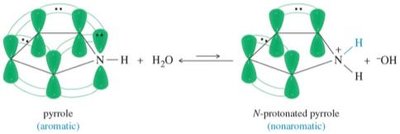
Pyridine and Pyrrole
Pyrrole: Aromatic due to delocalized lone pair on nitrogen. N-protonated pyrrole is non-aromatic (sp3 nitrogen).
Pyridine: Acts as a Brønsted base; protonation leaves aromatic π system intact.
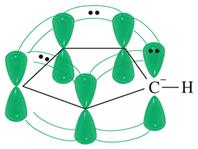
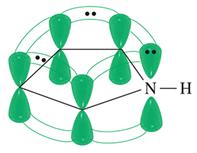
Pyrimidine and Imidazole
Imidazole and pyrimidine are aromatic rings with two nitrogen atoms. Purine, a fused ring system, is a key component of DNA and RNA.
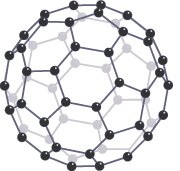
Allotropes of Carbon: Diamond, Graphite, and Fullerenes
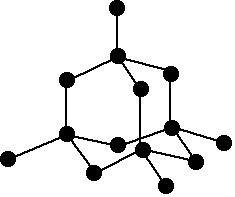
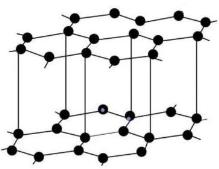
Carbon exists in several allotropes, each with distinct bonding and properties:
Feature | Diamond | Graphite | Fullerenes |
|---|---|---|---|
Bonding | 3D tetrahedral (sp3) | 2D hexagonal layers (sp2) | 3D spherical/tubular (sp2) |
Hardness | Very hard | Soft/slippery | Varies |
Electrical Conductivity | Insulator | Conductor | Semi-conductive/insulating |
Thermal Conductivity | Excellent | Poor (except certain directions) | Varies |
Transparency | Transparent | Opaque | Opaque |
Practice Problems
Provide IUPAC names for aromatic compounds.
Draw structures for named aromatic compounds.
Identify isomers and predict aromaticity based on structure and electron count.
Apply the polygon-and-circle method to orbital diagrams.
Explain stability using resonance and Hückel's rule.
Additional info: The notes expand on brief points with academic context, including definitions, examples, and explanations of aromaticity, resonance, and hybridization. All images included are directly relevant to the adjacent content, visually reinforcing key concepts.
