 뒤로
뒤로Aromaticity and Reactions of Aromatic Compounds: Electrophilic Aromatic Substitution and Birch Reduction
스터디 가이드 - 스마트 노트
 자료에 맞춘 맞춤형 노트, 핵심 정의, 예시, 맥락을 확장해 제공합니다.
Aromaticity and Reactions of Aromatic Compounds
Electrophilic Aromatic Substitution (EAS)
Electrophilic Aromatic Substitution (EAS) is a fundamental reaction in organic chemistry where an aromatic ring reacts with an electrophile, resulting in the substitution of a hydrogen atom on the ring. The regioselectivity of EAS is strongly influenced by substituents already present on the aromatic ring, which can be electron-donating groups (EDGs) or electron-withdrawing groups (EWGs).
Groups That Cooperate
Two EDGs meta to each other: Both groups activate the ring and direct incoming electrophiles to positions ortho and para to themselves, leading to cooperative effects and increased reactivity at certain positions.
An EDG para to an EWG: The EDG activates the ring and directs substitution ortho and para to itself, while the EWG deactivates and directs meta to itself. The result is that substitution occurs ortho to the EDG and meta to the EWG.
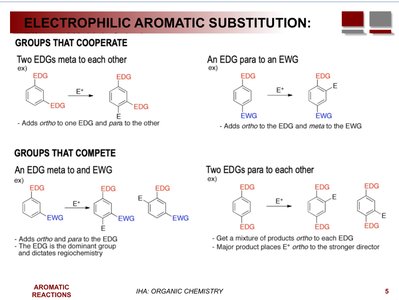
Groups That Compete
An EDG meta to an EWG: The EDG is the dominant group, and substitution occurs ortho and para to the EDG. The EWG's influence is less significant, but it can still affect regioselectivity and reactivity.
Two EDGs para to each other: Both groups activate the ring, leading to a mixture of products. The major product is typically ortho to the stronger EDG due to its greater activating effect.
Common Substituent Effects in EAS
Substituents on the aromatic ring can be classified based on their electron-donating or electron-withdrawing properties, which influence both the reactivity and the orientation of further substitution.
Electron-Donating Groups (EDGs): Activate the ring and direct new substituents to the ortho and para positions.
Electron-Withdrawing Groups (EWGs): Deactivate the ring and direct new substituents to the meta position.
Mechanistic Overview of EAS
The general mechanism for EAS involves three main steps:
Generation of the Electrophile (E+): The electrophile is produced, often with the help of a catalyst.
Formation of the Arenium Ion (Sigma Complex): The aromatic ring attacks the electrophile, forming a resonance-stabilized carbocation intermediate.
Deprotonation: Loss of a proton restores aromaticity, yielding the substituted aromatic compound.
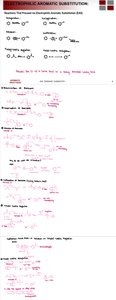
Example equation for EAS:
Birch Reduction
Overview
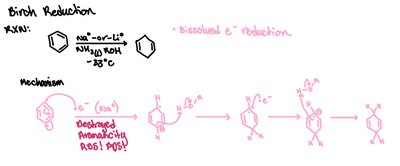
The Birch reduction is a unique method for the partial reduction of aromatic rings to non-conjugated cyclohexadienes using alkali metals (such as Na or Li) in liquid ammonia and an alcohol as a proton source. This reaction is classified as a dissolved electron reduction and is notable for disrupting aromaticity.
Reaction Conditions
Alkali metal (Na or Li)
Liquid ammonia (NH3)
Alcohol (ROH) as a proton source
Low temperature (typically -33°C)
Mechanism
An electron from the metal is transferred to the aromatic ring, generating a radical anion.
The radical anion is protonated by the alcohol.
A second electron is transferred, forming a cyclohexadienyl anion.
The anion is protonated again, yielding the 1,4-cyclohexadiene product.
Key features:
Disrupts aromaticity, forming non-aromatic products.
Selective for 1,4-reduction of the aromatic ring.
General equation:
Summary Table: Substituent Effects in EAS
Substituent Type | Effect on Reactivity | Directing Effect |
|---|---|---|
Electron-Donating Group (EDG) | Activates ring | Ortho/Para |
Electron-Withdrawing Group (EWG) | Deactivates ring | Meta |
