 뒤로
뒤로Carboxylic Acids and Their Derivatives: Structure, Nomenclature, Synthesis, and Reactivity
스터디 가이드 - 스마트 노트
 자료에 맞춘 맞춤형 노트, 핵심 정의, 예시, 맥락을 확장해 제공합니다.
Carboxylic Acids and Derivatives
Introduction to Carboxylic Acids
Carboxylic acids are organic compounds containing a carboxyl group (-COOH), which consists of a carbonyl group and a hydroxyl group attached to the same carbon atom. These compounds are distinctly acidic due to the resonance stabilization of their conjugate base, the carboxylate ion.
Carboxyl Group: The functional group responsible for the properties of carboxylic acids.
General Formula: , where R is an alkyl or aryl group.
Acidity: Carboxylic acids are more acidic than alcohols due to resonance stabilization of the carboxylate ion.

Nomenclature of Carboxylic Acids
Carboxylic acids are named using both common and IUPAC systems. The IUPAC name is derived from the longest carbon chain containing the carboxyl group, replacing the -e ending of the alkane with -oic acid. The carboxyl carbon is always carbon 1.
Common Names: Often reflect historical sources (e.g., formic acid from ants, acetic acid from vinegar).
IUPAC Names: Replace the -e of the parent alkane with -oic acid (e.g., ethanoic acid for acetic acid).
Unsaturated Acids: Named from the corresponding alkene, with the location and configuration (cis/trans or Z/E) of the double bond specified.
Aromatic Acids: Named as derivatives of benzoic acid; substituent positions are indicated by ortho-, meta-, para-, or numbers.


Examples of Nomenclature
4-oxoheptanoic acid: Heptanoic acid with a keto group at C-4.
2-bromobutanoic acid: Butanoic acid with a bromo substituent at C-2.
cis-4-phenylbut-2-enoic acid: Butenoic acid with a phenyl group at C-4 and a cis double bond at C-2.

Salts of Carboxylic Acids
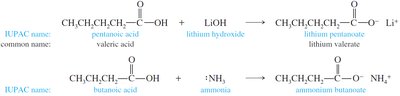
Carboxylic acids react with strong bases to form carboxylate salts and water. The salt is named by stating the cation first, followed by the carboxylate anion (replace -ic acid with -ate).
General Reaction:
Nomenclature: Sodium acetate, lithium valerate, ammonium butanoate, etc.


Synthesis of Carboxylic Acids
Oxidation of Alcohols and Alkylbenzenes
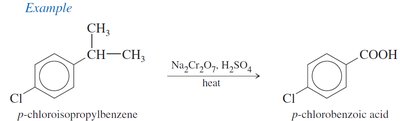
Primary alcohols and alkylbenzenes can be oxidized to carboxylic acids using strong oxidizing agents such as potassium permanganate or chromic acid.
Alcohol Oxidation:
Alkylbenzene Oxidation: Side chains on aromatic rings are oxidized to benzoic acid derivatives.

Carboxylation of Grignard Reagents
Grignard reagents react with carbon dioxide to form carboxylic acids after acidic workup.
General Reaction:

Reactions of Carboxylic Acids
Nucleophilic Acyl Substitution
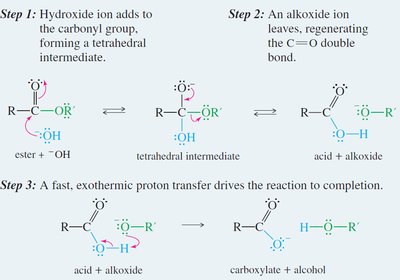
Carboxylic acids and their derivatives undergo nucleophilic acyl substitution, where a nucleophile replaces the leaving group attached to the acyl carbon.
Mechanism: Involves nucleophilic attack on the carbonyl carbon, formation of a tetrahedral intermediate, and expulsion of the leaving group.

Condensation of Acids with Alcohols (Fischer Esterification)
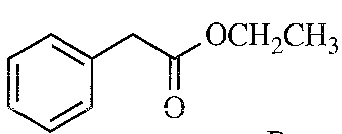
Carboxylic acids react with alcohols in the presence of acid to form esters and water. This is an equilibrium process that can be driven to completion by removing water or using excess alcohol.
General Reaction:
Mechanism: Acid-catalyzed nucleophilic acyl substitution.


Condensation of Acids with Amines
Carboxylic acids react with amines (with heat) to form amides, with water as a byproduct. This reaction is important for the synthesis of peptides and other amide-containing compounds.
General Reaction:
Reduction of Carboxylic Acids
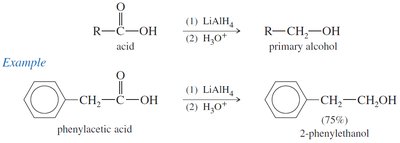
Carboxylic acids can be reduced to primary alcohols using strong reducing agents such as lithium aluminum hydride (LiAlH4) or borane (BH3).
Reduction to Alcohols:
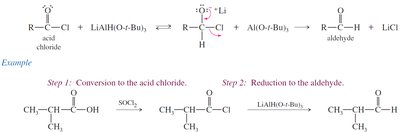
Reduction to Aldehydes: Possible with milder reducing agents (e.g., LiAl(OtBu)3H) from acid chlorides.

Alkylation of Carboxylic Acids
Carboxylic acids can be converted to ketones by reaction with organolithium or Grignard reagents (two equivalents required).
General Reaction:
Carboxylic Acid Derivatives
Types of Acid Derivatives
Carboxylic acid derivatives are compounds that can be hydrolyzed to carboxylic acids. The main types include acid chlorides, anhydrides, esters, amides, and nitriles.
Acid Chlorides (RCOCl)
Anhydrides (RCO)2O
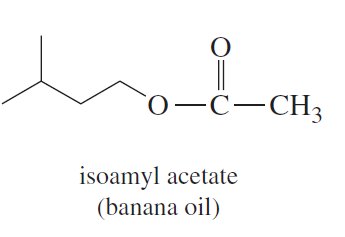
Esters (RCOOR')
Amides (RCONH2, RCONHR', RCONR'2)
Nitriles (RCN)

Synthesis and Interconversion of Acid Derivatives
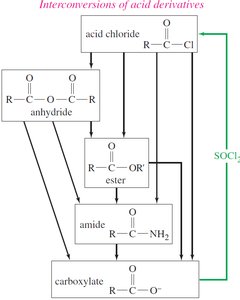
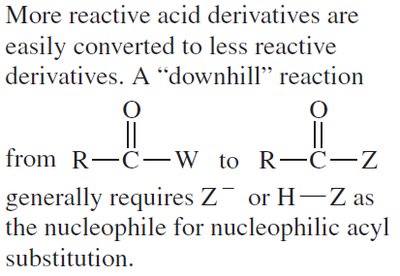
Acid derivatives can be interconverted via nucleophilic acyl substitution. More reactive derivatives (e.g., acid chlorides) can be converted to less reactive ones (e.g., amides, esters, carboxylates).
Order of Reactivity: Acid chloride > Anhydride > Ester > Amide > Carboxylate
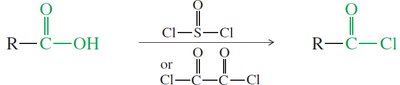
Preparation of Acid Chlorides: Carboxylic acids react with SOCl2 or (COCl)2 to form acid chlorides.
Reactivity of Acid Derivatives
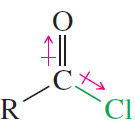
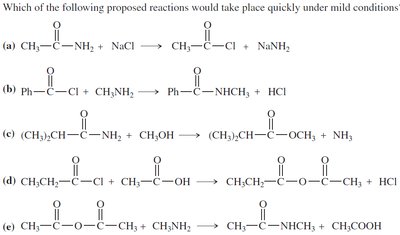
The reactivity of acid derivatives toward nucleophilic attack depends on the leaving group. More reactive derivatives have better leaving groups (less basic), while less reactive derivatives have poorer leaving groups (more basic).
Order of Reactivity: Acid chloride > Anhydride > Ester > Amide > Carboxylate
Hydrolysis of Acid Derivatives
All acid derivatives can be hydrolyzed to carboxylic acids under acidic or basic conditions. The rate of hydrolysis depends on the reactivity of the derivative.
General Reaction:
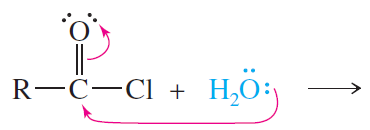
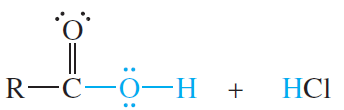

Reduction of Acid Derivatives
Lithium aluminum hydride (LiAlH4) reduces acid derivatives to alcohols or amines, depending on the derivative. Esters and acid chlorides are reduced to primary alcohols, while amides and nitriles are reduced to amines.
Reduction to Alcohols:
Reduction to Amines:
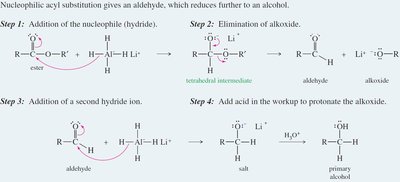
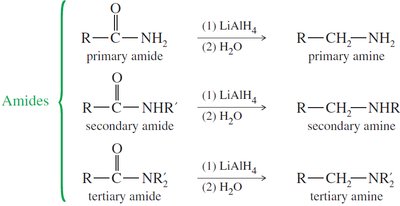

Reactions with Organometallic Reagents
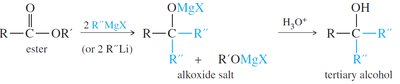
Grignard and organolithium reagents react with acid chlorides and esters to give tertiary alcohols after two additions. Amides and nitriles react to give ketones or amines, depending on the conditions.
General Reaction:
Summary Table: Reactivity of Acid Derivatives
Derivative | General Structure | Leaving Group | Reactivity |
|---|---|---|---|
Acid chloride | RCOCl | Cl- | Most reactive |
Anhydride | (RCO)2O | RCOO- | High |
Ester | RCOOR' | RO- | Moderate |
Amide | RCONH2 | NH2- | Low |
Carboxylate | RCOO- | -- | Least reactive |
Key Concepts and Applications
Carboxylic acids and derivatives are central to organic synthesis, biochemistry, and industrial chemistry.
Understanding their reactivity and interconversion is essential for designing synthetic routes to complex molecules.
Common laboratory and industrial processes include esterification, amide formation, reduction, and Grignard reactions.
