 뒤로
뒤로Chapter 6: Proton Transfer Reactions and Acid-Base Chemistry
스터디 가이드 - 스마트 노트
 자료에 맞춘 맞춤형 노트, 핵심 정의, 예시, 맥락을 확장해 제공합니다.
Proton Transfer Reactions: Fundamentals
Introduction to Proton Transfer and Acid-Base Chemistry
Proton transfer reactions, also known as acid-base reactions, are fundamental to organic chemistry. These reactions involve the transfer of a proton (H+) from an acid to a base, resulting in the formation of new chemical species with altered properties. Understanding the principles of acid-base chemistry is essential for predicting reaction outcomes and mechanisms.
Acid: Donates a proton (H+); the bond to hydrogen is broken.
Base: Accepts a proton (H+); the bond to hydrogen is formed.
Bronsted-Lowry definition: Acids are proton donors, bases are proton acceptors.
Conjugate base: What remains after an acid donates a proton.
Conjugate acid: What forms when a base accepts a proton.
Example: In the reaction , HCl is the acid, H2O is the base, Cl- is the conjugate base, and H3O+ is the conjugate acid.

Lewis Acids and Bases
The Lewis definition expands acid-base chemistry to include electron pair transfer:
Lewis acid: Electron pair acceptor.
Lewis base: Electron pair donor.
The labels for conjugate acid and base remain the same as in the Bronsted-Lowry system.
Curved Arrow Notation and Reaction Mechanisms
Organic chemists use curved arrows to depict the movement of electron pairs during reactions. Each arrow represents the movement of two electrons. Proton transfers typically occur in a single elementary step, with bonds breaking and forming simultaneously.
Thermodynamics and Reaction Coordinate Diagrams
Energy Changes in Chemical Reactions
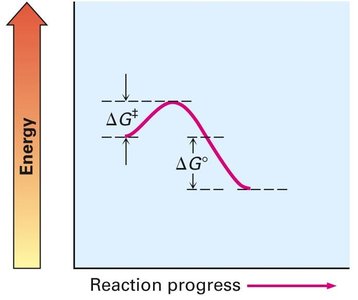
Reaction coordinate diagrams are used to visualize the energy changes that occur during a chemical reaction. The vertical axis represents energy, while the horizontal axis represents the progress of the reaction from reactants to products.
ΔG‡ (Activation Energy): The energy required to reach the transition state from the reactants.
ΔG° (Gibbs Free Energy Change): The overall energy difference between products and reactants.
Exergonic reactions: ΔG° < 0 (energy released, spontaneous).
Endergonic reactions: ΔG° > 0 (energy absorbed, non-spontaneous).
Equilibrium and the Relationship Between ΔG° and Keq
The position of equilibrium in a proton transfer reaction is determined by the relative stabilities of the reactants and products. The relationship between the equilibrium constant (Keq) and the standard free energy change is given by:
Where R is the gas constant and T is the temperature in Kelvin.
Large Keq (products favored): ΔG° is negative.
Small Keq (reactants favored): ΔG° is positive.
Keq ≈ 1: ΔG° ≈ 0 (similar amounts of products and reactants).
Factors Affecting Acid Strength: The CARDIN-al Rule
Overview of the CARDIN-al Rule
The strength of an acid is determined by the stability of its conjugate base. The CARDIN-al rule provides a hierarchy for evaluating conjugate base stability:
Charge: Charged acids are generally less stable than uncharged acids.
Atom: Electronegativity and size of the atom bearing the negative charge.
Resonance Delocalization: Delocalization of charge over multiple atoms increases stability.
Ductive Effects: Electron-withdrawing or donating groups affect charge distribution.
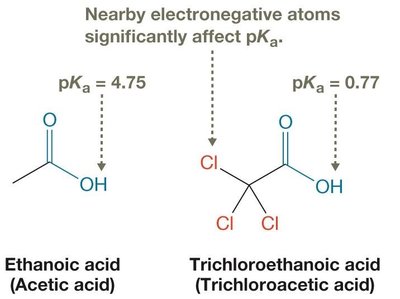
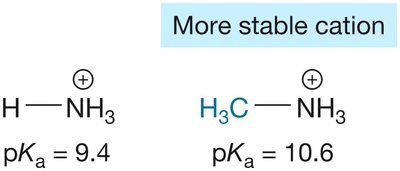
INductive effects: Nearby electronegative atoms stabilize anions and destabilize cations.
Charge Effects
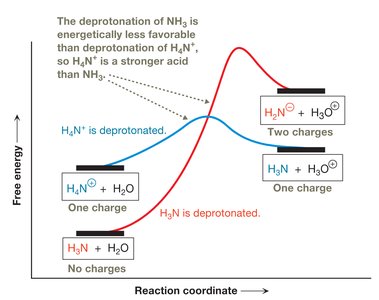
A proton is more acidic when attached to a positively charged atom. Charged molecules are generally higher in energy and less stable than their uncharged counterparts.
Atom Effects: Electronegativity and Size
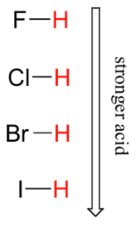
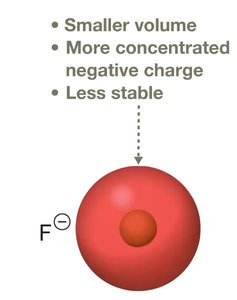
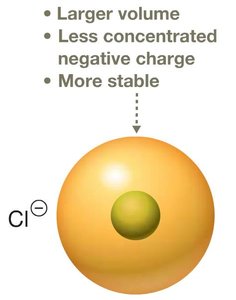
The stability of an anion increases as the electronegativity of the atom bearing the negative charge increases (across a row in the periodic table). However, as you move down a column, larger atoms can better stabilize negative charge due to increased volume.
Atom Effects: Hybridization
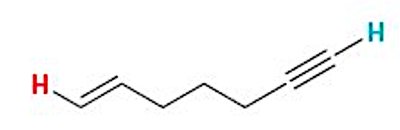
The more s-character an orbital has, the better it can stabilize a negative charge. Thus, acidity increases in the order:
sp3 < sp2 < sp
Resonance Delocalization
Resonance allows negative charge to be delocalized over multiple atoms, increasing the stability of the conjugate base and thus increasing acidity.
Inductive Effects
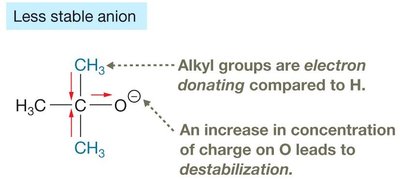
Electron-withdrawing groups (EWGs) stabilize anions by pulling electron density away, while electron-donating groups (EDGs) destabilize anions by increasing electron density. The effect is transmitted through sigma bonds.


Quantitative Analysis: pKa and Acid Strength
Acid Dissociation Constant (Ka) and pKa
The strength of an acid is measured by its acid dissociation constant (Ka):
pKa is a more convenient logarithmic scale:
Strong acids: Large Ka, low pKa (lose H+ easily).
Weak acids: Small Ka, high pKa.
Each unit difference in pKa corresponds to a tenfold difference in acid strength.
Using pKa Values to Predict Equilibrium
Proton transfer reactions favor the side with the weaker acid (higher pKa). The equilibrium constant can be estimated using the difference in pKa values:
pKa difference ≥ 10: Reaction is essentially irreversible.
pKa difference > 2 to 10: Equilibrium heavily favors the side with the weaker acid.
pKa difference < 2: Both products and reactants are present in significant amounts.


Applications: Organic Acids, Bases, and Functional Groups
Identifying Organic Acids and Bases
Organic acids: Typically have an acidic hydrogen attached to an electronegative atom (e.g., oxygen) or a functional group that can stabilize a negative charge.
Organic bases: Contain a lone pair that can accept a proton (often on nitrogen or oxygen).
Amphoteric compounds: Can act as either acids or bases depending on the reaction conditions.
Biological Relevance: Fexofenadine (Allegra®)
Fexofenadine is a second-generation antihistamine containing both acidic and basic functional groups. Its protonation state changes at physiological pH (~7.4), affecting its ability to cross the blood-brain barrier and thus its side effect profile.
At pH < pKa: The group is protonated.
At pH > pKa: The group is deprotonated.
Fexofenadine exists as a zwitterion (both positive and negative charges, net charge zero) at physiological pH, which prevents it from crossing the blood-brain barrier and causing drowsiness.
Summary Table: Acid Strength and Conjugate Base Stability
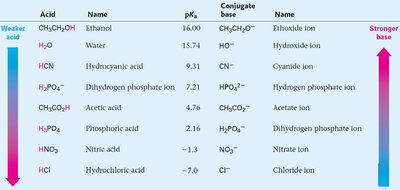
Acid | Name | pKa | Conjugate Base | Name |
|---|---|---|---|---|
CH3CH2OH | Ethanol | 16.00 | CH3CH2O− | Ethoxide ion |
H2O | Water | 15.74 | HO− | Hydroxide ion |
HCN | Hydrocyanic acid | 9.31 | CN− | Cyanide ion |
H2PO4− | Dihydrogen phosphate ion | 7.21 | HPO42− | Hydrogen phosphate ion |
CH3CO2H | Acetic acid | 4.76 | CH3CO2− | Acetate ion |
H3PO4 | Phosphoric acid | 2.16 | H2PO4− | Dihydrogen phosphate ion |
HNO3 | Nitric acid | −1.3 | NO3− | Nitrate ion |
HCl | Hydrochloric acid | −7.0 | Cl− | Chloride ion |
Summary of Key Concepts
Lower pKa = stronger acid; its conjugate base is more stable and weaker as a base.
Higher pKa = weaker acid; its conjugate base is less stable and stronger as a base.
Acid-base reactions favor the formation of the weaker acid (higher pKa).
Apply the CARDIN-al rule to rationalize trends in acidity and basicity.
