 뒤로
뒤로Formation of π Bonds by Elimination Processes (E1 and E2 Mechanisms)
스터디 가이드 - 스마트 노트
 자료에 맞춘 맞춤형 노트, 핵심 정의, 예시, 맥락을 확장해 제공합니다.
Formation of π Bonds by Elimination Processes
Introduction to Elimination Reactions
Elimination reactions are fundamental processes in organic chemistry that result in the formation of π bonds (typically alkenes) by the removal of atoms or groups from adjacent carbons in a molecule. These reactions are crucial for the synthesis of alkenes and are mechanistically related to substitution reactions. The two main types of elimination mechanisms are E1 (unimolecular elimination) and E2 (bimolecular elimination).
Review of Key Concepts
Conformations and π-Bonds
Newman Projections: Used to visualize conformations, especially syn and anti arrangements, which are important for understanding elimination mechanisms.
Types of Strain: Torsional, steric, and angle strain affect the stability of conformers and the feasibility of elimination reactions.
Cyclohexane Chair Conformations: Axial and equatorial positions influence the accessibility of hydrogens for elimination.
E and Z Alkene Stereoisomers: Stereochemistry of the double bond is determined by the arrangement of substituents.
Carbocation Rearrangements: Important in E1 mechanisms where intermediates can rearrange for greater stability.
Regiochemistry and Stereochemistry in Elimination
Definitions
Regioisomers: Constitutional isomers with functional groups at different positions.
Regioselectivity: Preference for the formation of one regioisomer over another.
Stereoisomers: Isomers with the same atomic connectivity but different spatial arrangements.
Stereoselectivity: Preference for the formation of one stereoisomer over another.
Elimination vs. Substitution: Nucleophiles and Bases
Key Differences
Nucleophilicity: A kinetic property; measures how quickly a nucleophile attacks an electrophile. All nucleophiles are Lewis bases (electron donors).
Basicity: A thermodynamic property; measures the equilibrium position in an acid-base reaction. Bases are nucleophiles that specifically attack hydrogen atoms.
Base Strength and pKa Values
Base strength is often measured by the pKa of the conjugate acid. Stronger bases have weaker conjugate acids (higher pKa values).
Functional Group | Acid | pKa (approximate) | Conjugate Base |
|---|---|---|---|
Hydrogen (e.g. NaH) | H2 | ~36 | H− |
Amines | R2NH | 35 | R2N− |
Alcohols | ROH | 16–20 | RO− |
Water | H2O | 15 | HO− |
Thiols | RSH | 10 | RS− |
Protonated amines | H4N+ | 10 | H3N |
Hydrogen cyanide | HCN | 9 | CN− |
Carboxylic acids | RCO2H | 5 | RCO2− |
Mineral acids | HX | −7 to −9 | X− |
Types of Elimination Reactions
E2: Elimination Bimolecular
The E2 mechanism is a concerted, one-step process where a strong base removes a proton from a β-carbon while the leaving group departs from the α-carbon, forming a π bond.
Mechanism: All bond-breaking and bond-forming steps occur simultaneously.
Kinetics: Second-order; rate depends on both base and substrate:
Favored by: Strong bases, good leaving groups, and polar aprotic solvents.
Stereochemistry: Requires anti-periplanar geometry (the hydrogen and leaving group must be in the same plane but opposite sides).
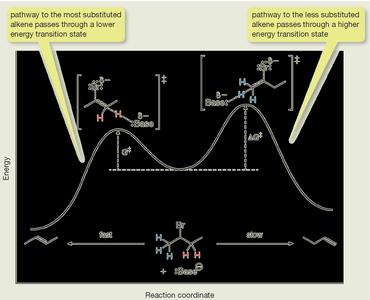
E2: Stereoselectivity and Regioselectivity
Stereoselectivity: The anti-periplanar arrangement leads to specific stereoisomers as products.
Regioselectivity (Zaitsev's Rule): The more substituted (and thus more stable) alkene is usually the major product, unless a bulky base is used, which favors the less substituted alkene.
E2: Summary Table
Factor | E2 |
|---|---|
Mechanism | One-step, concerted |
Kinetics | Second-order () |
Base Strength | Strong base required |
Leaving Group | Good leaving group required |
Solvent | Polar aprotic preferred |
Stereochemistry | Anti-periplanar geometry required |
E1: Elimination Unimolecular
The E1 mechanism proceeds in two steps: first, the leaving group departs to form a carbocation intermediate; second, a base removes a proton from the β-carbon, forming a π bond.
Mechanism: Two-step process with a carbocation intermediate.
Kinetics: First-order; rate depends only on the substrate:
Favored by: Weak bases, good leaving groups, and polar protic solvents.
Stereochemistry: No strict requirement; less stereoselective due to carbocation planarity.
Carbocation Rearrangements: Possible, leading to more stable intermediates and products.
E1: Summary Table
Factor | E1 |
|---|---|
Mechanism | Two-step, carbocation intermediate |
Kinetics | First-order () |
Base Strength | Weak base sufficient |
Leaving Group | Good leaving group required |
Solvent | Polar protic preferred |
Stereochemistry | No strict requirement |
Comparison of E1 and E2 Mechanisms
Feature | E2 | E1 |
|---|---|---|
Structure of R-X | 3° > 2° > 1° | 3° > 2° > 1° |
Kinetics | ||
Regiochemistry | Zaitsev's rule (more stable alkene) | Zaitsev's rule (more stable alkene) |
Stereochemistry | Anti-periplanar required | No requirement |
Base Strength | Strong | Weak |
Solvent | Polar aprotic | Polar protic |
Predicting Substitution and Elimination Pathways
Degree of Substitution: 1° (SN2 or E2), 2° (all possible), 3° (SN1, E1, or E2 depending on base/nucleophile strength).
Type of Nucleophile/Base: Strong nucleophile (SN2), strong base (E2), weak base/nucleophile (SN1/E1).
Solvent and Temperature: Polar protic (E1/SN1), polar aprotic (E2/SN2), heat favors elimination.
Special Example: Alcohol Oxidation as Elimination
Alcohols can undergo elimination to form carbonyl compounds (C=O π bonds) via oxidation. Primary alcohols are oxidized to aldehydes (and further to carboxylic acids), while secondary alcohols are oxidized to ketones. Tertiary alcohols do not undergo oxidation due to the absence of a removable hydrogen.
Strong Oxidants: Na2Cr2O7/H2SO4, CrO3/H2SO4 (Jones reagent)
Mild Oxidants: Br2/NaHCO3, Pyridinium chlorochromate (PCC)
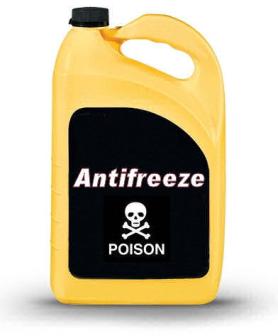
Biological Relevance: Ethanol is oxidized in the body to acetaldehyde and acetic acid; ethylene glycol (antifreeze) is metabolized to toxic oxalic acid.
Green Chemistry and Safer Oxidation Methods
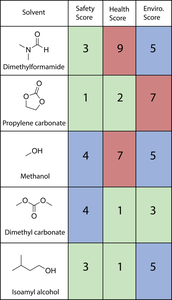
Chromium-based oxidants are effective but toxic and environmentally hazardous. Greener alternatives, such as molybdate catalysts with hydrogen peroxide, are being developed to minimize health and environmental risks.
Summary
E2 reactions are concerted, require strong bases, and are stereospecific (anti-periplanar geometry).
E1 reactions proceed via carbocation intermediates, are less stereoselective, and are favored by weak bases and polar protic solvents.
Regioselectivity (Zaitsev's rule) generally favors the more substituted alkene, but bulky bases can reverse this preference.
Alcohol oxidation is a special elimination process forming C=O π bonds, with important synthetic and biological implications.
Green chemistry principles encourage the use of less hazardous reagents and solvents in elimination and oxidation reactions.
