 뒤로
뒤로Nuclear Magnetic Resonance (NMR) Spectroscopy: Principles and Applications
스터디 가이드 - 스마트 노트
 자료에 맞춘 맞춤형 노트, 핵심 정의, 예시, 맥락을 확장해 제공합니다.
Chapter 13: Nuclear Magnetic Resonance (NMR) Spectroscopy
Introduction to NMR Spectroscopy
Nuclear Magnetic Resonance (NMR) spectroscopy is a fundamental analytical technique in organic chemistry, used for elucidating molecular structure. NMR exploits the magnetic properties of certain nuclei, providing detailed information about the chemical environment of atoms within a molecule.
NMR is the most powerful tool for organic structure determination.
Nuclei with odd atomic numbers or masses possess nuclear spin, which generates a magnetic moment.
1H nuclei can have spin states of +1/2 or –1/2.
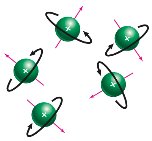
Principles of NMR: Nuclear Spin States and Resonance
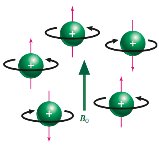
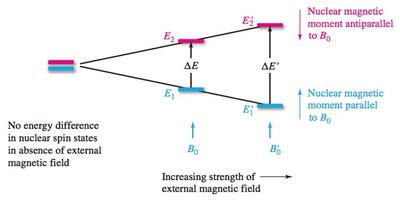
In the absence of an external magnetic field, nuclear spins are randomly oriented. When a magnetic field is applied, spins align either with or against the field, resulting in different energy states. Irradiation with radiofrequency causes transitions between these states, a phenomenon known as resonance.
External magnetic field (B0) causes alignment of nuclear spins.
Energy difference (ΔE) between spin states is proportional to magnetic field strength.
Gyromagnetic ratio (γ) is a constant for each nucleus.
Key equation:
NMR Spectrometer and Its Elements
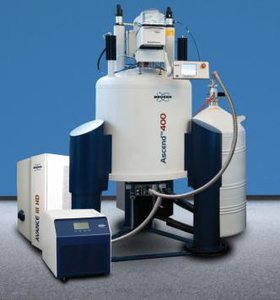
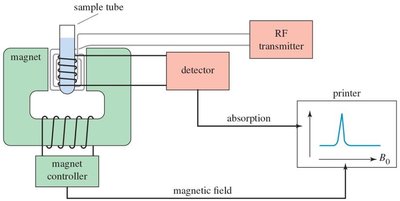
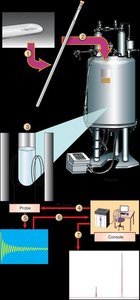
An NMR spectrometer consists of a powerful magnet, a radiofrequency transmitter, and a detector. The sample is placed in a magnetic field, irradiated with radio waves, and the resulting absorption is detected and plotted as an NMR spectrum.
Magnet: Generates a strong, uniform magnetic field.
RF transmitter: Applies radiofrequency pulses to the sample.
Detector: Measures emitted radio waves as nuclei relax.
Magnetic Shielding and Effect of Shielding
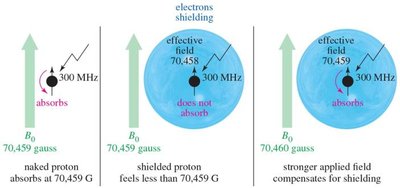
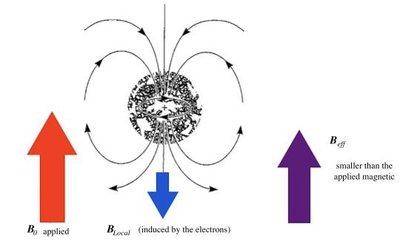
Protons are surrounded by electrons, which shield them from the external magnetic field. The induced local magnetic field opposes the applied field, resulting in a weaker effective field at the nucleus. The degree of shielding depends on the electron density around the proton.
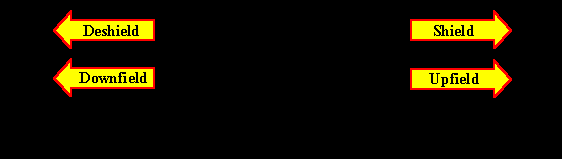
Shielded protons absorb at lower frequencies (upfield).
Deshielded protons absorb at higher frequencies (downfield).
Effect of Electronegative Atoms
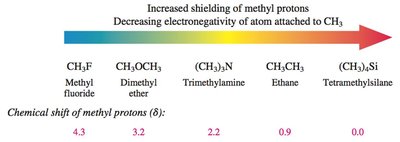
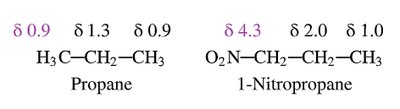
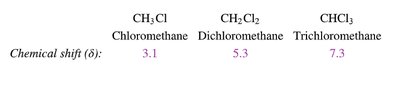
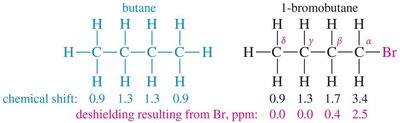
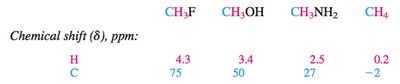
Electronegative atoms withdraw electron density, reducing shielding and causing protons to resonate at higher frequencies (downfield). The effect diminishes with distance and is cumulative.
Deshielded protons are found near electronegative groups.
Inductive effects decrease with increasing distance from the electronegative atom.
Chemical Shift (δ)
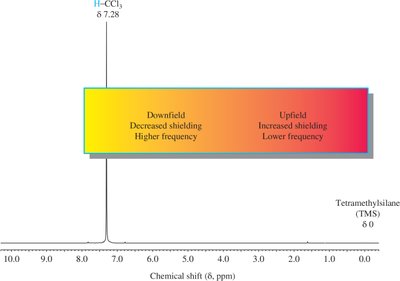
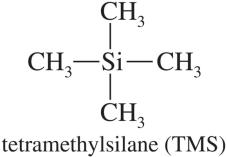
The chemical shift (δ) is a measure of the resonance frequency of a nucleus relative to a standard, typically tetramethylsilane (TMS). It is expressed in parts per million (ppm) and provides information about the electronic environment of the nucleus.
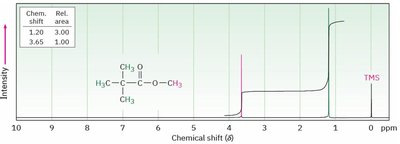
TMS is used as the internal standard (δ = 0.00 ppm).
Most 1H chemical shifts fall within 0–10 ppm.
Formula:
Characteristic Values of Chemical Shifts
Chemical shifts are influenced by the environment of the proton. Typical regions include:
Saturated region: Methyl, methylene, methine protons (0–3 ppm).
Allylic region: Protons adjacent to double bonds (~2.5–3.5 ppm).
O, N, Halogen-attached region: Protons near electronegative atoms (~3.5–4.5 ppm).
Vinylic protons: Protons on double bonds (~5–6 ppm).
Aromatic region: Protons on aromatic rings (~7–8 ppm).
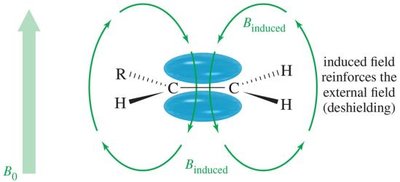
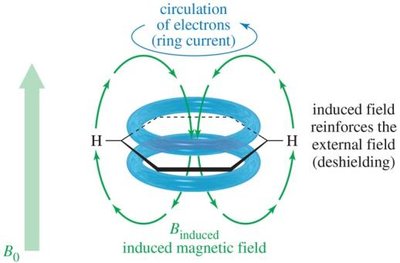
Integration
Integration measures the area under each NMR peak, which is proportional to the number of protons contributing to that signal. S-shaped curves represent integration, and the relative areas help determine the ratio of different types of protons.
Splitting: Multiplicity and the n + 1 Rule
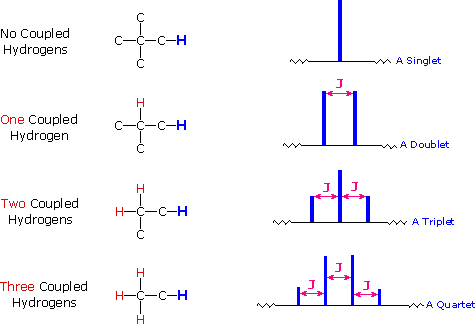
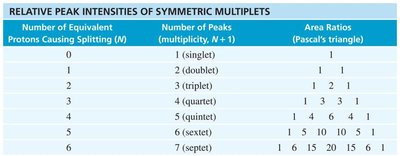
Spin-spin coupling between neighboring protons causes splitting of NMR signals into multiplets. The multiplicity follows the n + 1 rule, where n is the number of equivalent neighboring protons.
Singlet: No neighboring protons (n = 0).
Doublet: One neighboring proton (n = 1).
Triplet: Two neighboring protons (n = 2).
Quartet: Three neighboring protons (n = 3).

13C NMR Spectroscopy
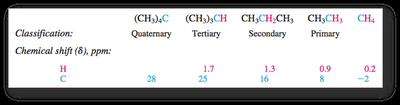
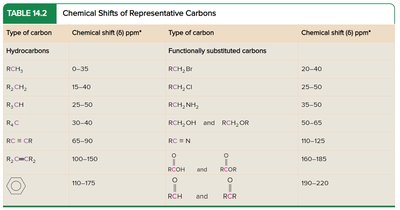
13C NMR provides information about the carbon skeleton of organic molecules. 13C is less abundant than 12C, so spectra require longer acquisition times. Chemical shifts are influenced by electronegativity and hybridization.
Electronegative substituents cause deshielding and higher δ values.
Hybridization: sp2 carbons are less shielded than sp3 carbons.
DEPT Spectra
DEPT (Distortionless Enhancement by Polarization Transfer) distinguishes between CH, CH2, and CH3 carbons by inverting the phase of CH2 signals.
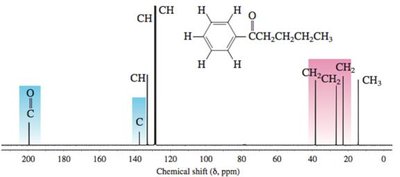
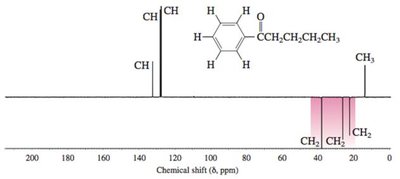
Summary
NMR spectroscopy is essential for determining organic molecular structure.
Key concepts include nuclear spin, magnetic shielding, chemical shift, integration, and splitting.
13C NMR complements 1H NMR by providing information about the carbon framework.
Practice Problems
Convert NMR peak frequencies to δ units using the formula.
Distinguish isomers using 13C NMR.
Interpret spectra (IR, NMR, Mass) to propose molecular structures.
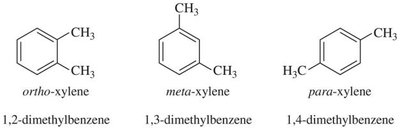
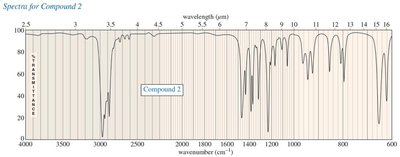
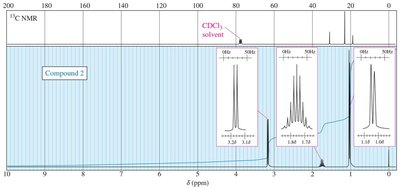
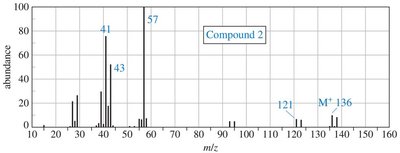
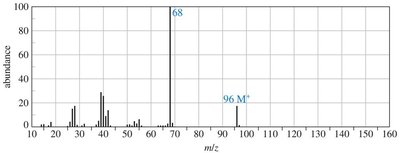
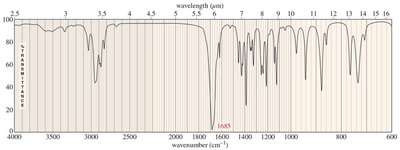
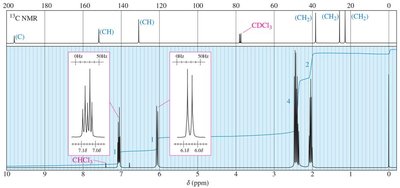
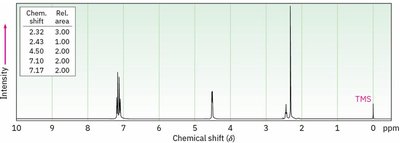
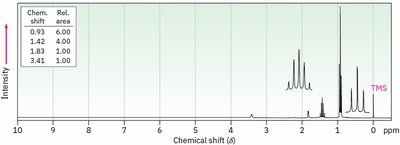
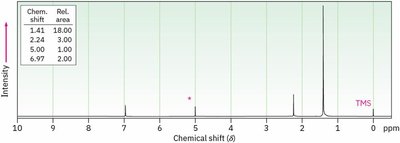
Additional info: The notes have been expanded to include definitions, examples, and academic context for each topic, ensuring completeness and clarity for exam preparation.
