 뒤로
뒤로Organic Chemistry Amines and Reactions Study Guide
스터디 가이드 - 스마트 노트
 자료에 맞춘 맞춤형 노트, 핵심 정의, 예시, 맥락을 확장해 제공합니다.
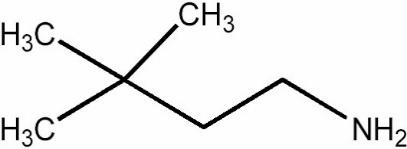
Q1. Provide the IUPAC name for the compound shown below.
Background
Topic: Nomenclature of Amines
This question tests your ability to apply IUPAC rules to name a primary amine with branching on the carbon chain.
Key Terms and Concepts:
Amine: An organic compound derived from ammonia by replacement of one or more hydrogen atoms by organic groups.
IUPAC Naming: Identify the longest carbon chain containing the amine group, number the chain to give the amine the lowest possible number, and name substituents as prefixes.
Step-by-Step Guidance
Identify the longest continuous carbon chain that contains the amine group. This will be the parent chain.
Number the carbon chain so that the carbon attached to the amine group gets the lowest possible number.
Identify and name any alkyl substituents attached to the parent chain. Assign their positions based on your numbering.
Combine the substituent names and positions with the parent chain name, and add the suffix "-amine" to indicate the presence of the amine group.
Try solving on your own before revealing the answer!
Final Answer: 3,3-dimethyl-1-butanamine
The parent chain is butane (4 carbons), with two methyl groups on carbon 3 and an amine group on carbon 1.
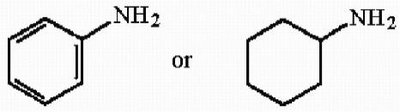
Q2. Circle the stronger base in the pair below, and briefly explain your choice.
Background
Topic: Basicity of Amines
This question tests your understanding of how structure affects the basicity of amines, especially the influence of aromaticity and electron delocalization.
Key Terms and Concepts:
Basicity: The ability of a compound to accept a proton (H+).
Aniline: An aromatic amine where the lone pair on nitrogen is delocalized into the benzene ring.
Cyclohexylamine: An aliphatic amine where the lone pair on nitrogen is localized.
Step-by-Step Guidance
Consider the availability of the nitrogen lone pair for protonation in each compound.
Recall that in aniline, the lone pair on nitrogen is delocalized into the aromatic ring, making it less available for bonding with a proton.
In cyclohexylamine, the nitrogen's lone pair is not delocalized and is more available to accept a proton.
Compare the basicity based on the electron availability at the nitrogen atom in each structure.
Try solving on your own before revealing the answer!
Final Answer: Cyclohexylamine is the stronger base.
The lone pair on aniline's nitrogen is delocalized into the aromatic π system, reducing its basicity compared to cyclohexylamine, where the lone pair is fully available for protonation.
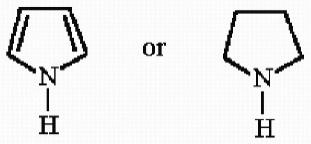
Q3. Circle the stronger base in the pair below, and briefly explain your choice.
Background
Topic: Basicity of Heterocyclic Amines
This question examines your understanding of aromaticity and how it affects the basicity of nitrogen-containing heterocycles.
Key Terms and Concepts:
Pyrrole: An aromatic five-membered ring with a nitrogen atom; the nitrogen lone pair is part of the aromatic system.
Pyrrolidine: A saturated five-membered ring with a nitrogen atom; the nitrogen lone pair is not involved in aromaticity.
Aromaticity: Stability gained by cyclic, planar molecules with delocalized π electrons.
Step-by-Step Guidance
Analyze the role of the nitrogen lone pair in each compound: is it involved in aromaticity or not?
Recall that in pyrrole, the nitrogen lone pair is part of the aromatic sextet, making it less available for protonation.
In pyrrolidine, the nitrogen lone pair is not involved in aromaticity and is more available to accept a proton.
Consider the effect of protonating pyrrole (loss of aromaticity) versus pyrrolidine (no loss of aromaticity).
Try solving on your own before revealing the answer!
Final Answer: Pyrrolidine is the stronger base.
Protonation of pyrrole disrupts aromaticity, making it much less basic than pyrrolidine, where the lone pair is fully available for protonation.
