뒤로
뒤로Organic Chemistry: Carboxylic Acid Derivatives and Their Reactions
스터디 가이드 - 스마트 노트
 자료에 맞춘 맞춤형 노트, 핵심 정의, 예시, 맥락을 확장해 제공합니다.
Q1. Predict the major organic product of the following reaction:
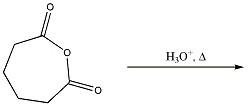
Background
Topic: Hydrolysis of Anhydrides
This question tests your understanding of the hydrolysis of cyclic anhydrides under acidic conditions and heat, a common transformation in carboxylic acid derivative chemistry.
Key Terms and Formulas
Anhydride: A compound derived from two carboxylic acids by the removal of water.
Hydrolysis: Reaction with water, often catalyzed by acid or base, to break a bond.
General Reaction:
Step-by-Step Guidance
Recognize that the starting material is a cyclic anhydride. Under acidic aqueous conditions and heat, anhydrides are hydrolyzed to carboxylic acids.
Identify the two carbonyl carbons in the anhydride ring. Each will become a carboxylic acid group after hydrolysis.
Draw the ring structure, and imagine "cutting" the anhydride bond (the oxygen bridge between the two carbonyls) to open the ring.
Add an -OH group to each carbonyl carbon where the ring was opened, converting each to a carboxylic acid group.
Count the number of carbons in the original ring to ensure the correct dicarboxylic acid is formed.
Try solving on your own before revealing the answer!
Final Answer:
The product is a linear dicarboxylic acid: HO2C-(CH2)5-CO2H (adipic acid).
Hydrolysis of the seven-membered cyclic anhydride opens the ring and forms a six-carbon dicarboxylic acid.
Q2. Predict the major product of the following reaction:
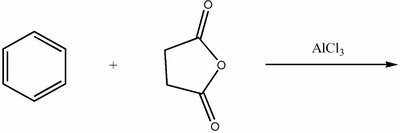
Background
Topic: Friedel–Crafts Acylation
This question tests your knowledge of the Friedel–Crafts acylation reaction, where an aromatic ring reacts with an acid chloride or anhydride in the presence of a Lewis acid catalyst (like AlCl3).
Key Terms and Formulas
Friedel–Crafts Acylation: Introduction of an acyl group onto an aromatic ring using an acid chloride or anhydride and AlCl3.
General Reaction:
Step-by-Step Guidance
Identify the acylating agent: here, it is succinic anhydride (a four-membered cyclic anhydride).
Recognize that AlCl3 will generate an acylium ion from the anhydride, which will act as the electrophile.
The benzene ring will undergo electrophilic aromatic substitution with the acylium ion, attaching the acyl group to the ring.
After the acyl group is attached, the product will be a benzene ring with a (CH2)2CO group (a 3-oxopropyl group) attached.
Consider possible rearrangements or further reactions, but in this case, the product is a simple aryl ketone.
Try solving on your own before revealing the answer!
Final Answer:
The product is 4-phenylbutan-2-one (phenyl attached to a four-carbon chain with a ketone at the 2-position).
This is a classic Friedel–Crafts acylation with succinic anhydride.
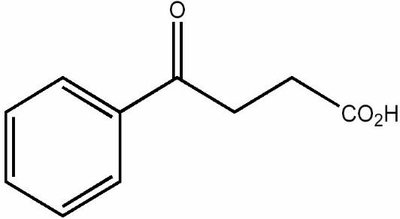
Q3. Provide the IUPAC name for the following compound:
Background
Topic: IUPAC Nomenclature of Carboxylic Acids and Ketones
This question tests your ability to name a compound containing both a carboxylic acid and a ketone functional group according to IUPAC rules.
Key Terms and Formulas
Carboxylic Acid: The highest priority functional group in IUPAC nomenclature.
Ketone: Named as an "oxo" substituent when a higher-priority group is present.
Step-by-Step Guidance
Identify the longest carbon chain containing the carboxylic acid group; this will be the parent chain.
Number the chain starting from the carboxylic acid carbon (which is always carbon 1).
Locate the position of the ketone group and name it as an "oxo" substituent, giving it the lowest possible number.
Identify and name any other substituents, such as the phenyl group, and assign their positions.
Combine the names, listing substituents in alphabetical order, and use proper IUPAC formatting.
Try solving on your own before revealing the answer!
Final Answer:
The IUPAC name is 4-oxo-4-phenylbutanoic acid.
The parent chain is butanoic acid, with a phenyl and an oxo group at the 4-position.
Q4. Predict the major product of the following reaction:

Background
Topic: Acylation of Amines
This question tests your understanding of the reaction between a primary amine and an acid anhydride, which forms an amide.
Key Terms and Formulas
Amide Formation: Reaction of an amine with an acid anhydride or acid chloride to form an amide.
General Reaction:
Step-by-Step Guidance
Identify the nucleophile (the amine) and the electrophile (the acetic anhydride).
The amine attacks one of the carbonyl carbons of the anhydride, leading to the formation of an amide bond.
The leaving group is the carboxylate anion, which is then protonated to form a carboxylic acid (acetic acid).
Draw the structure of the resulting amide, ensuring the acyl group is attached to the nitrogen.
Check the product for correct connectivity and functional groups.
Try solving on your own before revealing the answer!
Final Answer:
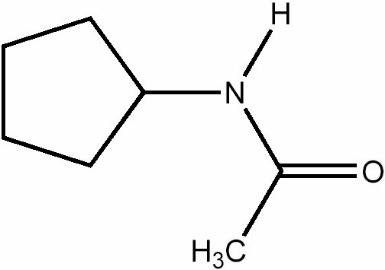
The product is N-cyclopentylacetamide (shown in image_5).
The cyclopentylamine is acylated to form the corresponding amide.