 뒤로
뒤로Organic Chemistry: Carboxylic Acids, Nomenclature, Acidity, and Reactions
스터디 가이드 - 스마트 노트
 자료에 맞춘 맞춤형 노트, 핵심 정의, 예시, 맥락을 확장해 제공합니다.
Q4. Provide the IUPAC name for the compound shown below.
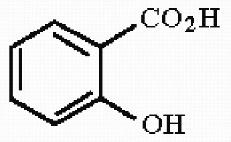
Background
Topic: Carboxylic Acid and Phenol Nomenclature
This question tests your ability to apply IUPAC rules to name aromatic compounds with multiple functional groups, specifically a carboxylic acid and a hydroxyl group.
Key Terms and Concepts:
Carboxylic acid: The -COOH group, which takes priority in naming.
Hydroxy group: The -OH group, named as a substituent when attached to a benzene ring with a higher-priority group.
Ortho (o-), meta (m-), para (p-): Describes the relative positions of substituents on a benzene ring (1,2-; 1,3-; 1,4- positions).
Step-by-Step Guidance
Identify the parent structure: The benzene ring with a carboxylic acid group is called benzoic acid.
Number the ring so that the carboxylic acid group is at position 1 (highest priority).
Locate the position of the hydroxyl (-OH) group relative to the carboxylic acid. Assign the lowest possible number to the -OH group.
Name the compound as a substituted benzoic acid, using the appropriate locant for the -OH group.
Try solving on your own before revealing the answer!
Final Answer: 2-hydroxybenzoic acid (or o-hydroxybenzoic acid)
The carboxylic acid group is at position 1, and the hydroxyl group is at position 2 (ortho to the acid). The IUPAC name is 2-hydroxybenzoic acid. The common name is salicylic acid.
Q6. Provide the IUPAC name for the compound shown below.
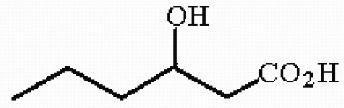
Background
Topic: Nomenclature of Hydroxy Carboxylic Acids
This question tests your ability to name straight-chain carboxylic acids with a hydroxyl substituent using IUPAC rules.
Key Terms and Concepts:
Carboxylic acid: The -COOH group, which is always at position 1 in IUPAC naming.
Hydroxy group: The -OH group, named as a substituent with its position indicated by a number.
Hexanoic acid: The parent name for a six-carbon carboxylic acid.
Step-by-Step Guidance
Identify the longest carbon chain containing the carboxylic acid group. Number the chain starting from the carboxylic acid carbon.
Locate the position of the hydroxyl group by counting from the carboxylic acid carbon.
Name the compound as a hydroxy-substituted hexanoic acid, using the correct locant for the -OH group.
Try solving on your own before revealing the answer!
Final Answer: 3-hydroxyhexanoic acid
The carboxylic acid is at carbon 1, and the hydroxyl group is at carbon 3. The IUPAC name is 3-hydroxyhexanoic acid.
Q22. List the following weak acids in order of increasing acidity (from lowest to highest).

Background
Topic: Acidity of Carboxylic Acids and Substituent Effects
This question tests your understanding of how electron-withdrawing groups (like halogens) affect the acidity of carboxylic acids.
Key Terms and Concepts:
Acidity: The tendency of a compound to donate a proton (H+).
Electron-withdrawing groups: Atoms or groups (like Cl, Br) that stabilize the negative charge on the conjugate base, increasing acidity.
Inductive effect: The effect of electronegative atoms pulling electron density through sigma bonds, stabilizing the conjugate base.
Step-by-Step Guidance
Identify the substituents on each acid and their positions relative to the carboxylic acid group.
Recall that electron-withdrawing groups (like Cl, Br) increase acidity, especially when closer to the carboxyl group.
Compare the number and position of halogen substituents for each compound.
Arrange the acids in order of increasing acidity based on the strength and proximity of electron-withdrawing groups.
Try solving on your own before revealing the answer!
Final Answer: B) 4 < 1 < 3 < 2 < 5
Acidity increases with more and/or closer electron-withdrawing groups. Compound 5, with two chlorines, is the most acidic; compound 4, with no halogen, is the least acidic.
Q59. Provide the major organic product of the following reaction.

Background
Topic: Oxidative Cleavage of Alkenes
This question tests your knowledge of the reaction of alkenes with strong oxidizing agents like potassium permanganate (KMnO4) under heated, concentrated conditions.
Key Terms and Concepts:
Oxidative cleavage: The breaking of carbon-carbon double bonds to form carbonyl-containing products.
KMnO4 (potassium permanganate): A strong oxidizer that can cleave double bonds and oxidize the resulting fragments to carboxylic acids.
Ring opening: In cyclic alkenes, oxidative cleavage can break the ring and form dicarboxylic acids.
Step-by-Step Guidance
Recognize that cyclopentene is a five-membered ring with one double bond.
Under hot, concentrated KMnO4, the double bond is cleaved, and each carbon of the double bond is oxidized to a carboxylic acid group.
Draw the resulting open-chain dicarboxylic acid, ensuring both ends are carboxylic acids.
Try solving on your own before revealing the answer!
Final Answer: Glutaric acid (pentanedioic acid)
The oxidative cleavage of cyclopentene with hot, concentrated KMnO4 produces a five-carbon dicarboxylic acid: HOOC-(CH2)3-COOH, known as glutaric acid or pentanedioic acid.
