 뒤로
뒤로Organic Chemistry: Electrophilic Aromatic Substitution – Practice Problems with Step-by-Step Guidance
스터디 가이드 - 스마트 노트
 자료에 맞춘 맞춤형 노트, 핵심 정의, 예시, 맥락을 확장해 제공합니다.
Q1. Provide the structure of the major organic product(s) in the following reaction:
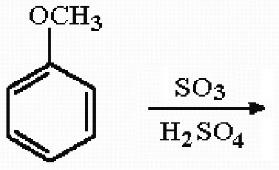
Background
Topic: Electrophilic Aromatic Substitution (Sulfonation)
This question tests your understanding of the sulfonation of aromatic compounds, specifically how substituents like -OCH3 (methoxy) affect the regiochemistry of the reaction.
Key Terms and Formulas
Electrophilic Aromatic Substitution (EAS): A reaction where an aromatic ring reacts with an electrophile, replacing a hydrogen atom.
Sulfonation: Introduction of a sulfonic acid group (-SO3H) onto the aromatic ring using SO3 and H2SO4.
Activating Group: The -OCH3 group is an electron-donating group, which activates the ring and directs substitution to the ortho and para positions.
Step-by-Step Guidance
Identify the substituent on the benzene ring: The -OCH3 group is an activating, ortho/para-directing group.
Recognize the electrophile: In the presence of SO3 and H2SO4, the electrophile is SO3 (sulfonic acid group).
Predict the major product: The sulfonic acid group will add to the ortho and para positions relative to the -OCH3 group, but steric and electronic effects usually favor one position.
Draw the possible products: Place the -SO3H group at the ortho and para positions to the -OCH3 group.
Consider which product is favored: Think about steric hindrance and resonance stabilization to determine the major product.
Try solving on your own before revealing the answer!
Final Answer:
The major product is para-methoxybenzenesulfonic acid (the -SO3H group is para to the -OCH3 group):
The para product is favored due to less steric hindrance compared to the ortho position.
Q2. Provide the structure of the major organic product(s) in the following reaction:
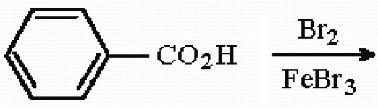
Background
Topic: Electrophilic Aromatic Substitution (Bromination)
This question tests your understanding of how electron-withdrawing groups like -CO2H (carboxylic acid) affect the reactivity and regiochemistry of aromatic bromination.
Key Terms and Formulas
Deactivating Group: The -CO2H group is electron-withdrawing and deactivates the ring, making it less reactive toward EAS and directing substitution to the meta position.
Bromination: Introduction of a bromine atom onto the aromatic ring using Br2 and FeBr3.
Step-by-Step Guidance
Identify the substituent: The -CO2H group is a strong deactivator and meta-director.
Recognize the electrophile: Br2/FeBr3 generates Br+ as the electrophile.
Predict the major product: Bromine will add to the meta position relative to the -CO2H group.
Draw the possible products: Place Br at the meta positions (relative to -CO2H).
Consider which product is favored: The major product will have Br at the position meta to -CO2H.
Try solving on your own before revealing the answer!
Final Answer:
The major product is meta-bromobenzoic acid (bromine at the position meta to the carboxylic acid group):
The -CO2H group directs substitution to the meta position due to its strong electron-withdrawing effect.
Q3. Provide the major organic product(s) of the following reaction:
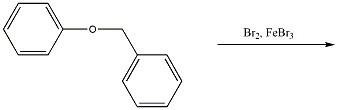
Background
Topic: Electrophilic Aromatic Substitution (Bromination of Ether-Substituted Aromatics)
This question tests your understanding of how an ether substituent (-OCH2Ph) affects the reactivity and regiochemistry of aromatic bromination.
Key Terms and Formulas
Ether Substituent: The -OCH2Ph group is an electron-donating group, activating the ring and directing substitution to the ortho and para positions.
Bromination: Introduction of a bromine atom onto the aromatic ring using Br2 and FeBr3.
Step-by-Step Guidance
Identify the substituent: The -OCH2Ph group is an activating, ortho/para-directing group.
Recognize the electrophile: Br2/FeBr3 generates Br+ as the electrophile.
Predict the major product: Bromine will add to the ortho and para positions relative to the -OCH2Ph group.
Draw the possible products: Place Br at the ortho and para positions to the -OCH2Ph group.
Consider which product is favored: The para position is typically favored due to less steric hindrance.
Try solving on your own before revealing the answer!
Final Answer:
The major product is para-bromobenzyl phenyl ether (Br at the para position to the -OCH2Ph group):
The para product is favored due to less steric hindrance compared to the ortho position.
Q4. Provide the major organic product(s) of the following reaction:
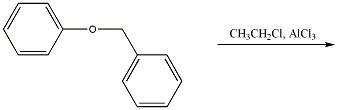
Background
Topic: Friedel-Crafts Alkylation
This question tests your understanding of the Friedel-Crafts alkylation reaction, specifically how an ether substituent affects the reactivity and regiochemistry of the reaction.
Key Terms and Formulas
Friedel-Crafts Alkylation: Introduction of an alkyl group onto an aromatic ring using an alkyl halide and AlCl3.
Ether Substituent: The -OCH2Ph group is an activating, ortho/para-directing group.
Step-by-Step Guidance
Identify the substituent: The -OCH2Ph group is an activating, ortho/para-directing group.
Recognize the electrophile: CH3CH2Cl/AlCl3 generates an ethyl carbocation (or equivalent) as the electrophile.
Predict the major product: The ethyl group will add to the ortho and para positions relative to the -OCH2Ph group.
Draw the possible products: Place the ethyl group at the ortho and para positions to the -OCH2Ph group.
Consider which product is favored: The para position is typically favored due to less steric hindrance.
Try solving on your own before revealing the answer!
Final Answer:
The major product is para-ethylbenzyl phenyl ether (ethyl group at the para position to the -OCH2Ph group):
The para product is favored due to less steric hindrance compared to the ortho position.
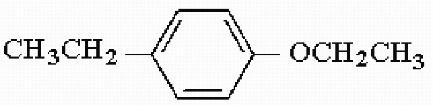
Q5. Provide the structure of the major mononitration product of the compound below:
Background
Topic: Electrophilic Aromatic Substitution (Nitration)
This question tests your understanding of how multiple substituents affect the regiochemistry of nitration on a benzene ring.
Key Terms and Formulas
Nitration: Introduction of a nitro group (-NO2) onto the aromatic ring using HNO3 and H2SO4.
Activating Groups: Both ethyl (-CH2CH3) and ethoxy (-OCH2CH3) are activating, ortho/para-directing groups.
Step-by-Step Guidance
Identify the substituents: Both -CH2CH3 and -OCH2CH3 are ortho/para-directing.
Predict the directing effects: The nitro group will be introduced at a position that is ortho or para to both substituents, if possible.
Draw the possible products: Place the -NO2 group at the positions ortho/para to both substituents.
Consider steric and electronic effects: Determine which position is most favored based on the combined directing effects.
Choose the major product: The position that is ortho/para to both substituents and least hindered will be the major product.
Try solving on your own before revealing the answer!
Final Answer:
The major product is the nitro group at the position ortho to the ethyl group and para to the ethoxy group:
This position is favored due to the combined ortho/para-directing effects of both substituents.
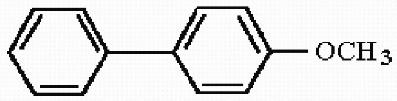
Q6. Provide the structure of the major mononitration product of the compound below:
Background
Topic: Electrophilic Aromatic Substitution (Nitration of Biphenyl Derivatives)
This question tests your understanding of how a methoxy group on a biphenyl system affects the regiochemistry of nitration.
Key Terms and Formulas
Nitration: Introduction of a nitro group (-NO2) onto the aromatic ring using HNO3 and H2SO4.
Activating Group: The -OCH3 group is an activating, ortho/para-directing group.
Biphenyl System: The presence of two aromatic rings can influence the reactivity and directing effects.
Step-by-Step Guidance
Identify the substituent: The -OCH3 group is an activating, ortho/para-directing group on the biphenyl ring.
Predict the directing effects: The nitro group will be introduced at the ortho or para position relative to the -OCH3 group.
Draw the possible products: Place the -NO2 group at the ortho and para positions to the -OCH3 group.
Consider steric and electronic effects: Determine which position is most favored based on the structure of the biphenyl system.
Choose the major product: The position that is para to the -OCH3 group is typically favored due to less steric hindrance.
Try solving on your own before revealing the answer!
Final Answer:
The major product is the nitro group at the para position to the -OCH3 group on the biphenyl ring:
The para position is favored due to less steric hindrance and resonance stabilization.
