 뒤로
뒤로Organic Chemistry I Exam Study Guidance (Lewis Structures, Functional Groups, Newman Projections, Resonance, and More)
스터디 가이드 - 스마트 노트
 자료에 맞춘 맞춤형 노트, 핵심 정의, 예시, 맥락을 확장해 제공합니다.
Q2. Which of the following depict a valid Lewis structure (including all lone pairs and formal charges) for N2O?
Background
Topic: Lewis Structures and Formal Charges
This question tests your ability to draw and interpret Lewis structures for molecules, including the correct placement of lone pairs and formal charges. Understanding how to assign formal charges and represent all electrons is essential for predicting molecular stability and reactivity.
Key Terms and Formulas:
Lewis Structure: A diagram showing all valence electrons, bonds, and lone pairs for a molecule.
Formal Charge: Calculated as:
Lone Pair: A pair of valence electrons not involved in bonding.
Step-by-Step Guidance
Count the total number of valence electrons for N2O. Nitrogen has 5, oxygen has 6, so for N2O: electrons.
Arrange the atoms. Typically, nitrogen atoms are adjacent, and oxygen is terminal due to its higher electronegativity.
Draw possible bonding patterns (single, double, triple bonds) between the atoms, making sure the total number of electrons matches the count from step 1.
Assign lone pairs to each atom to complete their octets, and check if the formal charges are minimized and correctly placed.
Compare the given structures to your own, checking for correct electron count, lone pairs, and formal charges.

Try solving on your own before revealing the answer!
Final Answer: Structure A is the valid Lewis structure for N2O.
Structure A shows all lone pairs and formal charges correctly, matching the total valence electron count and minimizing formal charges. The other options either misplace charges or lone pairs, or do not satisfy the octet rule.
Q11. Which molecule features all of the following functional groups: ester, amine, and ketone?
Background
Topic: Functional Groups Identification
This question tests your ability to recognize and identify multiple functional groups within a single molecule. Being able to spot esters, amines, and ketones is fundamental for understanding organic reactivity and nomenclature.
Key Terms:
Ester: Contains a carbonyl group bonded to an oxygen atom, which is also bonded to another carbon ().
Amine: Contains a nitrogen atom bonded to carbon(s) (, , or ).
Ketone: Contains a carbonyl group bonded to two carbons ().
Step-by-Step Guidance
Examine each molecule for the presence of an ester group (look for linkages).
Check for an amine group (look for nitrogen atoms bonded to carbon or hydrogen).
Identify a ketone group (look for a carbonyl group bonded to two carbons).
Verify that all three functional groups are present in the same molecule.
Compare each option to see which one contains all three groups.
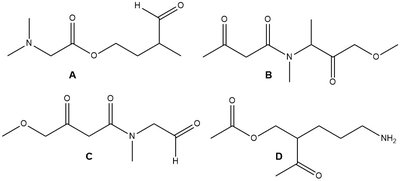
Try solving on your own before revealing the answer!
Final Answer: Molecule B features all three functional groups: ester, amine, and ketone.
Molecule B contains an ester (COO), an amine (N), and a ketone (C=O) group, all within the same structure. The other molecules are missing at least one of these groups.
Q4. Which line-angle structure correctly depicts the molecule as shown in the Newman projection?
Background
Topic: Newman Projections and Line-Angle Structures
This question tests your ability to interpret Newman projections and translate them into line-angle (skeletal) structures. Newman projections are used to visualize the spatial arrangement of atoms around a bond, which is important for understanding conformational isomerism.
Key Terms:
Newman Projection: A way to view a molecule along a specific bond, showing the relative positions of substituents.
Line-Angle Structure: A simplified drawing where lines represent bonds and vertices represent carbon atoms.
Step-by-Step Guidance
Analyze the Newman projection to determine which groups are attached to the front and back carbons.
Identify the spatial arrangement (e.g., staggered or eclipsed) and the identity of each substituent (e.g., methyl, halogen).
Translate the arrangement into a line-angle structure, making sure the connectivity and orientation match the projection.
Compare the given line-angle structures to your translation to find the correct match.
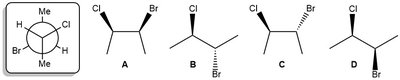
Try solving on your own before revealing the answer!
Final Answer: Structure B correctly depicts the molecule as shown in the Newman projection.
Structure B matches the spatial arrangement and connectivity of the substituents as shown in the Newman projection. The other options do not align with the projection's details.
