 뒤로
뒤로Organic Chemistry Practice Problems – Step-by-Step Guidance
스터디 가이드 - 스마트 노트
 자료에 맞춘 맞춤형 노트, 핵심 정의, 예시, 맥락을 확장해 제공합니다.
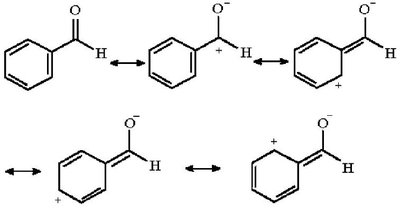
Q3. Would you expect the carbonyl carbon of benzaldehyde to be more or less electrophilic than that of acetaldehyde? Explain using resonance structures.
Background
Topic: Electrophilicity of Carbonyl Carbons & Resonance Effects
This question tests your understanding of how resonance and aromaticity affect the reactivity of carbonyl groups, specifically comparing benzaldehyde (an aromatic aldehyde) and acetaldehyde (an aliphatic aldehyde).
Key Terms and Concepts:
Electrophilicity: The tendency of a molecule or atom to accept electrons.
Resonance: Delocalization of electrons across multiple atoms, stabilizing the molecule.
Carbonyl Group: A functional group with a carbon double-bonded to oxygen (C=O).
Benzaldehyde: An aromatic aldehyde (C6H5CHO).
Acetaldehyde: An aliphatic aldehyde (CH3CHO).
Step-by-Step Guidance
Draw the resonance structures for benzaldehyde. Notice how the aromatic ring can delocalize the negative charge from the oxygen, spreading it onto the ring.
Compare this to acetaldehyde, which does not have an aromatic ring and thus cannot delocalize the charge as effectively.
Consider how resonance stabilization in benzaldehyde reduces the partial positive charge on the carbonyl carbon, making it less electrophilic.
Think about the implications: a less electrophilic carbonyl carbon is less reactive toward nucleophiles.
Set up your explanation using the resonance forms to show the difference in electron distribution between benzaldehyde and acetaldehyde.
Try solving on your own before revealing the answer!
Final Answer:
The carbonyl carbon of benzaldehyde is less electrophilic than that of acetaldehyde. This is because the aromatic ring in benzaldehyde allows for resonance delocalization of the negative charge, reducing the partial positive charge on the carbonyl carbon. As shown in the resonance structures, the electron density is spread onto the ring, making the carbonyl carbon less attractive to nucleophiles.
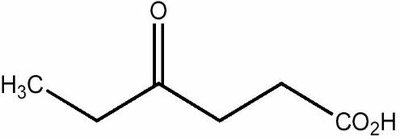
Q7. Provide the structure of 4-oxohexanoic acid.
Background
Topic: IUPAC Nomenclature and Structure Drawing
This question tests your ability to interpret IUPAC names and translate them into correct structural formulas for organic molecules.
Key Terms:
Oxo: Indicates a ketone (C=O) group.
Hexanoic acid: A six-carbon carboxylic acid.
Numbering: The ketone is at carbon 4, carboxylic acid at carbon 1.
Step-by-Step Guidance
Start by drawing a six-carbon chain (hexanoic acid backbone).
Place the carboxylic acid group () at carbon 1.
Identify carbon 4 and add a ketone () group at this position.
Check the structure to ensure all atoms and functional groups are correctly placed according to the IUPAC name.
Try solving on your own before revealing the answer!
Final Answer:
The structure of 4-oxohexanoic acid is a six-carbon chain with a carboxylic acid at carbon 1 and a ketone at carbon 4, as shown in the image above.
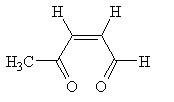
Q14. Give an IUPAC name to the following compound. Be sure to include configurational information in the name.
Background
Topic: IUPAC Nomenclature with Stereochemistry
This question tests your ability to name compounds using IUPAC rules, including the correct use of stereochemical descriptors (E/Z or cis/trans).
Key Terms:
IUPAC Nomenclature: Systematic method for naming organic compounds.
Configurational Information: Indicates the geometry around double bonds (E/Z).
Oxo: Ketone group.
Enal: Aldehyde with a double bond.
Step-by-Step Guidance
Identify the longest carbon chain containing the aldehyde and double bond.
Number the chain so the aldehyde gets the lowest possible number.
Locate the ketone (oxo) and double bond positions.
Determine the configuration (E/Z) of the double bond based on the priority of substituents.
Combine all information to construct the full IUPAC name, including stereochemistry.
Try solving on your own before revealing the answer!
Final Answer:
The IUPAC name is (Z)-4-oxo-2-pentenal or (Z)-4-oxopent-2-enal, including the Z configuration for the double bond.
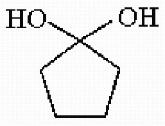
Q65. Provide the structure of the hydrate of cyclopentanone.
Background
Topic: Hydration of Ketones
This question tests your understanding of how ketones react with water to form hydrates (geminal diols).
Key Terms:
Hydrate: A compound formed by the addition of water to a carbonyl group, resulting in two hydroxyl groups on the same carbon.
Cyclopentanone: A five-membered ring ketone.
Step-by-Step Guidance
Draw the structure of cyclopentanone (a five-membered ring with a ketone).
Add water across the carbonyl group, converting the ketone to a geminal diol (two OH groups on the same carbon).
Check that both hydroxyl groups are attached to the same carbon in the ring.
Try solving on your own before revealing the answer!
Final Answer:
The hydrate of cyclopentanone is a cyclopentane ring with two hydroxyl groups attached to the same carbon, as shown in the image above.
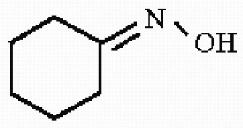
Q103. Provide the structure of cyclohexanone oxime.
Background
Topic: Oxime Formation from Ketones
This question tests your knowledge of the reaction between ketones and hydroxylamine to form oximes.
Key Terms:
Oxime: A compound formed by the reaction of a carbonyl group with hydroxylamine ().
Cyclohexanone: A six-membered ring ketone.
Step-by-Step Guidance
Draw the structure of cyclohexanone (a six-membered ring with a ketone).
Replace the carbonyl oxygen with a group, forming the oxime.
Check that the group is double-bonded to the ring carbon.
Try solving on your own before revealing the answer!
Final Answer:
The structure of cyclohexanone oxime is a cyclohexane ring with a double bond to a group, as shown in the image above.
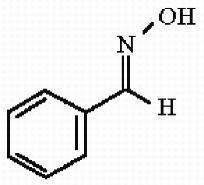
Q104. Provide the structure of the major organic product which results when benzaldehyde reacts with hydroxylamine in the presence of acid.
Background
Topic: Oxime Formation from Aldehydes
This question tests your understanding of the reaction between aldehydes and hydroxylamine to form oximes.
Key Terms:
Oxime: Product of aldehyde or ketone reacting with hydroxylamine ().
Benzaldehyde: Aromatic aldehyde ().
Step-by-Step Guidance
Draw the structure of benzaldehyde (aromatic ring with an aldehyde group).
Replace the carbonyl oxygen with a group, forming the oxime.
Check that the group is double-bonded to the carbon attached to the aromatic ring.
Try solving on your own before revealing the answer!
Final Answer:
The major organic product is benzaldehyde oxime, with the group double-bonded to the carbon attached to the aromatic ring, as shown in the image above.
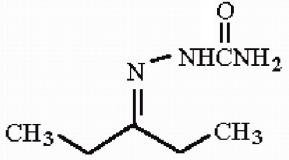
Q107. Provide the structure of the semicarbazone derivative of 3-pentanone.
Background
Topic: Semicarbazone Formation from Ketones
This question tests your knowledge of the reaction between ketones and semicarbazide to form semicarbazones.
Key Terms:
Semicarbazone: Product formed by reaction of a carbonyl group with semicarbazide.
3-pentanone: A five-carbon ketone with the ketone at carbon 3.
Step-by-Step Guidance
Draw the structure of 3-pentanone (five-carbon chain with a ketone at carbon 3).
Replace the carbonyl oxygen with a semicarbazide group ().
Check that the semicarbazone group is double-bonded to the carbon at position 3.
Try solving on your own before revealing the answer!
Final Answer:
The semicarbazone derivative of 3-pentanone is a five-carbon chain with a semicarbazone group double-bonded to carbon 3, as shown in the image above.
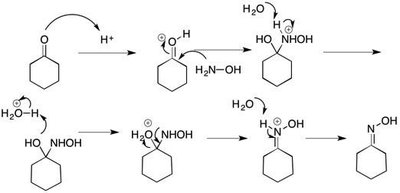
Q108. Provide a detailed, stepwise mechanism for the acid-catalyzed condensation reaction between cyclohexanone and H2NOH.
Background
Topic: Mechanism of Oxime Formation
This question tests your ability to describe the stepwise mechanism for the formation of an oxime from a ketone and hydroxylamine under acidic conditions.
Key Terms:
Condensation Reaction: Reaction where two molecules combine with the loss of a small molecule (often water).
Oxime Formation: Reaction of a carbonyl compound with hydroxylamine.
Acid Catalysis: Use of acid to facilitate the reaction.
Step-by-Step Guidance
Protonate the carbonyl oxygen of cyclohexanone to increase its electrophilicity.
Nucleophilic attack by hydroxylamine () on the carbonyl carbon.
Formation of a tetrahedral intermediate, followed by proton transfers.
Loss of water to form the oxime product.
Draw each step, showing electron movement and intermediates.
Try solving on your own before revealing the answer!
Final Answer:
The mechanism involves protonation of the carbonyl, nucleophilic attack by hydroxylamine, formation of a tetrahedral intermediate, proton transfers, and elimination of water to yield the oxime, as shown in the image above.
