 뒤로
뒤로Reactions at the Alpha-Carbon: Mechanisms, Reactivity, and Synthetic Applications
스터디 가이드 - 스마트 노트
 자료에 맞춘 맞춤형 노트, 핵심 정의, 예시, 맥락을 확장해 제공합니다.
Reactions at the Alpha-Carbon
Introduction to Alpha-Carbon Reactivity
The alpha-carbon in carbonyl compounds is a key site for reactivity due to its proximity to the electron-withdrawing carbonyl group. This chapter explores the acidity of alpha-hydrogens, the formation and reactivity of enolate ions, and the synthetic transformations that exploit these properties.
Acidity of Alpha-Hydrogens
Comparing Acidity of sp3 Carbons
Hydrogens attached to sp3 carbons (alkanes) are generally very weak acids, with high pKa values (typically >40).
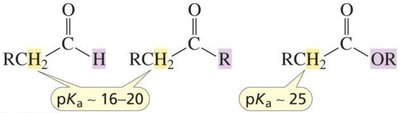
When an sp3 carbon is adjacent to a carbonyl group (the alpha-carbon), the acidity of its hydrogens increases significantly (pKa ~16–20 for ketones and aldehydes).
This increased acidity is due to resonance stabilization of the resulting enolate ion.
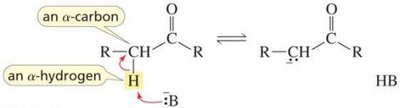
Resonance Stabilization of Enolate Ions
When a base removes an alpha-hydrogen, the electrons left behind are delocalized onto the oxygen atom of the carbonyl group, forming an enolate ion.
Delocalization increases the stability of the conjugate base, making the alpha-hydrogen more acidic than typical alkane hydrogens.
Acidity Trends in Carbonyl Compounds
Aldehydes and ketones have more acidic alpha-hydrogens than esters due to more effective resonance stabilization.
Esters are less acidic because lone pair delocalization from the oxygen competes with enolate formation.
Acid Ionization Constants of Carbon Acids
The following table summarizes the pKa values of various carbon acids, illustrating the effect of adjacent electron-withdrawing groups:
Compound | pKa |
|---|---|
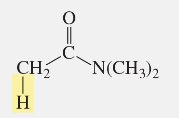
CH2C(O)N(CH3)2 | 30 |
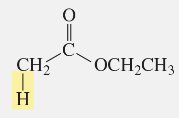
CH2C(O)OCH2CH3 | 25 |
CH2C(O)CH3 | 20 |
CH2C(O)H | 17 |
CH2C≡N | 25 |
N≡CC(H)C≡N | 11.8 |
CH3CH(NO2) | 8.6 |
O2NCH(NO2) | 3.6 |
Resonance and Delocalization
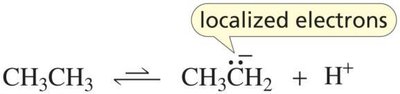
Localized vs. Delocalized Electrons
In simple alkanes, the electrons left behind after deprotonation are localized on carbon, resulting in poor stabilization.
In carbonyl compounds, these electrons are delocalized onto the oxygen atom, greatly increasing stability.

Effect of Multiple Electron-Withdrawing Groups
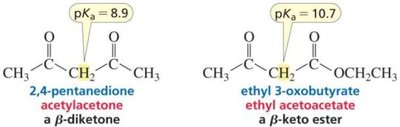
Compounds with two electron-withdrawing groups (e.g., β-diketones, β-keto esters) have even more acidic alpha-hydrogens due to enhanced resonance stabilization.

Keto–Enol Tautomerism
Definition and Stability
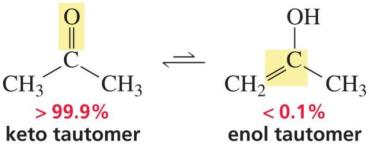
Tautomers are isomers that differ in the position of a hydrogen and a double bond.
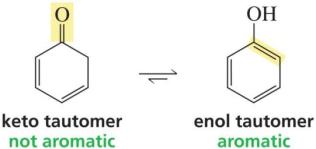
For most ketones and aldehydes, the keto form is more stable than the enol form.
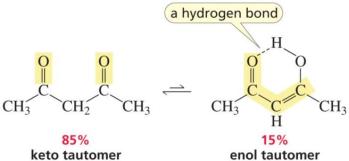
Hydrogen bonding or aromaticity can stabilize the enol tautomer in some cases.
Mechanisms of Keto–Enol Interconversion
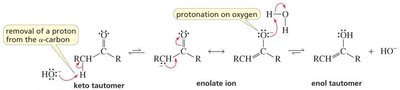
Base-catalyzed: Removal of an alpha-proton forms an enolate, which is then protonated on oxygen.
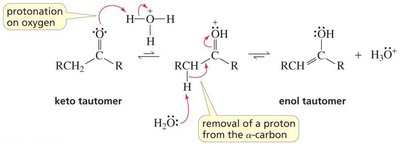
Acid-catalyzed: Protonation of the carbonyl oxygen is followed by removal of an alpha-proton.
Alpha-Halogenation of Carbonyl Compounds
Acid- and Base-Catalyzed Halogenation
In acid-catalyzed halogenation, only one alpha-hydrogen is replaced by a halogen.
In base-promoted halogenation, all alpha-hydrogens can be replaced due to increased enolate formation.

The Hell–Volhard–Zelinski (HVZ) Reaction
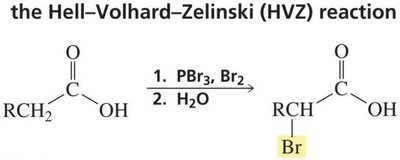
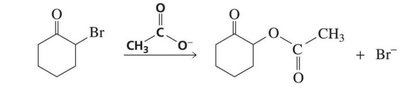
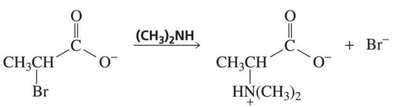
The HVZ reaction selectively brominates the alpha-carbon of carboxylic acids via acyl bromide intermediates.
Strong bases cannot be used for nucleophilic substitution of the bromine, as they promote elimination.

Enolate Ion Formation and Alkylation
Using LDA to Form Enolate Ions
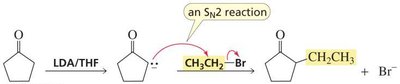
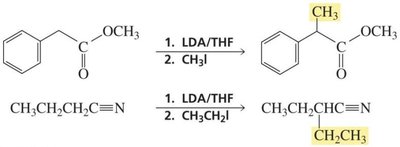
Lithium diisopropylamide (LDA) is a strong, non-nucleophilic base used to generate enolate ions quantitatively.
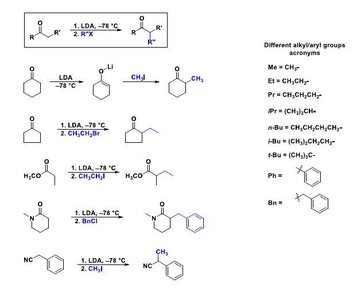
Enolate ions can be alkylated at the alpha-carbon via SN2 reactions with alkyl halides.



Alkylation of Esters and Nitriles
Enolate ions derived from esters and nitriles can also undergo alkylation at the alpha-carbon.
Kinetic vs. Thermodynamic Enolate Ions
Product Control in Enolate Formation
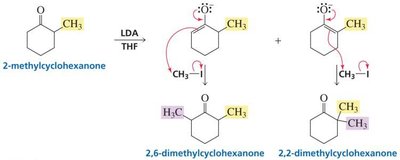
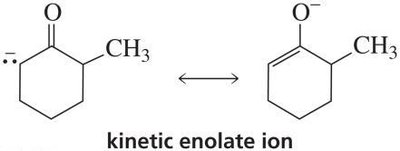
Kinetic enolate: Formed faster, less substituted, and less stable; favored by strong, bulky bases at low temperature.
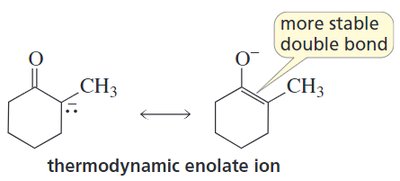
Thermodynamic enolate: More substituted and more stable; favored by weaker bases at higher temperature.
Enamines as Enolate Equivalents
Formation and Reactivity of Enamines
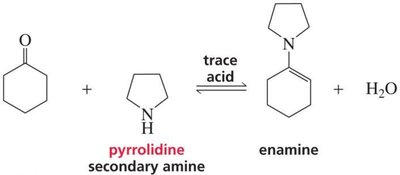
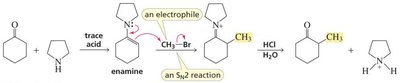
Enamines are formed by the reaction of secondary amines with ketones or aldehydes.
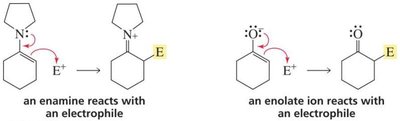
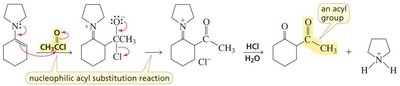
They react with electrophiles similarly to enolate ions but avoid the need for strong bases.
Conjugate Addition and Michael Reactions
Conjugate Addition to α,β-Unsaturated Carbonyls
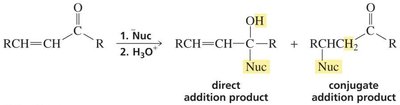
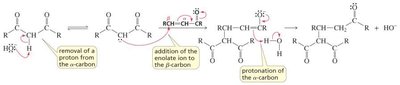
Nucleophiles can add to the beta-carbon of α,β-unsaturated carbonyl compounds (conjugate or Michael addition).
When the nucleophile is an enolate ion, the reaction is called a Michael reaction, forming 1,5-dicarbonyl compounds.
Aldol Addition and Condensation
Aldol Addition
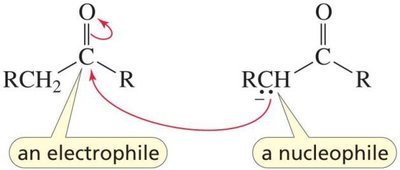
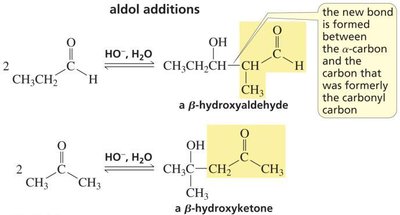
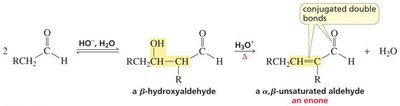
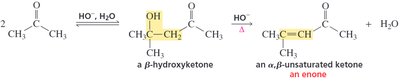
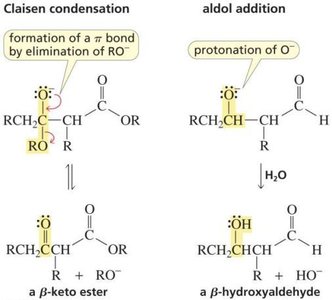
In the aldol addition, an enolate ion attacks another carbonyl compound, forming a β-hydroxyaldehyde or β-hydroxyketone.
This reaction increases the carbon skeleton by forming a new C–C bond.
Aldol Condensation
Upon heating or under acidic/basic conditions, the aldol addition product can lose water to form an α,β-unsaturated carbonyl compound (enone or enal).
This elimination is called an aldol condensation.

Crossed Aldol and Claisen Condensations
Crossed Aldol Addition
When two different carbonyl compounds are used, the reaction is called a crossed aldol addition.
To obtain a single product, use a compound without alpha-hydrogens or generate the enolate ion selectively with LDA.

Claisen Condensation
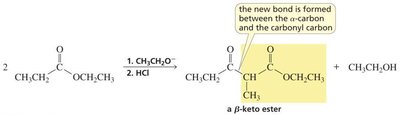
The Claisen condensation involves the reaction of two esters (or one ester and one ketone) to form a β-keto ester.
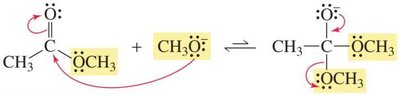
The nucleophile should be identical to the OR group of the ester to avoid transesterification.
Intramolecular Condensations and Annulations
Dieckmann Condensation
The Dieckmann condensation is an intramolecular Claisen condensation, forming cyclic β-keto esters.
Robinson Annulation
The Robinson annulation is a sequence of Michael addition and intramolecular aldol condensation, forming cyclohexenone rings.
Decarboxylation and Synthetic Applications
Decarboxylation of β-Keto Acids
β-Keto acids and malonic acid derivatives can lose CO2 upon heating, forming enols that tautomerize to carbonyl compounds.
Malonic Ester and Acetoacetic Ester Synthesis
Malonic ester synthesis allows the preparation of substituted acetic acids by alkylation and decarboxylation.
Acetoacetic ester synthesis is used to prepare methyl ketones via alkylation and decarboxylation.
Summary Table: Key Reactions at the Alpha-Carbon
Reaction | Main Transformation |
|---|---|
Keto–Enol Interconversion | Equilibrium between keto and enol forms |
Alpha-Halogenation | Replacement of alpha-H with halogen |
HVZ Reaction | Alpha-bromination of carboxylic acids |
Enolate Alkylation | Alkylation at the alpha-carbon |
Michael Addition | Conjugate addition to α,β-unsaturated carbonyls |
Aldol Addition/Condensation | Formation of β-hydroxy carbonyls and enones/enals |
Claisen Condensation | Formation of β-keto esters |
Dieckmann Condensation | Intramolecular Claisen condensation (cyclic β-keto esters) |
Robinson Annulation | Formation of cyclohexenone rings |
Malonic/Acetoacetic Ester Synthesis | Preparation of substituted acids/ketones |
Additional info: This summary integrates mechanistic details, key concepts, and representative examples to provide a comprehensive overview of alpha-carbon chemistry in organic synthesis.
