 뒤로
뒤로Reactions of Aromatic Compounds: Electrophilic and Nucleophilic Substitution, Coupling, and Addition Mechanisms
스터디 가이드 - 스마트 노트
 자료에 맞춘 맞춤형 노트, 핵심 정의, 예시, 맥락을 확장해 제공합니다.
Reactions of Aromatic Compounds
Electrophilic Aromatic Substitution (EAS)
Electrophilic Aromatic Substitution is a fundamental reaction in organic chemistry where an electrophile replaces a hydrogen atom on an aromatic ring, typically benzene. The aromatic system is temporarily disrupted during the reaction, but aromaticity is restored after deprotonation.
Mechanism: The reaction proceeds in two main steps: formation of the sigma complex (arenium ion) and deprotonation to restore aromaticity.
Rate-Determining Step: Formation of the arenium ion is slow and endothermic, making it the rate-determining step.
Catalysts: Common catalysts include FeBr3, AlCl3, and H2SO4, which generate strong electrophiles.
Regioselectivity: Substituents on the ring influence the position of incoming electrophiles (ortho, meta, para).
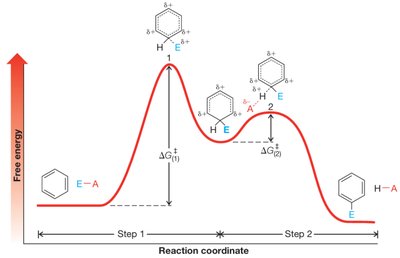
Additional info: The diagram illustrates the energy profile of EAS, showing the high activation energy for the formation of the sigma complex and the rapid deprotonation step.
Halogenation, Nitration, and Sulfonation of Benzene
These are classic examples of EAS reactions, each involving the generation of a specific electrophile and substitution on the aromatic ring.
Halogenation: Chlorination and bromination require Lewis acid catalysts; iodination needs an oxidizing agent.
Nitration: Uses a nitronium ion (NO2+) generated from HNO3 and H2SO4.
Sulfonation: Involves SO3 or H2SO4 to produce benzenesulfonic acid.
Friedel-Crafts Alkylation and Acylation
Friedel-Crafts reactions are important for forming carbon-carbon bonds on aromatic rings. Alkylation introduces alkyl groups, while acylation adds acyl groups.
Alkylation: Susceptible to carbocation rearrangements and multiple substitutions.
Acylation: Avoids rearrangements and polysubstitution; acyl groups deactivate the ring.
Clemmensen Reduction: Converts aryl ketones to alkylbenzenes by reducing the carbonyl group.
Activating and Deactivating Groups
Substituents on the aromatic ring affect both the reactivity and the regioselectivity of EAS. Activating groups (electron-donating) increase reactivity and direct substitution to ortho/para positions, while deactivating groups (electron-withdrawing) decrease reactivity and direct substitution to meta positions.
Activating Groups: Examples include –NH2, –OH, –OR, –R, and aryl groups.
Deactivating Groups: Examples include –NO2, –CF3, carbonyls, and sulfonic acids.
Halogens: Unique in being deactivating but ortho/para-directing due to resonance effects.
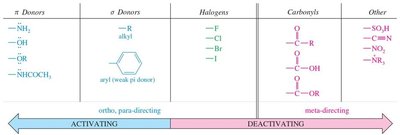
Additional info: The table classifies common substituents by their electronic effects and directing properties.
Regioselectivity: Ortho, Meta, and Para Attack
The position of substitution is determined by the nature of the substituent already present on the ring. Electron-donating groups favor ortho and para positions, while electron-withdrawing groups favor meta positions.
Ortho/Para Directors: Substituents that stabilize the carbocation intermediate at these positions.
Meta Directors: Substituents that destabilize ortho/para positions, making meta attack more favorable.
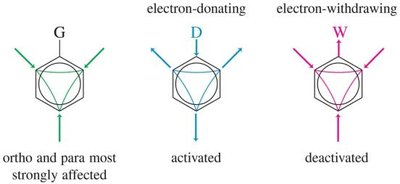
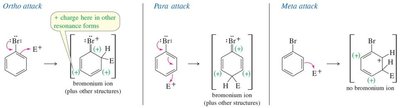
Additional info: The diagrams show how electron-donating and electron-withdrawing groups affect the stability of intermediates and the preferred sites of substitution.
Effect of Multiple Substituents
When more than one substituent is present, their combined electronic effects determine the outcome of EAS. The strongest directing group usually dominates.
Both Ortho/Para Directors: The most activating group dictates the major product.
Mixed Directors: The stronger effect (often deactivating) dominates.
Both Meta Directors: Substitution occurs at the least hindered meta position.
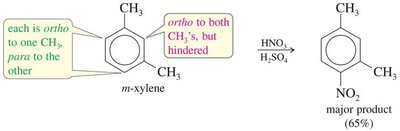
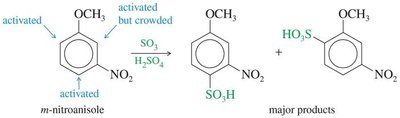
Additional info: These examples illustrate how substituent effects guide the formation of major products in multi-substituted aromatic compounds.
Organometallic Reagents and Coupling Reactions
Organometallic reagents such as alkyl lithium and Gilman reagents (organocuprates) are used for forming C–C bonds in aromatic systems. Coupling reactions like Suzuki and Heck are palladium-catalyzed processes for constructing complex aromatic structures.
Gilman Reagents: Prepared from organolithium and copper(I) salts; used in cross-coupling.
Suzuki Coupling: Couples aryl/vinyl halides with boronic acids.
Heck Reaction: Couples aryl/vinyl halides with alkenes.
Nucleophilic Aromatic Substitution (SnAr)
In SnAr, a nucleophile replaces a leaving group (usually a halide) on an aromatic ring, facilitated by electron-withdrawing groups that stabilize the intermediate.
Mechanism: Addition of nucleophile forms a sigma complex, followed by elimination of the leaving group.
Requirements: Strong EWGs and good leaving groups.
Elimination-Addition (Benzyne Mechanism)
Under extreme conditions, unactivated halobenzenes can undergo nucleophilic substitution via the benzyne mechanism, involving elimination to form a benzyne intermediate followed by nucleophilic addition.
Addition Reactions: Chlorination, Hydrogenation, Birch Reduction
Addition reactions to aromatic rings include chlorination under heat and pressure, catalytic hydrogenation, and the Birch reduction.
Birch Reduction: Reduces benzene to 1,4-cyclohexadiene using sodium or lithium in liquid ammonia and alcohol.
Mechanism: Involves formation of radical anion and subsequent protonation steps.
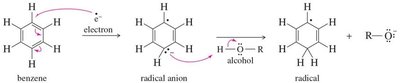
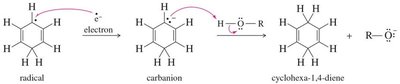
Additional info: The images show the stepwise electron and proton transfers in the Birch reduction.
Practice Problems and Applications
Practice problems reinforce understanding of mechanisms, regioselectivity, and product prediction in aromatic chemistry.

Additional info: The image illustrates the regioselectivity of nitration in biphenyl, showing both major and minor products.
