 뒤로
뒤로Reactions of Aromatic Compounds: Nomenclature, Reactivity, and Mechanisms
스터디 가이드 - 스마트 노트
 자료에 맞춘 맞춤형 노트, 핵심 정의, 예시, 맥락을 확장해 제공합니다.
Reactions of Aromatic Compounds
Introduction to Aromatic Compounds
Aromatic compounds, particularly benzene and its derivatives, are a central topic in organic chemistry due to their unique stability and reactivity. This chapter focuses on the nomenclature, reactivity, and mechanisms of reactions involving aromatic compounds, especially electrophilic aromatic substitution (EAS).
Nomenclature of Benzene Derivatives
Monosubstituted Benzenes
Monosubstituted benzene derivatives are named by identifying the substituent attached to the benzene ring. If the substituent is larger than the ring, it becomes the parent chain. Many derivatives have common names that are widely used in practice.
Phenyl group (Ph or φ): Used to represent a benzene ring as a substituent.
Benzyl group (Bn): Refers to the phenylmethyl group.
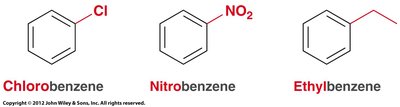
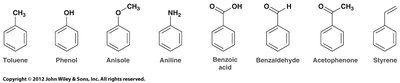
Disubstituted and Polysubstituted Benzenes
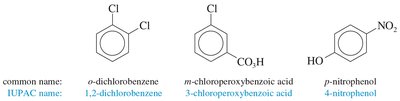
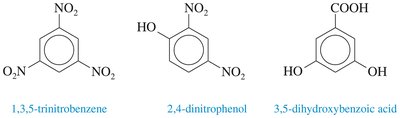
When two or more substituents are present, their relative positions are indicated by the prefixes ortho- (o-) for 1,2-, meta- (m-) for 1,3-, and para- (p-) for 1,4- disubstitution. For three or more substituents, the ring is numbered to give the lowest possible set of locants, with functional groups taking priority at position 1.
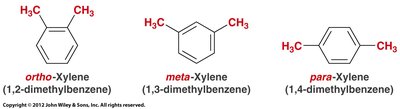
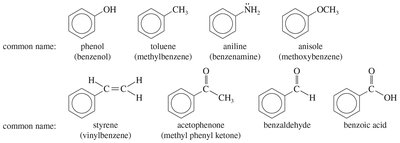
Naming Rules
Identify the parent chain (usually the aromatic ring).
Name and number the substituents to give the lowest possible numbers.
List substituents alphabetically (ignoring prefixes except iso-).
For common names, the group in the parent name is assigned position 1.

Electrophilic Aromatic Substitution (EAS)
General Mechanism
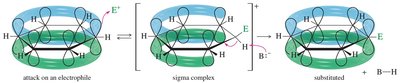
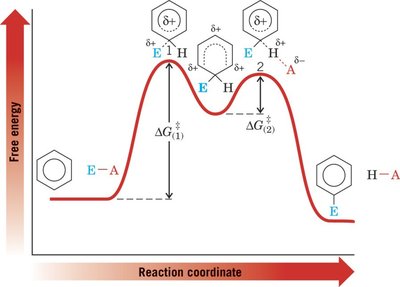
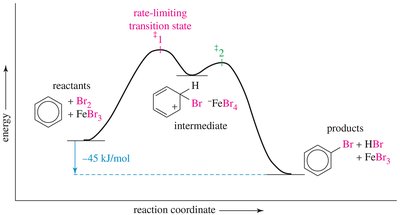
Benzene's pi electrons are stabilized by aromaticity but can react with strong electrophiles to form a resonance-stabilized carbocation intermediate called a sigma complex (arenium ion). Aromaticity is restored by loss of a proton.
Step 1: Attack of the electrophile (E+) on the aromatic ring, forming the sigma complex (rate-determining step).
Step 2: Loss of a proton to regenerate aromaticity.
Halogenation of Benzene
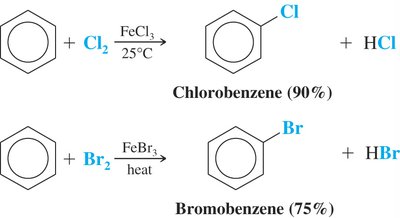
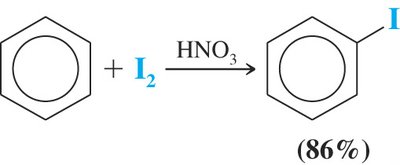
Halogenation requires a Lewis acid catalyst (e.g., FeCl3, FeBr3). Fluorination is too rapid, while iodination requires an oxidizing agent. The mechanism involves generation of a highly reactive halogen electrophile.
Step 1: Halogen reacts with Lewis acid to form the electrophile.
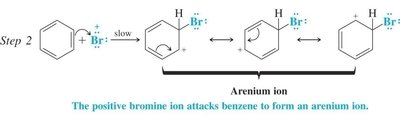
Step 2: Electrophile attacks benzene, forming the arenium ion.
Step 3: Loss of a proton restores aromaticity and regenerates the catalyst.

Nitration of Benzene
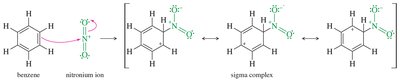
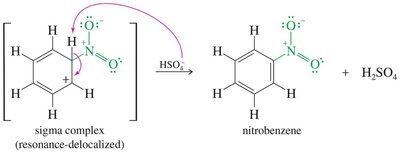
Nitration uses a mixture of concentrated HNO3 and H2SO4 to generate the nitronium ion (NO2+), which acts as the electrophile. The reaction produces nitrobenzene.
Step 1: Formation of NO2+ from HNO3 and H2SO4.
Step 2: Attack of NO2+ on benzene to form the sigma complex.
Step 3: Loss of a proton to regenerate aromaticity.

Sulfonation of Benzene
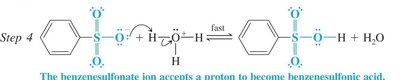
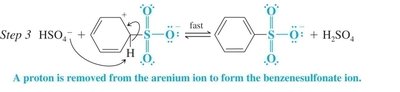
Sulfonation involves substitution of H by SO3 (sulfonic acid group). The reaction is reversible and uses fuming sulfuric acid (SO3 in H2SO4).
Step 1: Generation of SO3 in concentrated H2SO4.
Step 2: SO3 acts as the electrophile, forming the sigma complex.
Step 3: Loss of a proton forms benzenesulfonic acid.




Substituent Effects on Reactivity and Orientation
Activating and Deactivating Groups
Substituents on the benzene ring influence both the rate of EAS and the position where new substituents are introduced. Electron-donating groups (EDGs) activate the ring and direct new groups to the ortho and para positions, while electron-withdrawing groups (EWGs) deactivate the ring and direct new groups to the meta position.
EDGs: Increase electron density, increase reactivity, ortho/para-directing (e.g., –NH2, –OH, –OCH3, –CH3).
EWGs: Decrease electron density, decrease reactivity, meta-directing (e.g., –NO2, –COOH, –SO3H, –CN).
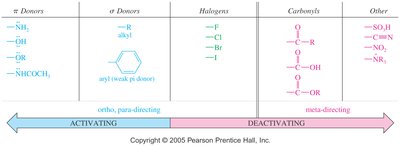
Ortho, Meta, and Para Directing Effects
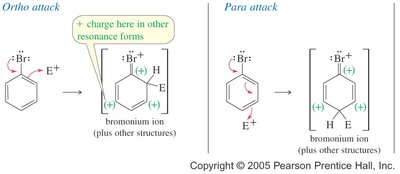
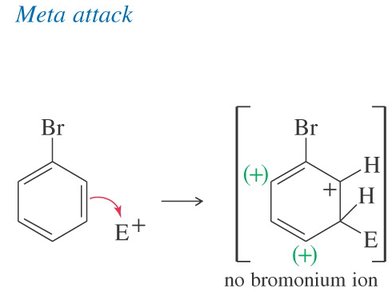
The directing effects are explained by resonance and inductive effects in the sigma complex. For EDGs, ortho and para positions are stabilized; for EWGs, meta positions are less destabilized.
Halogens: Are deactivating but ortho/para-directing due to resonance stabilization.
Multiple Substituents
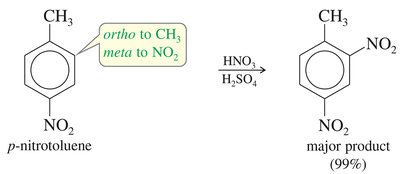
When more than one substituent is present, their directing effects may reinforce or oppose each other. The most powerful activating group usually dominates the orientation of further substitution.
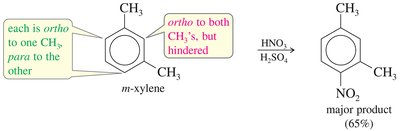
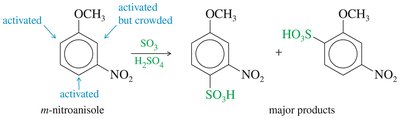
Friedel–Crafts Alkylation and Acylation
Friedel–Crafts Alkylation
Alkylation introduces an alkyl group onto the aromatic ring using an alkyl halide and a Lewis acid (e.g., AlCl3). The reaction proceeds via a carbocation intermediate, which may rearrange to a more stable carbocation.
Limitations: Rearrangement, polyalkylation, poor yields with strong EWGs or amino groups, aryl/vinylic halides do not react.
Friedel–Crafts Acylation
Acylation introduces an acyl group using an acid chloride and AlCl3. The electrophile is the acylium ion (R–C≡O+). No rearrangement occurs, and the product can be reduced to an alkylbenzene via Clemmensen reduction (Zn/Hg, HCl).

Nucleophilic Aromatic Substitution (NAS)
Addition-Elimination Mechanism
NAS occurs when a strong EWG is ortho or para to a leaving group (usually a halide). The nucleophile adds to the ring, forming a Meisenheimer complex, followed by elimination of the leaving group.
Requirements: Electron-poor ring, good leaving group, EWG ortho/para to leaving group.
Benzyne Mechanism (Elimination-Addition)
When no EWG is present, strong base (e.g., NaNH2) can induce elimination to form a benzyne intermediate, which is then attacked by a nucleophile.
Organometallic Coupling Reactions
Organocuprate (Gilman) Reagents
Lithium dialkylcuprates can couple with aryl or vinyl halides to form new C–C bonds, overcoming some limitations of Friedel–Crafts reactions.
Palladium-Catalyzed Couplings
Heck Reaction: Couples aryl/vinyl halides with alkenes.
Suzuki Reaction: Couples aryl/vinyl halides with boronic acids or esters.
Other Reactions of Aromatic Compounds
Birch Reduction
Reduces aromatic rings to nonconjugated 1,4-cyclohexadienes using sodium or lithium in liquid ammonia and alcohol.
Side-Chain Reactions
Oxidation: Alkylbenzenes are oxidized to benzoic acid by KMnO4 or Na2Cr2O7/H2SO4.
Halogenation: Benzylic position is selectively halogenated by Br2.
SN1/SN2 Reactions: Benzylic halides are highly reactive due to resonance stabilization.
Oxidation of Phenols
Phenols can be oxidized to quinones, which are conjugated diketones.
Summary Table: Activating and Deactivating Groups
Group Type | Examples | Directing Effect | Reactivity |
|---|---|---|---|
Strongly Activating | –NH2, –OH, –O– | Ortho/Para | Much faster than benzene |
Moderately Activating | –NHCOR, –OR | Ortho/Para | Faster than benzene |
Weakly Activating | –R, –Ph | Ortho/Para | Slightly faster than benzene |
Weakly Deactivating | –F, –Cl, –Br, –I | Ortho/Para | Slightly slower than benzene |
Moderately Deactivating | –COOR, –COR, –CHO, –COOH, –SO3H, –CN | Meta | Slower than benzene |
Strongly Deactivating | –NO2, –CF3, –CCl3, –NR3+ | Meta | Much slower than benzene |
Additional info: This summary integrates key concepts, mechanisms, and examples from the provided lecture slides and textbook images, ensuring a comprehensive and exam-focused review of aromatic compound reactions.
