 뒤로
뒤로Reactions of Benzene and Substituted Benzenes: Structure, Nomenclature, and Reactivity
스터디 가이드 - 스마트 노트
 자료에 맞춘 맞춤형 노트, 핵심 정의, 예시, 맥락을 확장해 제공합니다.
Reactions of Benzene and Substituted Benzenes
Introduction to Aromatic Compounds
Benzene and its derivatives are a central class of compounds in organic chemistry, known for their unique stability and reactivity. This chapter explores the structure, nomenclature, and reactions of benzene and substituted benzenes, with a focus on electrophilic aromatic substitution and the influence of substituents on reactivity and orientation.
Structure and Aromaticity of Benzene
Benzene: Structure and Stability
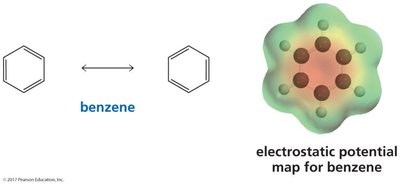
Benzene is a cyclic, planar molecule with six carbon atoms forming a hexagonal ring, each bonded to one hydrogen atom.
It possesses a delocalized cloud of π electrons above and below the plane of the ring, contributing to its unusual stability (aromaticity).
All carbon–carbon bonds in benzene are of equal length, intermediate between single and double bonds.
Benzene is classified as aromatic due to its stability and electronic structure.
Criteria for Aromaticity
The molecule must be cyclic and planar.
There must be an uninterrupted cloud of π electrons (every atom in the ring must have a p orbital).
The π cloud must contain an odd number of pairs of π electrons, following Hückel's rule: π electrons (where n = 0, 1, 2, ...; i.e., 2, 6, 10, 14, ... π electrons).
Example: Benzene has 6 π electrons (n = 1), satisfying Hückel's rule.
Nomenclature of Benzene Derivatives
Naming Monosubstituted Benzenes
Monosubstituted benzenes are named by adding the substituent name to "benzene" or by using common names for certain derivatives.
Examples: bromobenzene, chlorobenzene, nitrobenzene, ethylbenzene

Common names: toluene (methylbenzene), phenol (hydroxybenzene), aniline (aminobenzene), benzenesulfonic acid

Phenyl and Benzyl Substituents
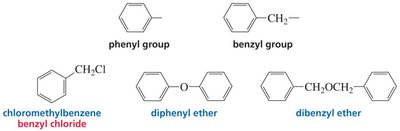
The phenyl group (C6H5–) is a benzene ring minus one hydrogen.
The benzyl group (C6H5CH2–) is a benzene ring attached to a methylene group.
Naming Disubstituted and Polysubstituted Benzenes
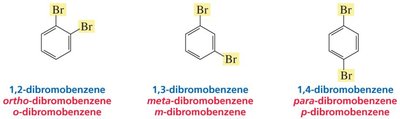
Relative positions are indicated by numbers or prefixes:
ortho- (o-): adjacent (1,2-)
meta- (m-): separated by one carbon (1,3-)
para- (p-): opposite (1,4-)
Substituents are listed alphabetically, and the ring is numbered to give the lowest possible numbers.
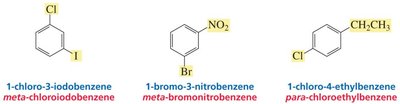
For polysubstituted benzenes, continue numbering to give the lowest set of numbers, and list substituents alphabetically.

Reactivity and Mechanisms of Benzene
Electrophilic Aromatic Substitution (EAS)
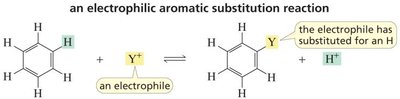
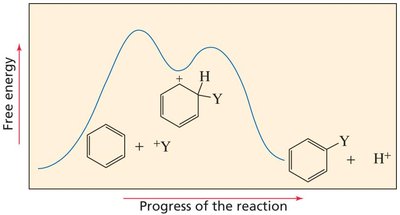
Benzene typically undergoes electrophilic aromatic substitution (EAS) reactions, where an electrophile replaces a hydrogen atom on the ring.
The aromatic ring acts as a nucleophile, attacking the electrophile (E+).
The intermediate loses a proton to restore aromaticity.
Halogenation of Benzene
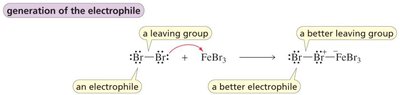
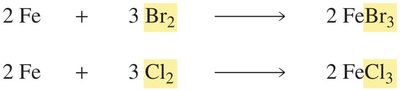
Bromination and chlorination require a Lewis acid catalyst (e.g., FeBr3, FeCl3) to generate a more reactive electrophile.
The mechanism involves formation of the electrophile, addition to the ring, and deprotonation.
Nitration of Benzene
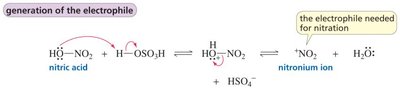
Nitration uses a mixture of concentrated HNO3 and H2SO4 to generate the nitronium ion (NO2+), the active electrophile.
The nitronium ion adds to the ring, followed by deprotonation.


Sulfonation of Benzene
Sulfonation uses concentrated H2SO4 to generate the sulfonium ion (SO3H+).
The reaction is reversible; heating with dilute acid removes the sulfonic acid group (desulfonation).



Friedel–Crafts Alkylation and Acylation
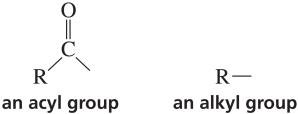
Friedel–Crafts alkylation introduces an alkyl group using an alkyl halide and AlCl3 as a catalyst.
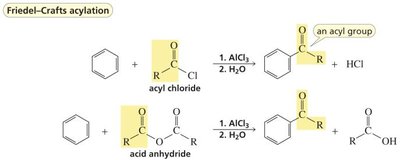
Friedel–Crafts acylation introduces an acyl group using an acyl chloride or acid anhydride and AlCl3.
Carbocation rearrangements can occur during alkylation, leading to unexpected products.


Substituent Effects on Reactivity and Orientation
Activating and Deactivating Groups
Electron-donating groups (EDGs) increase the reactivity of the benzene ring toward EAS and stabilize the carbocation intermediate. They are called activating groups.
Electron-withdrawing groups (EWGs) decrease the reactivity and destabilize the intermediate. They are called deactivating groups.
Examples: Alkyl groups are weakly activating; nitro groups are strongly deactivating.
Orientation: Ortho, Meta, Para Directors
Activating groups and halogens direct new substituents to the ortho and para positions.
Moderately and strongly deactivating groups direct new substituents to the meta position.
The stability of the carbocation intermediate determines the orientation of substitution.
Synthetic Applications and Special Reactions
Designing Syntheses
The order of reactions is crucial, especially when multiple substituents are involved.
Some reactions (e.g., Friedel–Crafts) do not work with meta-directing groups present.
Protecting groups may be needed (e.g., acetylation of aniline before nitration).
Arenediazonium Salts and Sandmeyer Reactions
Arenediazonium salts are intermediates that allow for the introduction of various substituents (e.g., halides, hydroxyl, cyano groups) via Sandmeyer reactions.
These reactions are especially useful for preparing meta-substituted products.
Nucleophilic Aromatic Substitution
Normally, aryl halides do not undergo nucleophilic substitution due to the electron-rich π system.
If a strong electron-withdrawing group is ortho or para to the leaving group, nucleophilic aromatic substitution can occur.
Summary Table: Common Substituent Effects
Substituent | Effect on Reactivity | Orientation |
|---|---|---|
–OH, –NH2, –OCH3 | Strongly activating | Ortho/Para |
–CH3, –C2H5 | Weakly activating | Ortho/Para |
–F, –Cl, –Br, –I | Weakly deactivating | Ortho/Para |
–NO2, –COOH, –SO3H | Strongly deactivating | Meta |
Key Equations
Hückel's Rule: π electrons (n = 0, 1, 2, ...)
General EAS Reaction:
Nitration:
Sulfonation:
Friedel–Crafts Alkylation:
Friedel–Crafts Acylation:
Additional info: This summary covers the core concepts, nomenclature, mechanisms, and synthetic strategies for aromatic compounds as outlined in a typical Organic Chemistry II course, focusing on Chapter 18: Reactions of Benzene and Substituted Benzenes.
