 뒤로
뒤로Synthetic Polymers: Structure, Mechanisms, and Applications
스터디 가이드 - 스마트 노트
 자료에 맞춘 맞춤형 노트, 핵심 정의, 예시, 맥락을 확장해 제공합니다.
Synthetic Polymers
Introduction to Polymers
Synthetic polymers are large molecules composed of repeating units called monomers. These macromolecules are fundamental to modern materials science and are used in a wide range of applications, from packaging to textiles and biomedical devices.
Polymerization is the process of linking monomers to form polymers.
Polymers can be classified based on their synthesis mechanism: chain-growth (addition) and step-growth (condensation).
Examples include plastics, fibers, adhesives, and rubbers.
Chain-Growth (Addition) Polymerization
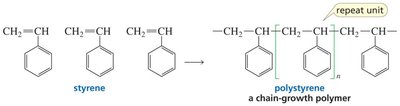
Chain-growth polymers are formed by chain reactions, where monomers with double bonds (typically alkenes) are added sequentially to a growing chain. This process is central to the production of many common plastics.
Monomers typically contain a double bond (e.g., ethylene, styrene).
Mechanisms include radical, cationic, and anionic polymerization.
Examples: Polyethylene, polyvinyl chloride (PVC), polypropylene, polystyrene.
Example: Polystyrene is formed from the monomer styrene by chain-growth polymerization.
Step-Growth (Condensation) Polymerization
Step-growth polymers are formed by the reaction of two molecules, often with the elimination of a small molecule such as water or methanol. This mechanism is typical for polyesters and polyamides.
Monomers may have two different functional groups or be two different bifunctional compounds.
High yields are required to obtain long polymer chains.
Examples: Nylon, Dacron (polyethylene terephthalate), Kevlar.
Example: Dacron is formed by the condensation of dimethyl terephthalate and 1,2-ethanediol.

Important Chain-Growth Polymers and Their Uses
Common Polymers and Their Applications
Monomer | Polymer Name | Uses |
|---|---|---|
CH2=CH2 (Ethylene) | Polyethylene | Toys, water bottles, grocery bags |
CH2=CHCl (Vinyl chloride) | Polyvinyl chloride (PVC) | Shampoo bottles, pipes, siding, flooring |
CH2=CHCH3 (Propylene) | Polypropylene | Molded caps, margarine tubs, carpeting |
CH2=CH-Ph (Styrene) | Polystyrene | Egg cartons, hot drink cups, insulation |
CH2=CF2 (Tetrafluoroethylene) | Poly(tetrafluoroethylene) (Teflon) | Nonstick surfaces, cable insulation |
CH2=CHCN (Acrylonitrile) | Poly(acrylonitrile) | Rugs, blankets, yarn, apparel |
CH2=C(CH3)COOCH3 (Methyl methacrylate) | Poly(methyl methacrylate) | Plexiglas, Lucite |
CH2=CHOCOCH3 (Vinyl acetate) | Poly(vinyl acetate) | White glue, adhesives |
Polymerization Mechanisms
Radical Polymerization
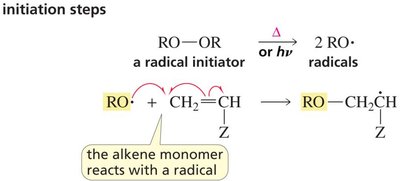
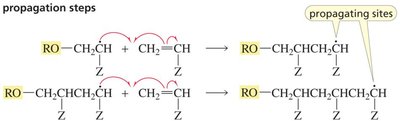
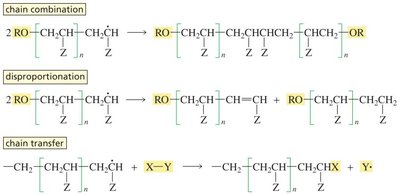
Radical polymerization is initiated by a radical, which reacts with the monomer to form a new radical, propagating the chain. Termination occurs by combination or disproportionation.
Initiation: Formation of radicals, often by heat or light.
Propagation: Radical adds to monomer, forming a new radical.
Termination: Radicals combine or disproportionate, ending chain growth.
Molecular weight can be controlled by chain transfer.
Cationic Polymerization
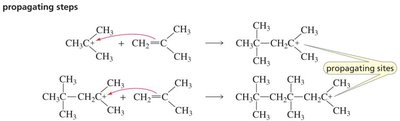
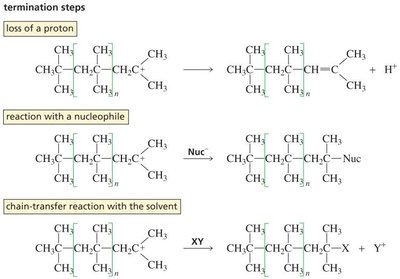
Cationic polymerization is initiated by an electrophile, typically a proton or Lewis acid, which generates a carbocation. The carbocation reacts with monomers, propagating the chain. Termination can occur by loss of a proton, reaction with a nucleophile, or chain transfer.
Initiator: Electrophile (e.g., BF3 + H2O).
Propagation: Carbocation adds to monomer, forming a new carbocation.
Termination: Loss of proton, nucleophile attack, or chain transfer.

Anionic Polymerization
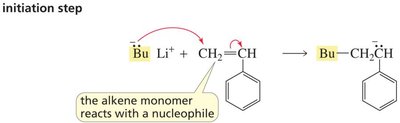
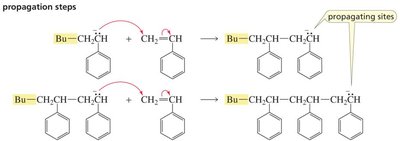
Anionic polymerization is initiated by a nucleophile, which reacts with the monomer to form an anion. The chain remains active until it is terminated, often resulting in "living polymers." Monomers with electron-withdrawing substituents are suitable for this mechanism.
Initiator: Nucleophile (e.g., BuLi).
Propagation: Anion adds to monomer, forming a new anion.
Termination: Occurs when the chain is "killed" by a suitable reagent.
Polymer Structure and Properties
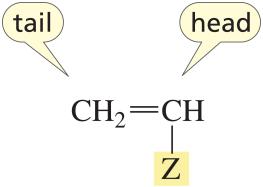
Head-to-Tail Linkage
Chain-growth polymerization of monosubstituted ethylenes typically favors head-to-tail addition, which is influenced by steric and electronic factors.
Head-to-tail addition results in a regular arrangement of substituents.
Stabilization of the propagating site by groups such as phenyl enhances this preference.

Branching and Flexibility
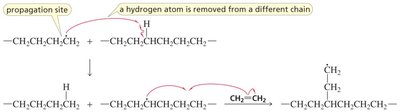
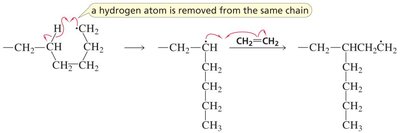
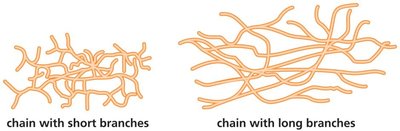
Branching in polymer chains affects their physical properties. Short branches increase flexibility, while long branches can make the polymer more rigid.
Branching occurs when hydrogen atoms are removed from the chain, leading to side chains.
Branched polymers are generally more flexible than linear polymers.
Plasticizers
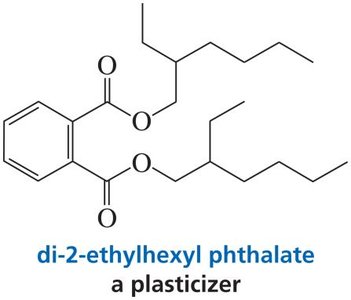
A plasticizer is a compound added to polymers to increase their flexibility by reducing intermolecular forces.
Commonly used in PVC to make it softer and more pliable.
Example: di-2-ethylhexyl phthalate.
Step-Growth Polymers: Polyamides and Polyesters
Nylon (Polyamide)
Nylon is a polyamide formed by step-growth polymerization. Nylon 6 is made from a monomer with two different functional groups, while Nylon 66 is made from two different bifunctional monomers.
Used in textiles, carpets, ropes, and as a substitute for metal in bearings and gears.
Polyamides are strong and resistant to abrasion.
Kevlar (Aromatic Polyamide)
Kevlar is an aromatic polyamide (aramid) with exceptional strength due to the incorporation of aromatic rings and hydrogen bonding.
Used in bullet-resistant vests, helmets, and high-performance equipment.
Five times stronger than steel on an equal weight basis.
Dacron (Polyester)
Dacron is a polyester formed by step-growth polymerization, where monomers are joined by ester groups. It is used in clothing, bottles, and films.
Polyesters are resistant to wrinkles and have high tensile strength.
Can be processed to form Mylar, a strong film.
Polymer Crystallinity and Properties
Crystallinity
The degree of crystallinity in a polymer affects its density, melting point, hardness, and resistance to heat.
Crystallinity (%) | Density (g/cm3) | Melting Point (°C) |
|---|---|---|
55 | 0.92 | 109 |
62 | 0.93 | 116 |
70 | 0.94 | 125 |
77 | 0.95 | 130 |
85 | 0.96 | 133 |
Key Point: Higher crystallinity leads to denser, harder, and more heat-resistant polymers.
Biodegradable Polymers
Polylactic Acid (PLA)
PLA is a biodegradable polymer used in cold drink glasses, fabrics, food packaging, sutures, and drug delivery systems. It is broken down by microorganisms into small molecules.
Cannot be used for hot drinks due to its thermal properties.
Used in 3D printing as filament.
Polyhydroxyalkanoates (PHAs)
PHAs are condensation polymers of 3-hydroxycarboxylic acids and are used for wastepaper baskets, toothbrush holders, and soap dispensers.
Biodegradable and environmentally friendly.
Summary Table: Polymerization Mechanisms and Suitable Monomers
Mechanism | Initiator | Suitable Monomers |
|---|---|---|
Radical Polymerization | Radical | Alkenes with substituents that stabilize radicals (e.g., styrene) |
Cationic Polymerization | Electrophile | Alkenes with electron-donating substituents (e.g., isobutylene, methyl vinyl ether) |
Anionic Polymerization | Nucleophile | Alkenes with electron-withdrawing substituents (e.g., acrylonitrile, methyl methacrylate) |
Additional info: Some alkenes can undergo polymerization by more than one mechanism, depending on the substituents and reaction conditions.
