Ch. 10 - Reactions of Alcohols, Ethers, Epoxides, Amines, and Sulfur-Containing Compounds
Bruice - Organic Chemistry 8th Edition
Bruice8th EditionOrganic ChemistryISBN: 9780135213711당신이 사용하는 게 아니라요?교과서 변경
10장, 문제 62

What alkenes would you expect to be obtained from the acid-catalyzed dehydration of 1-hexanol?

검증된 단계별 안내
1
Identify the starting material: 1-hexanol, which is an alcohol with the molecular formula C6H13OH.
Understand the reaction type: Acid-catalyzed dehydration of alcohols typically involves the removal of a water molecule to form an alkene.
Recognize the mechanism: The reaction proceeds via an E1 mechanism, where the alcohol is first protonated by the acid, leading to the formation of a carbocation intermediate.
Consider carbocation rearrangement: The initial carbocation can rearrange to form a more stable carbocation if possible, which can lead to different alkene products.
Determine possible alkenes: From the carbocation intermediate(s), identify the possible alkenes by considering the elimination of a proton from adjacent carbon atoms, leading to the formation of double bonds.

비슷한 문제에 대한 검증된 영상 답변:

이 영상 해법은 위 문제에 도움이 된다고 튜터들이 추천한 것입니다.

주요 개념

질문에 올바르게 답하기 위해 반드시 이해해야 하는 핵심 개념들은 다음과 같습니다.

Dehydration Reaction

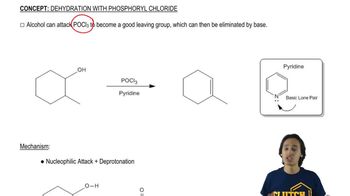
A dehydration reaction involves the removal of a water molecule from an alcohol, resulting in the formation of an alkene. In the case of 1-hexanol, this reaction is typically acid-catalyzed, meaning an acid is used to facilitate the removal of the hydroxyl group and a hydrogen atom from adjacent carbon atoms, leading to the formation of a double bond.
추천 영상:
01:23
General Reaction of Dehydration with POCl3

Markovnikov's Rule

Markovnikov's Rule states that in the addition of HX to an alkene, the hydrogen atom will attach to the carbon with the greater number of hydrogen atoms already attached. This principle is crucial in predicting the major products of dehydration reactions, as it helps determine the stability of the resulting alkenes based on the carbocation intermediates formed during the reaction.
추천 영상:
03:54
The 18 and 16 Electron Rule

Carbocation Stability

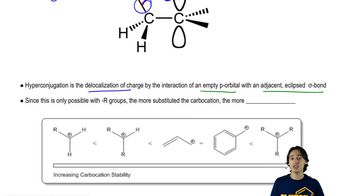
Carbocation stability is a key factor in organic reactions, particularly in dehydration processes. Carbocations are positively charged carbon species that can form during the dehydration of alcohols. The stability of these intermediates increases with the degree of substitution: tertiary carbocations are more stable than secondary, which are more stable than primary. This stability influences the major alkene products formed during the reaction.
추천 영상:
05:58
Determining Carbocation Stability