Ch. 17 - Reactions at the Alpha-Carbon
Bruice - Organic Chemistry 8th Edition
Bruice8th EditionOrganic ChemistryISBN: 9780135213711당신이 사용하는 게 아니라요?교과서 변경
17장, 문제 11a

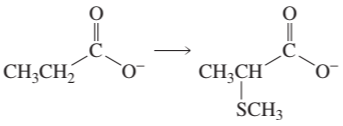
Show how the following compounds can be prepared from the given starting material:
a. Chemical reaction showing the conversion of a carboxylate to a thioether with a methyl group.

검증된 단계별 안내
1
Step 1: Analyze the starting material, 3-methylbutanoate, and the target compound, 3-methyl-2-(methylthio)butanoate. Notice that the target compound has a methylthio (-SCH3) group added to the alpha-carbon (the carbon adjacent to the carbonyl group). This suggests a nucleophilic substitution or addition reaction at the alpha-carbon.
Step 2: To activate the alpha-carbon for substitution, perform an alpha-halogenation reaction. Treat the starting material with a halogen (e.g., Br2 or Cl2) in the presence of a base (e.g., NaOH). This will replace one of the alpha-hydrogens with a halogen atom, forming 3-methyl-2-halo-butanoate.
Step 3: Introduce the methylthio group (-SCH3) by performing a nucleophilic substitution reaction. Use a nucleophile such as sodium methanethiolate (NaSCH3) to replace the halogen atom at the alpha-carbon with the methylthio group. This step converts 3-methyl-2-halo-butanoate into 3-methyl-2-(methylthio)butanoate.
Step 4: Ensure the reaction conditions are mild to avoid side reactions. For example, use an appropriate solvent like ethanol or acetone to facilitate the nucleophilic substitution reaction.
Step 5: Purify the product using techniques such as distillation or recrystallization to isolate 3-methyl-2-(methylthio)butanoate in its pure form.

비슷한 문제에 대한 검증된 영상 답변:

이 영상 해법은 위 문제에 도움이 된다고 튜터들이 추천한 것입니다.
영상 길이:
2m

주요 개념

질문에 올바르게 답하기 위해 반드시 이해해야 하는 핵심 개념들은 다음과 같습니다.

Nucleophilic Substitution

Nucleophilic substitution is a fundamental reaction mechanism in organic chemistry where a nucleophile attacks an electrophile, resulting in the replacement of a leaving group. In the context of the given reaction, the nucleophile (methylthio group) attacks the carbon atom of the 3-methylbutanoate that is bonded to the leaving group, facilitating the formation of the desired product.
추천 영상:
01:47
Nucleophiles and Electrophiles can react in Substitution Reactions.

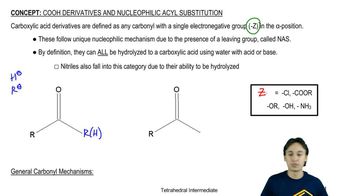
Carboxylic Acid Derivatives

Carboxylic acid derivatives, such as esters and thioesters, are compounds that can be derived from carboxylic acids by replacing the hydroxyl group with another functional group. Understanding these derivatives is crucial for predicting the reactivity and transformation of compounds like 3-methylbutanoate into 3-methyl-2-(methylthio)butanoate, as they often undergo nucleophilic substitution reactions.
추천 영상:
03:50
Intro to Carboxylic Acid Derivatives

Reaction Mechanisms

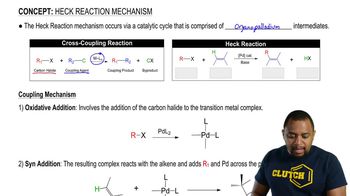
A reaction mechanism describes the step-by-step process by which reactants are converted into products, detailing the formation and breaking of bonds. In this case, analyzing the mechanism of the nucleophilic substitution will help in understanding how the methylthio group is introduced into the 3-methylbutanoate structure, leading to the formation of the target compound.
추천 영상:
02:16
Heck Reaction Mechanism