Butyric acid, the compound responsible for the unpleasant odor and taste of sour milk, has a pKa value of 4.82. What is its Ka value? Is it a stronger acid or a weaker acid than vitamin C?
Ch. 2 - Acids and Bases: Central to Understanding Organic Chemistry
2장, 문제 4b
What is the conjugate base of each of the following?
1. NH3
2. HBr
3. HNO3
4. H2O
검증된 단계별 안내1
Step 1: Understand the concept of a conjugate base. A conjugate base is formed when an acid donates a proton (H⁺). The conjugate base will have one less hydrogen atom and a negative charge compared to the original acid.
Step 2: For NH₃ (ammonia), identify the acid and remove one proton (H⁺). The conjugate base will be NH₂⁻. This is because NH₃ loses a hydrogen atom and gains a negative charge.
Step 3: For HBr (hydrobromic acid), remove one proton (H⁺) from the molecule. The conjugate base will be Br⁻, as HBr loses its hydrogen atom and becomes negatively charged.
Step 4: For HNO₃ (nitric acid), remove one proton (H⁺) from the molecule. The conjugate base will be NO₃⁻, as HNO₃ loses its hydrogen atom and gains a negative charge.
Step 5: For H₂O (water), remove one proton (H⁺) from the molecule. The conjugate base will be OH⁻, as H₂O loses a hydrogen atom and becomes negatively charged.

비슷한 문제에 대한 검증된 영상 답변:
이 영상 해법은 위 문제에 도움이 된다고 튜터들이 추천한 것입니다.
영상 길이:
2m주요 개념
질문에 올바르게 답하기 위해 반드시 이해해야 하는 핵심 개념들은 다음과 같습니다.
Conjugate Acid-Base Theory
The conjugate acid-base theory, developed by Brønsted and Lowry, defines acids as proton donors and bases as proton acceptors. When an acid donates a proton (H+), it forms its conjugate base, while the base that accepts the proton becomes its conjugate acid. Understanding this relationship is crucial for identifying conjugate pairs in chemical reactions.
추천 영상:
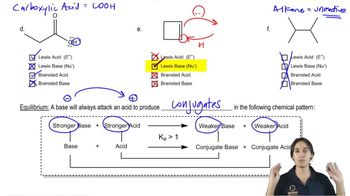
Equilibrium constant and conjugates.
Ammonia (NH3) and its Conjugate Base
Ammonia (NH3) acts as a weak base in aqueous solutions. When it accepts a proton, it forms its conjugate acid, ammonium (NH4+). The conjugate base of ammonia, however, is the amide ion (NH2-), which is formed when ammonia donates a proton. Recognizing this transformation is essential for solving the question.
추천 영상:
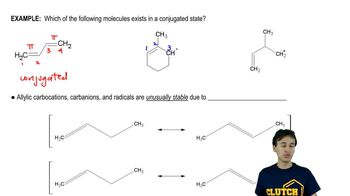
Conjugated states
Strong Acids and Their Conjugate Bases
Strong acids, such as HBr and HNO3, completely dissociate in water, meaning they donate protons readily. The conjugate bases of strong acids are typically very weak and have negligible basicity. For example, the conjugate base of HBr is bromide ion (Br-), and for HNO3, it is nitrate ion (NO3-). Understanding the strength of acids and their corresponding conjugate bases is vital for this question.
추천 영상:
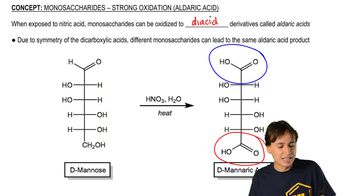
Monosaccharides - Strong Oxidation (Aldaric Acid)
관련 실천
교과서 질문
932
views
교과서 질문
What is the conjugate acid of each of the following?
1. NH3
2. Cl−
3. HO−
4. H2O
1887
views
교과서 질문
a. Which is a stronger acid: one with a pKa of 5.2 or one with a pKa of 5.8?
b. Which is a stronger acid: one with an acid dissociation constant of 3.4 × 10⁻³ or one with an acid dissociation constant of 2.1 × 10⁻⁴?
1499
views
교과서 질문
Consider the following reaction:
HBr + -C≡N ⇌ Br− + HC≡N
c. What is the conjugate base of the acid on the left?
d. What is the conjugate acid of the base on the left?
1238
views
교과서 질문
An acid has a Ka of 4.53 × 10⁻⁶ in water. What is its Keq for reaction with water in a dilute solution? ([H2O] = 55.5 M)
1574
views
교과서 질문
Consider the following reaction:
HBr + -C≡N ⇌ Br− + HC≡N
g. What is the conjugate base of the acid on the right?
h. What is the conjugate acid of the base on the right?
1201
views