Ch. 2 - Acids and Bases: Central to Understanding Organic Chemistry
Bruice - Organic Chemistry 8th Edition
Bruice8th EditionOrganic ChemistryISBN: 9780135213711당신이 사용하는 게 아니라요?교과서 변경
2장, 문제 33

If HCl is a weaker acid than HBr, why is ClCH2COOH a stronger acid than BrCH2COOH?

검증된 단계별 안내
1
Step 1: Understand the problem. The question is asking why ClCH2COOH (chloroacetic acid) is a stronger acid than BrCH2COOH (bromoacetic acid), despite HCl being a weaker acid than HBr. This involves analyzing the inductive effect of the halogen substituents (Cl and Br) on the carboxylic acid group.
Step 2: Recall the concept of electronegativity. Chlorine (Cl) is more electronegative than bromine (Br). Electronegativity is the ability of an atom to attract electrons towards itself. This property plays a key role in the inductive effect.
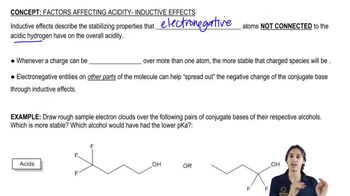
Step 3: Explain the inductive effect. The electronegative halogen substituent (Cl or Br) pulls electron density away from the carboxylic acid group through the sigma bonds. This stabilizes the negative charge on the conjugate base (CH2COO⁻) after the acid donates a proton (H⁺). A more stable conjugate base corresponds to a stronger acid.
Step 4: Compare the inductive effects of Cl and Br. Since Cl is more electronegative than Br, it exerts a stronger inductive effect. This means ClCH2COOH has a more stabilized conjugate base compared to BrCH2COOH, making it a stronger acid.
Step 5: Summarize the reasoning. The strength of ClCH2COOH as an acid is due to the stronger inductive effect of chlorine compared to bromine, which stabilizes the conjugate base more effectively. This explains why ClCH2COOH is a stronger acid than BrCH2COOH, even though HCl is a weaker acid than HBr.

비슷한 문제에 대한 검증된 영상 답변:

이 영상 해법은 위 문제에 도움이 된다고 튜터들이 추천한 것입니다.
영상 길이:
7m

주요 개념

질문에 올바르게 답하기 위해 반드시 이해해야 하는 핵심 개념들은 다음과 같습니다.

Acid Strength and Electronegativity

Acid strength is influenced by the stability of the conjugate base formed after deprotonation. In this case, the electronegativity of the halogen atoms plays a crucial role. Chlorine is more electronegative than bromine, which means that the negative charge on the conjugate base (ClCH2COO-) is better stabilized by the chlorine atom compared to the bromine atom in BrCH2COO-. This stabilization leads to ClCH2COOH being a stronger acid.
추천 영상:
1:47
Electronegativity

Inductive Effect

The inductive effect refers to the electron-withdrawing or electron-donating effects that substituents have on a molecule. In ClCH2COOH, the chlorine atom exerts a strong electron-withdrawing inductive effect, which stabilizes the negative charge on the conjugate base. In contrast, bromine, being larger and less electronegative, exerts a weaker inductive effect, resulting in less stabilization of the conjugate base BrCH2COO-, making BrCH2COOH a weaker acid.
추천 영상:
01:47
Understanding the Inductive Effect.

Comparative Acid-Base Strength

When comparing acids, it is essential to consider both the strength of the acid and the stability of its conjugate base. Although HCl is a weaker acid than HBr, the specific structural context of ClCH2COOH and BrCH2COOH alters their acid strengths. The combination of electronegativity and inductive effects in the respective carboxylic acids leads to ClCH2COOH being a stronger acid than BrCH2COOH despite the general trend observed with HCl and HBr.
추천 영상:
02:49
The Lewis definition of acids and bases.