Ch. 3 - An Introduction to Organic Compounds: Nomenclature, Physical Properties, and Structure
Bruice - Organic Chemistry 8th Edition
Bruice8th EditionOrganic ChemistryISBN: 9780135213711당신이 사용하는 게 아니라요?교과서 변경
3장, 문제 31a

Predict the approximate size of the following bond angles.
(a) the C—O—C bond angle in an ether

검증된 단계별 안내
1
Review the molecular geometry of the ether functional group. In an ether, the central oxygen atom is bonded to two carbon atoms and has two lone pairs of electrons. This gives the oxygen atom a total of four regions of electron density.
Apply the Valence Shell Electron Pair Repulsion (VSEPR) theory. According to VSEPR, the regions of electron density around the oxygen atom will arrange themselves to minimize repulsion. This typically results in a tetrahedral electron geometry.
Understand the impact of lone pairs. Lone pairs of electrons exert greater repulsion than bonding pairs, which slightly compresses the bond angles from the ideal tetrahedral angle of 109.5°.
Estimate the bond angle. Due to the presence of two lone pairs on the oxygen atom, the C—O—C bond angle in an ether is slightly less than 109.5°, typically around 105° to 107°.
Conclude that the approximate bond angle can be predicted based on the tetrahedral geometry and the influence of lone pair repulsion, leading to a slightly reduced angle compared to the ideal tetrahedral value.

비슷한 문제에 대한 검증된 영상 답변:

이 영상 해법은 위 문제에 도움이 된다고 튜터들이 추천한 것입니다.

주요 개념

질문에 올바르게 답하기 위해 반드시 이해해야 하는 핵심 개념들은 다음과 같습니다.

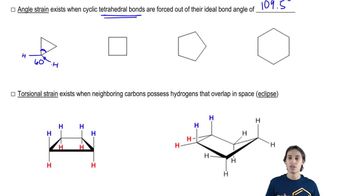
Bond Angles

Bond angles are the angles formed between two adjacent bonds at a central atom. They are influenced by the hybridization of the atom and the presence of lone pairs, which can repel bonding pairs and alter the expected angles. Understanding typical bond angles helps predict molecular geometry and reactivity.
추천 영상:
02:46
What is angle strain?

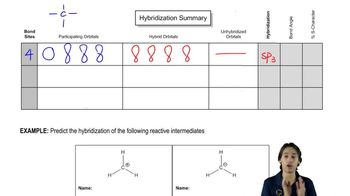
Hybridization

Hybridization is the concept of mixing atomic orbitals to form new hybrid orbitals that can accommodate bonding. In ethers, the carbon atoms are typically sp3 hybridized, leading to a tetrahedral arrangement around each carbon. This hybridization affects the bond angles, which are generally around 109.5 degrees in a tetrahedral geometry.
추천 영상:
10:43
Using bond sites to predict hybridization

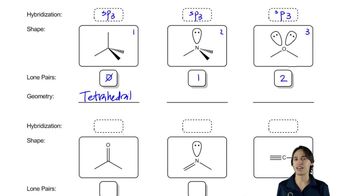
Molecular Geometry

Molecular geometry refers to the three-dimensional arrangement of atoms in a molecule. In the case of ethers, the C—O—C bond angle is influenced by the tetrahedral geometry of the surrounding carbon atoms and the lone pairs on the oxygen atom. This geometry helps predict the physical and chemical properties of the molecule.
추천 영상:
07:44
Molecular Geometry Explained.