
The same alkane is obtained from the catalytic hydrogenation of both alkene A and alkene B. The heat of hydrogenation of alkene A is 29.8 kcal/mol, and the heat of hydrogenation of alkene B is 31.4 kcal/mol. Which alkene is more stable?
Ch. 5 - Alkenes: Structure, Nomenclature, and an Introduction to Reactivity • Thermodynamics and Kinetics
모든 교과서
Bruice 8th Edition
Ch. 5 - Alkenes: Structure, Nomenclature, and an Introduction to Reactivity • Thermodynamics and Kinetics
문제 25a,b
Bruice 8th Edition
Ch. 5 - Alkenes: Structure, Nomenclature, and an Introduction to Reactivity • Thermodynamics and Kinetics
문제 25a,b5장, 문제 25a,b
How many different alkenes can be hydrogenated to form
a. butane?
b. 3-methylpentane?
검증된 단계별 안내1
Identify the molecular formula of the target alkane. For butane, the molecular formula is C₄H₁₀, and for 3-methylpentane, the molecular formula is C₆H₁₄.
Recall that alkenes are unsaturated hydrocarbons containing at least one double bond. Hydrogenation of an alkene adds H₂ across the double bond, converting it into a saturated alkane.
For part (a), determine all possible alkenes with the molecular formula C₄H₈. Consider different structural isomers, including straight-chain and branched alkenes, as well as positional isomers of the double bond.
For part (b), determine all possible alkenes with the molecular formula C₆H₁₂ that can be hydrogenated to form 3-methylpentane. Focus on structural isomers where the double bond is positioned in a way that hydrogenation results in the correct branching pattern of 3-methylpentane.
Count the total number of unique alkenes for each part, ensuring that stereoisomers (cis/trans or E/Z) are also considered where applicable, as they represent distinct alkenes.

비슷한 문제에 대한 검증된 영상 답변:
이 영상 해법은 위 문제에 도움이 된다고 튜터들이 추천한 것입니다.
영상 길이:
6m주요 개념
질문에 올바르게 답하기 위해 반드시 이해해야 하는 핵심 개념들은 다음과 같습니다.
Alkenes
Alkenes are hydrocarbons that contain at least one carbon-carbon double bond (C=C). They are unsaturated compounds, meaning they have fewer hydrogen atoms than alkanes, which are saturated. The presence of the double bond allows alkenes to undergo various chemical reactions, including hydrogenation, where hydrogen is added across the double bond to form alkanes.
추천 영상:
가이드 코스
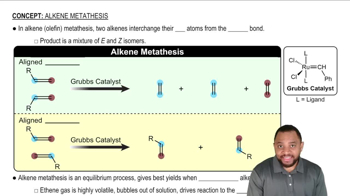
Alkene Metathesis Concept 1
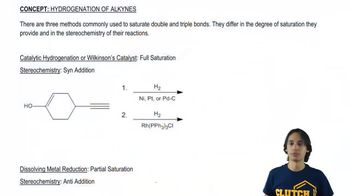
Hydrogenation
Hydrogenation is a chemical reaction that involves the addition of hydrogen (H2) to an unsaturated compound, such as an alkene, to convert it into a saturated compound, typically an alkane. This reaction is often facilitated by catalysts, such as platinum, palladium, or nickel, and is significant in organic chemistry for modifying the structure and properties of organic molecules.
추천 영상:
The definition of hydrogenation.
Structural Isomers
Structural isomers are compounds that have the same molecular formula but differ in the arrangement of atoms. In the context of alkenes, different structural isomers can lead to various alkenes that can be hydrogenated to yield the same alkane. Understanding structural isomerism is crucial for determining how many distinct alkenes can produce a specific alkane upon hydrogenation.
추천 영상:
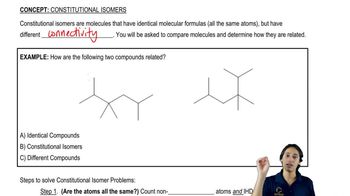
What is a constitutional isomer?
관련 실천
교과서 질문
1064
views
교과서 질문
a. For a reaction with ∆H° = -12 kcal/mol and ∆S° = 0.01 kcal mol-1 K-1, calculate the ∆G° and the equilibrium constant at:
1. 30 °C and 2. 150 °C.
b. How does ∆G° change as T increases?
c. How does Keq change as T increases?
1364
views
교과서 질문
Convert the following perspective formulas to Fischer projections.
(c)
(d)
1291
views
교과서 질문
What alkene would you start with if you wanted to synthesize
b. ethylcyclopentane?
1165
views
교과서 질문
What alkene would you start with if you wanted to synthesize
a. pentane?
1163
views
교과서 질문
Rank the following compounds from most stable to least stable:
trans-3-hexene, cis-3-hexene, cis-2,5-dimethyl-3-hexene, (Z)-3,4-dimethyl-3-hexene
1560
views